

At the tender age of 15, Picasso created his first large-format work, First Communion (165 x 117 cm; 64 15/16 x 46 1/16 in.), depicting his sister during the communion, alongside their parents. Picasso demonstrates astonishing artistic skills, offering a refined anatomical and psychological study of each of the characters that comprise the work, as well as a personal and intimate interpretation of a religious motif. By removing elements that were commonly used, such as the cross and saints, Picasso offers us a portrait of religion that is different from that of the late 19th century.
Some interesting preliminary studies and sketches from this work have been preserved, demonstrating Picasso’s deep interest and analysis. The Malaga-born artist wanted to squeeze every ounce of sensitivity out of the entire piece, and this is evident in his studies.
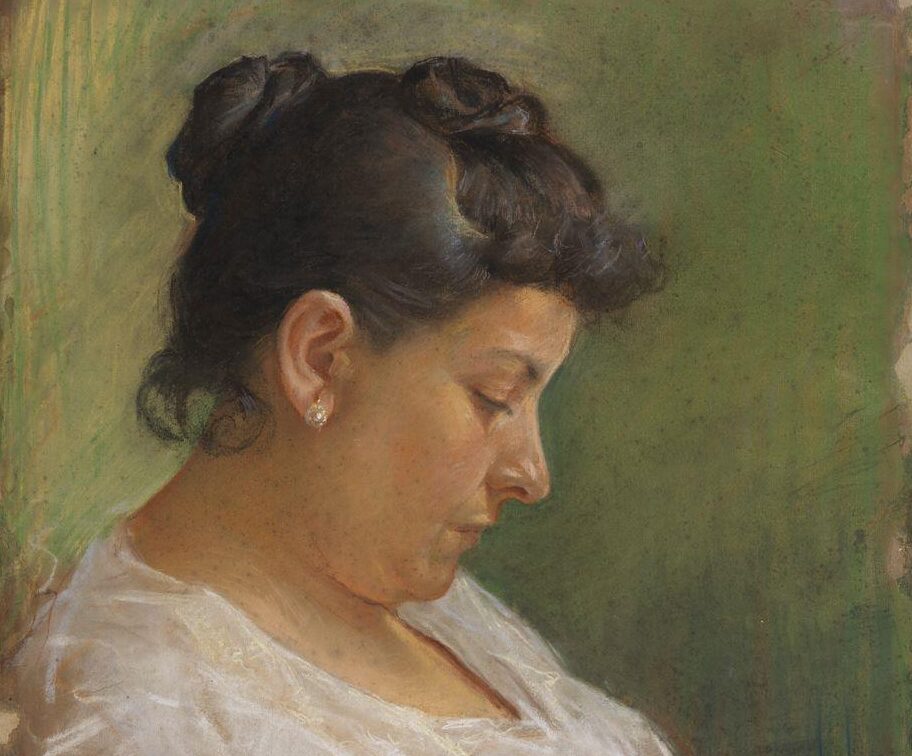
4. The Artist’s Mother
Continuing his academic training at the Llotja in Barcelona, the young Picasso did not hesitate to show off his considerable academic and portraiture skills. He painted this portrait of his mother using pastels, demonstrating his technical prowess in techniques other than oil painting. Through careful brushstrokes and a profound sensitivity to the nuances of light and color, the work conveys the repose of the face in profile. The artist managed to capture the moment when his mother was resting, giving the scene a tender and peaceful feel.
5. Science and Charity
Science and Charity represent the culmination of his early artistic period. It was the work that would kick-start his prolific career. The painting was presented at the National Exhibition of Fine Arts held in Madrid in 1897, where it received 25 honourable mentions.
The characters express enormous psychological depth, in line with the aesthetics of social realism that was beginning to prevail at the time. The young Picasso chooses a timeless theme: the debate between faith and reason, and as we can see in his early art, he does so in a masterful way. We can all feel part of the work, surrounded by cold walls—while the doctor’s watch reminds us of an undeniable truth, the nun’s tender care offers a soothing balm.
Anyone who does not know their past is doomed to repeat it, and that is why we, lovers of beauty, those who call ourselves aesthetes and artists, must question the artists we study. We must search, investigate, immerse ourselves in their essence, in their beginnings, and discover their roots. Sapere Aude! In this way, we can find in Picasso the genius common to all masters: the genius that is cultivated with discipline, sown with perseverance, and reaped with fame.