

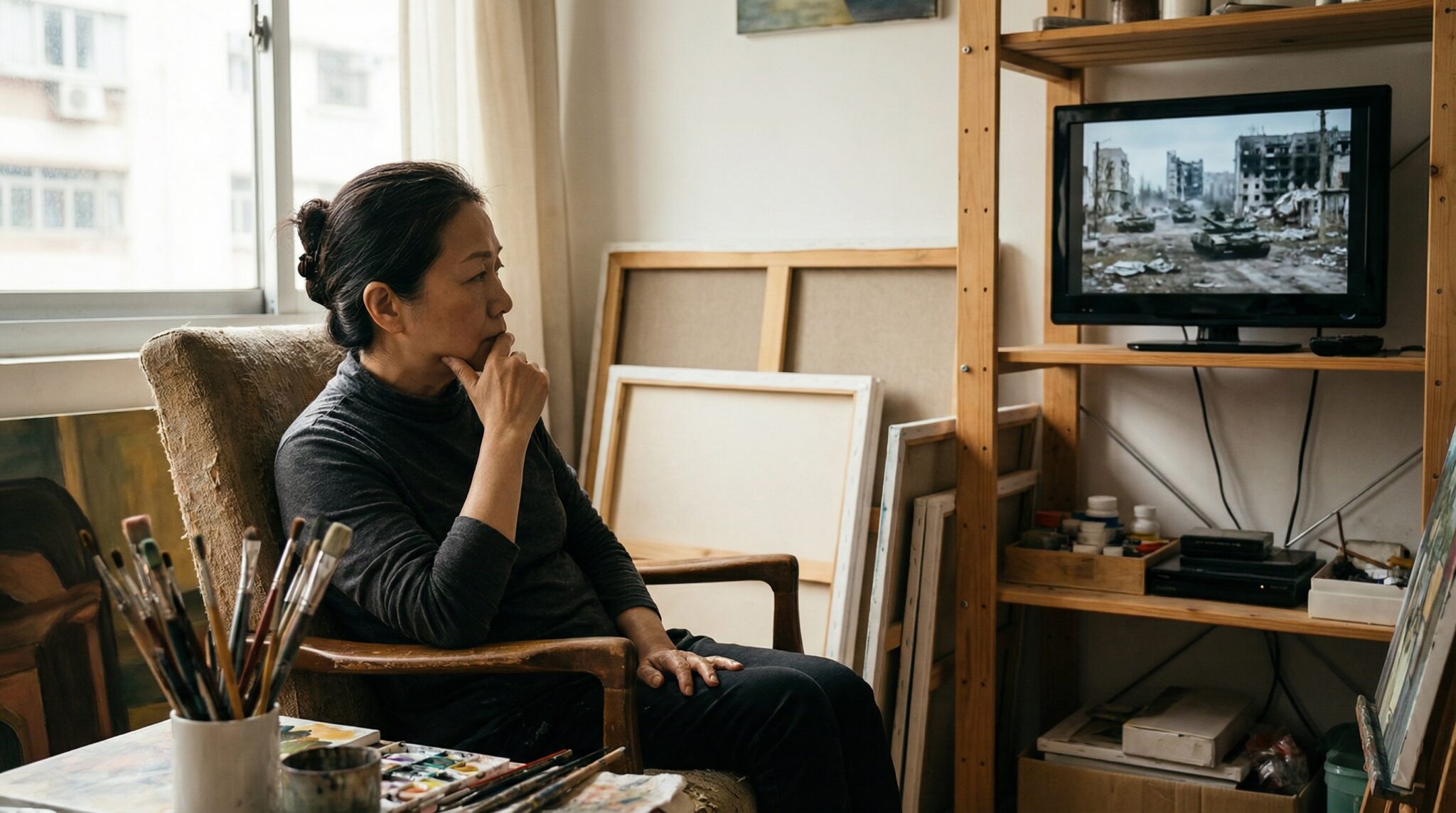
An artist recently sent me an image that hit a little too close to home. It showed the world literally going up in flames, while a tiny figure stood in the foreground desperately trying to interest passersby in a painting. When global crises dominate the news cycle, trying to sell your work can feel entirely disconnected from reality.
I felt this acutely during a recent ArtWalk when a couple walked into the gallery. I asked them where they were from, and when they mentioned their hometown, I could hear the sheer exhaustion in their voices from recent events in their community. Yet, there they were, standing in my gallery, actively looking at art.
When the world feels chaotic, it is easy to convince yourself that your creative output is secondary. The truth is exactly the opposite: when the ground shakes, art stops being a luxury and becomes a psychological anchor.
1. The Myth of Frivolity
When headlines look like a dystopian novel, your inner critic gets exceptionally loud. “How can I promote my landscape paintings when everything is burning?”
This is a natural reaction, but it relies on a completely flawed premise. Art is not inherently frivolous, and buyers do not view it that way.
Through decades of running this gallery, I’ve watched collectors consistently return to art during the most difficult cultural moments. Here is what is actually happening in the collector’s mind:
- The need for refuge: Collectors aren’t buying art to ignore reality; they are buying it to create a physical sanctuary in their homes.
- The search for stability: Human beings have incredibly short attention spans for pure chaos and actively crave a return to equilibrium.
- The human connection: A painting on a wall serves as a permanent, quiet reminder that someone, somewhere, is still capable of creating beauty.
2. Art as a Tool for Processing Tragedy
If you doubt the primal necessity of art, look at how communities respond to deep, visceral tragedies. People do not just write letters or hold press conferences; they create.
At the sites of recent community tragedies, we see mounds of flowers, paintings, poetry, and handmade objects left as temporary memorials. This isn’t a coincidence.
It is a human instinct to counteract destruction with creation. “I cannot fix this massive problem, but I can make this one beautiful thing.”
The contrast of a beautiful object against a dark backdrop makes that beauty infinitely more valuable to the viewer. Your job as an artist is to provide that contrast.
3. The Strategic Mental Health Retreat
Recognizing the profound value of your art does not mean you have to be a machine. If the news cycle is overwhelming your ability to think rationally, marketing your work is going to feel utterly impossible.
You have full permission to step away from the easel and the keyboard (as if you need permission from me . . .). One artist recently shared that he had to pull back entirely for three weeks just to regain his mental footing.
Here is how to execute a strategic pause without sabotaging your business:
- Pull back entirely: Turn off the news, shut the studio door, and stop trying to force inspiration when your tank is empty.
- Recharge the batteries: Spend time with your dog, pull weeds in the garden, and temporarily shift your focus to tactile, low-stakes responsibilities.
- Return with clarity: Taking a break isn’t quitting; it is a strategic retreat. When that artist finally returned to the studio, he produced the most beautiful print of his career.
One Final Takeaway
As artists, your fundamental purpose is to shine a light into the darkness. Whether you are actively promoting a new series today or taking a quiet month to rebuild your mental health, your creative voice remains necessary.
Never let the noise of a chaotic world convince you that your brushstrokes do not matter.
Question for Readers
How do you balance marketing your artwork when the world feels overwhelmingly chaotic? Have you ever taken a strategic step back to recharge, and how did it impact your creative output when you returned?