

Who is Salome?
The real Salome was a 1st-century Jewish princess. Her stepfather was Herod Antipas (not to be confused with his more infamous father, Herod the Great). He was regent of the region of Galilee in Palestine, which was at that time under Roman control. Very little is known of Salome, but she rose to fame thanks to her depiction as a key character in the famous biblical episode of the beheading of John the Baptist.
According to the New Testament, Salome danced for her stepfather and his guests at a dinner party for his birthday. So pleased was Herod with Salome’s performance that he granted her a wish. Coerced by her mother, Herodias, Salome asked for the head of John the Baptist. Reluctantly, Herod agreed.
Early Interpretations
In the Bible, Salome is a victim of her mother’s scheming. She has no interest nor taste for the violence that was to follow. Herodias’ growing resentment towards John the Baptist (who had criticized her marriage to Herod) was the driving force behind the beheading, with Salome being an unwilling and unknowing participant.
Most of the early artistic interpretations of the episode align with this version of the story. Caravaggio’s Salome Receives the Head of John the Baptist is a prime example. Like many before and after him, Caravaggio (1571–1610) chose to represent the moment Salome is given the head of John the Baptist by the executioner. Her expression is one of distaste, with her eyes looking away from the severed head. In contrast, the artist added Herodias in the background, smirking at the success of her plan.
While this portrayal is an example of the simplistic characterization of women as either evil or virtuous, it contains none of the eroticized and exoticized elements that came to characterize Salome’s story in future portrayals.
A 19th-Century Revival
In the 19th century, the story and character of Salome underwent a radical transformation—from unwitting victim to bloodthirsty, uninhibited temptress. Artists found in her the perfect image through which we can see very timely topics of the day: from the fascination with the East and its depiction as a land of magic and mystery (as opposed to the more civilized, rational West) to the fears around the growing independence of women in society and the sexual liberation that follows.
This shift toward a prototypical femme fatale is shaped by the work of three very different artists: French symbolist painter Gustave Moreau, German composer Richard Strauss, and literary master Oscar Wilde.
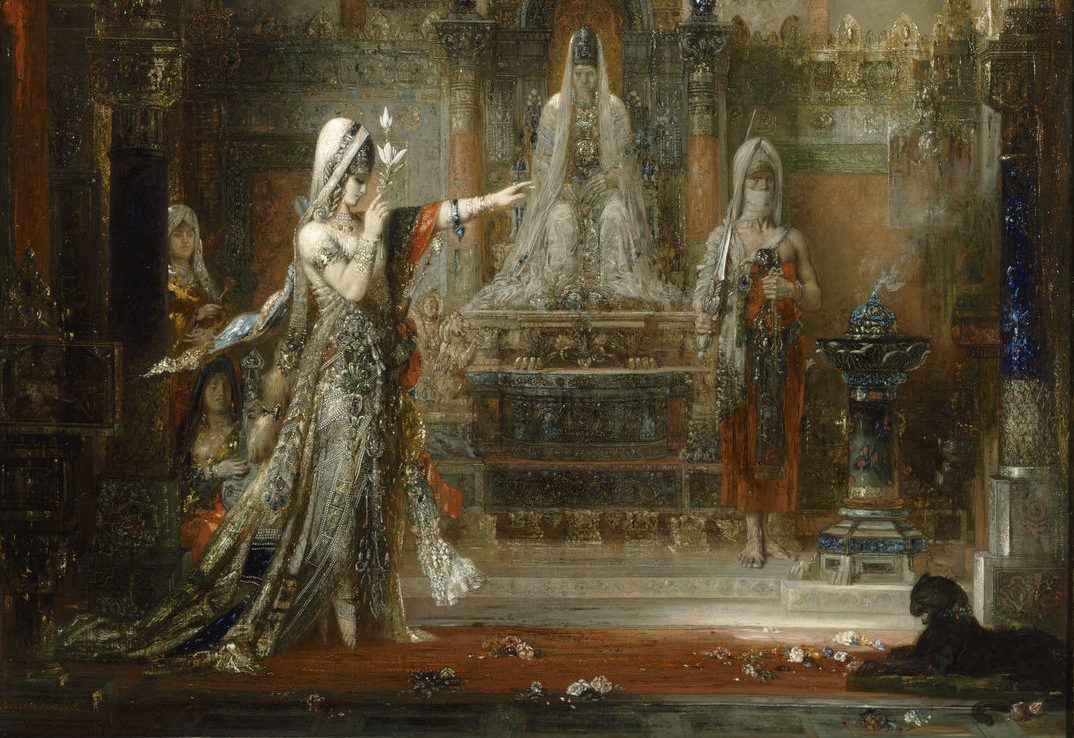
Gustave Moreau (1826–1898) started it all. He was very interested in the myth of Salome and created several artworks (paintings, but also sketches and drawings) connected to the biblical episode. The most famous one is his 1876 Salome Dancing Before Herod.
Here, Salome is portrayed as a mystical, almost magical creature, as she dances to entice Herod to have her wish to have John the Baptist killed granted. All of Moreau’s Salomes are either dressed in revealing, lavish clothing or entirely naked—his interpretation turned Salome into a rather different figure than what had been generally portrayed in previous centuries.
Salome on Stage
In 1893, Oscar Wilde (1854–1900) published Salome, a one-act play centered around the events leading to and resulting from the beheading of John the Baptist. Wilde dramatically rewrote the story. Salome became a disarmingly beautiful woman. She was lustfully attracted to the saintly John the Baptist, who refused her. As she danced for Herod, she used her stepfather’s infatuation with her to ask for John the Baptist’s head. She kissed it incessantly to quench her lust before Herod, in disgust, ordered his army to end her life.
Wilde’s play was made all the more impactful by the work of British illustrator Aubrey Beardsley (1872–1898). Beardsley was a controversial artist. He is considered, alongside Wilde, as one of the leading figures of the Aestheticism movement and a precursor and forerunner of Art Nouveau. His black ink drawings are often dark, grotesque, and erotically charged.
In his illustrations for the English translation of Wilde’s play (which Wilde had originally written in French in 1893), Salome appears to exert a devilish and witch-like feminine power.
Wilde’s play was the inspiration for Richard Strauss’s opera of the same name that debuted in 1903. This is where a new characterization of Salome took hold on a broader stage. Famously, Strauss (1864–1949) formalizes Salome’s dance for Herod as the so-called “Dance of the Seven Veils”—giving it a heavily eroticized spin and establishing the character of Salome as an erotic symbol in art from then onwards.
Since Then…
Since then, Salome has been mostly associated with sin, sexuality, and eroticism. Inspired by the 19th-century readaptation of the character, many prominent artists have left her role as a femme fatale unquestioned—unclad or scantily clad, her features have been wild and exoticized, and her body language overly sexualized. From then on, signs of her earlier image are very much absent.