

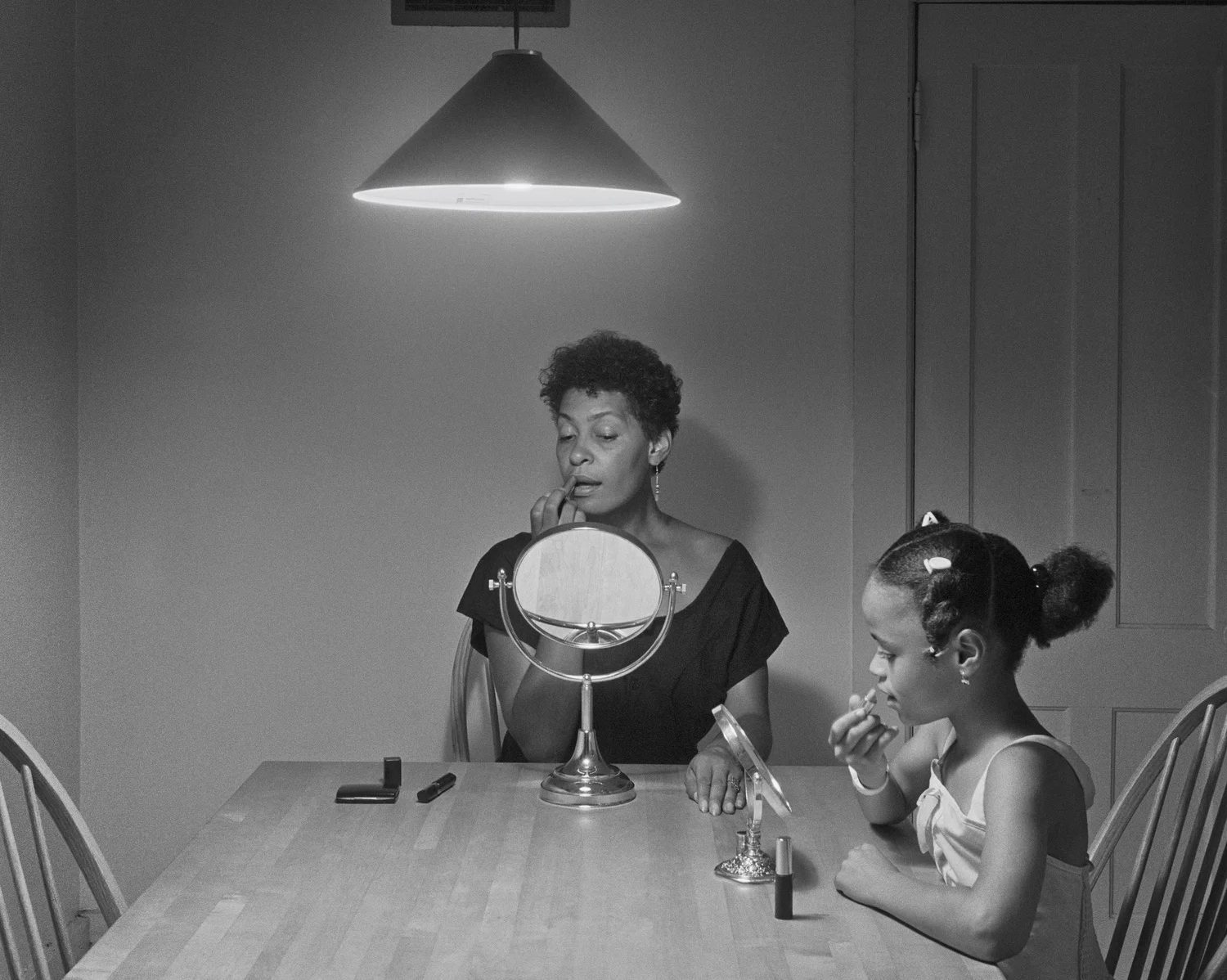
Everywoman
Carrie Mae Weems used herself in her Kitchen Table Series photographs, performing as an archetypal everywoman. When asked why she used herself as a model, her answer was simple: she was at home and she was available! This artist is very aware that the kitchen table is a stage where life’s biggest (and smallest) moments play out. The kitchen is a private yet communal space. She uses her own body as a landscape to explore the complex realities of human emotion and daily life.
Mood
Moods change across these photos. At times, Weems is gently exploring the idea of womanhood and family. But in other images, we are more aware of that bright overhead light—the light of interrogation, with a harsher and more challenging tone. The camera is fixed in position, but the characters and their feelings can change.
Seeing Ourselves
Work by Black artists is almost always assumed to be about “Blackness,” while a white artist is considered to be sharing truths about the universal condition. Weems has always been clear that the Kitchen Table Series is not just about race. Every woman can relate to something in this work. And every man can identify scenes from their past or present lives.
The Challenge
A Black female artist faces huge intersectional challenges in the worlds of art and academia, as well as in general society. Carrie Mae Weems certainly rises to the challenge—her work is triumphant!
The feminist activist and writer bell hooks explored themes of intersectionality in her book Teaching to Transgress (1994, Routledge). She explored the idea of people who were straddling two or more worlds, trying to make space for themselves. She wrote: “They must believe they can inhabit two different worlds, but they must make each space one of comfort. They must creatively invent ways to cross borders… to subvert and challenge the existing cultures.” Weems, in her life and in her art, seems to have always been striving for that.
Inspirational
Three decades on, the Kitchen Table Series is still so utterly contemporary. And Weems’ work continues to inspire. She is an artist who empowers both viewers and other artists. Once she got a seat at the art world table, she made it her mission to ensure that the doors are flung open and that seats are available for the artists who come after her. We will end with a wonderful poem about the kitchen table by Joy Harjo, poet and performer, of the Muskogee (Creek) Nation.
Perhaps The World Ends Here
The world begins at a kitchen table. No matter what, we must eat to live.
The gifts of earth are brought and prepared, set on the table. So it has been since creation, and it will go on.
We chase chickens or dogs away from it. Babies teethe at the corners. They scrape their knees under it.
It is here that children are given instructions on what it means to be human. We make men at it, we make women.
At this table we gossip, recall enemies and the ghosts of lovers.
Our dreams drink coffee with us as they put their arms around our children. They laugh with us at our poor falling-down selves and as we put ourselves back together once again at the table.
This table has been a house in the rain, an umbrella in the sun.
Wars have begun and ended at this table. It is a place to hide in the shadow of terror. A place to celebrate the terrible victory.
We have given birth on this table, and have prepared our parents for burial here.
At this table we sing with joy, with sorrow. We pray of suffering and remorse. We give thanks.
Perhaps the world will end at the kitchen table, while we are laughing and crying, eating of the last sweet bite.
Joy Harjo, poem from The Woman Who Fell From the Sky, 1994, WW Norton and Company.