

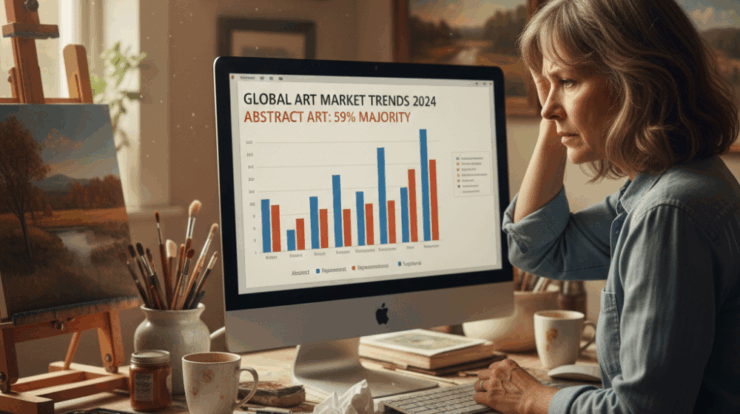
Every few months, a new industry report ripples through the art world. You’ve likely seen the headlines: “Abstract Paintings Top Gallery Sales” or “Minimalism Is Out, Figurative Is In.” (see this article, or this one, for example) For an artist, these statistics can feel like a high-stakes weather report. If you aren’t painting what the charts say is “hot,” it’s easy to feel like you’re standing in the rain while everyone else is in the sun.
But before you trade your brushes for a palette knife or swap your landscapes for color blocks, it is vital to look under the hood of that data. In the art market, “broad data” is often a distraction from “pragmatic strategy.”
The Illusion of the “Average” Gallery
The most common mistake is assuming that a trend reported by a major platform or a massive survey applies to every corner of the market. If a platform that primarily services contemporary, urban galleries reports that non-figurative abstraction accounts for 60% of sales, that data is accurate for their ecosystem.
However, if you are a traditional landscape painter represented by a gallery in the Southwest or a rural arts hub, that 60% figure is completely irrelevant to your reality. A gallery’s inventory is a self-fulfilling prophecy: they sell what they carry. If a gallery specializes in abstract work, their sales data will naturally skew that way. Using a global “average” to guide your specific studio practice is like checking the temperature in New York to decide what to wear in Santa Fe.
Data vs. Anecdote
Scientific-level data in the art world is notoriously difficult to capture. Most reports are based on “enhanced anecdotal information”—surveys where gallery owners are asked what is “important” to their business rather than being asked for raw, audited sales figures.
The wording matters. When a dealer says a category is “important,” they might mean it’s what they are currently excited about or what they’ve seen the most of on social media. It doesn’t necessarily mean that is where the most money is changing hands. We are all prone to “confirmation bias”—the tendency to notice the things that reinforce what we already believe. If an artist believes abstract art is selling better, they will notice every abstract “sold” sticker and ignore the representational sales happening right next to them.
The Danger of Chasing the Curve
There is a significant “opportunity cost” to chasing trends. Art is an evolutionary process, not a manufacturing one. When you attempt to pivot your style to match a market report, you risk two things:
-
Losing Authenticity: Buyers are sophisticated. They can often sense when an artist is “trying on” a style that doesn’t belong to them. Authenticity is a primary driver of value; trend-chasing is its antithesis.
-
Missing the Market: By the time a trend is documented in a major report, the market is already saturated. If you start a new body of work today based on a 2024 report, you might be finishing that work just as the pendulum swings back the other way.
The Power of the Micro-Trend
Instead of looking at the global Art Market (with a capital M), look at your market.
Real, actionable data comes from your own collectors and your own galleries. If your website traffic shows a sudden, sustained spike in interest for your figurative work over your abstracts, that is a “micro-trend” worth investigating. Unlike a national report, this data is specific to your hand and your audience.
Growth in an artist’s career rarely comes from a sudden, dramatic shift in subject matter. It comes from small, iterative changes—listening to the “push and pull” of your specific buyers and refining your unique voice. Your job isn’t to be a weather vane for the industry; it’s to build a shelter that your specific audience wants to inhabit.
What Is Your “North Star” Data?
When you see reports claiming a certain style is “dominating” the market, does it make you feel pressured to pivot, or do you trust your own sales history more? I’d love to hear how you balance staying aware of the industry while remaining true to your personal vision.