

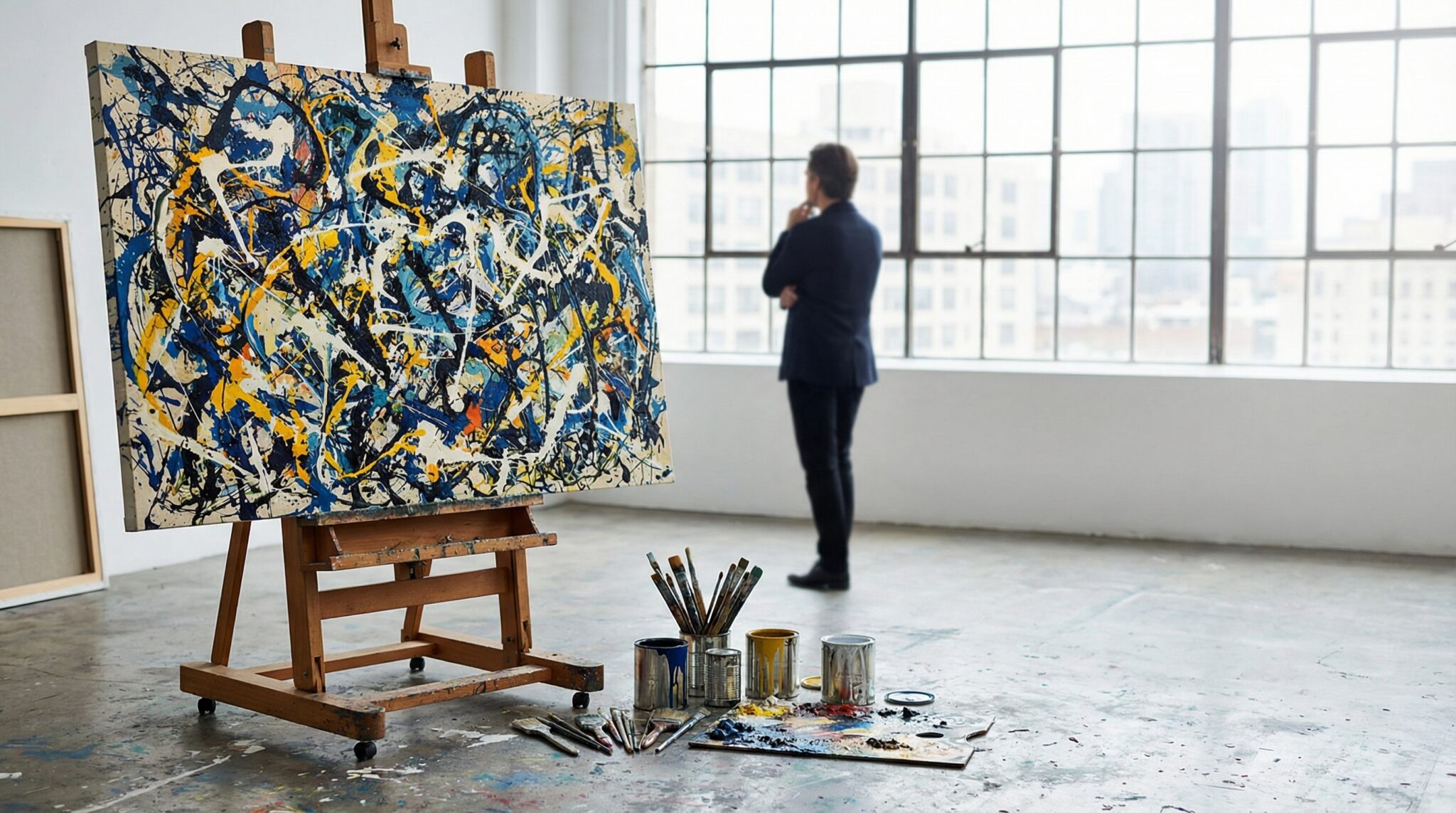
Picture a gallery visitor standing in front of a stunning, complex abstract painting. They tilt their head, squint, and mutter those four dreaded words: “I could do that.”
As a gallery owner, I observe this kind of skepticism regularly. It is a natural reflex for viewers encountering non-representational work or mixed-media pieces where the technical effort isn’t immediately obvious to the untrained eye.
But I have also watched that exact skepticism evaporate in seconds when the buyer discovers the rigorous, deliberate method behind the canvas. Revealing your creative process is not just about sharing a behind-the-scenes peek—it is a highly effective sales strategy.
Lifting the veil on your artistic technique builds undeniable value, proving your mastery and transforming passive onlookers into emotionally invested collectors.
The Psychology of the Skeptical Collector
Many buyers walk into a gallery looking for a connection, but they are terrified of looking foolish. When they look at an abstract piece and cannot immediately decipher the technique, their defense mechanism kicks in.
They assume the work is just random squiggles or carelessly thrown paint. “Where is the skill in this?” they wonder.
You have to educate them. When you show a collector the steps you took to arrive at the finished piece, you provide them with a critical intellectual foothold. You give them the vocabulary to understand your work and, more importantly, the confidence to buy it.
Understanding your process makes the collector feel like an insider. It adds a rich narrative to the physical object that they can later share with friends who visit their home.
The Jackson Pollock Proof
If you worry that showing your process ruins the magic, consider a legendary story about Jackson Pollock. He once had a skeptical reporter in his studio who implied his drip paintings were just random, talentless splashing.
Pollock did not write a thesis to defend his work. Instead, he expertly flicked a glob of paint across the room, landing it precisely on the door handle as he ordered the reporter to get out.
He demonstrated absolute, deliberate control over a medium that looked chaotic to the layman. There was real forethought, rigorous skill, and hard-earned experience driving every drop of paint.
When you pull back the curtain on your own studio practice, you are executing your own version of the doorknob flick. You are proving that your abstraction is intentional, complex, and irreplicable by an amateur.
Strategic Ways to Pull Back the Curtain
You do not need to give away your deepest trade secrets to build value. You just need to show enough of the journey to prove the destination was earned.
Here are a few pragmatic ways to document your process and engage collectors:
-
Time-Lapse Progressions: Compress forty hours of painting into a thirty-second video to showcase your immense patience and the sheer volume of transparent layers involved.
-
Compositional Planning: Share the digital sketches, Photoshop mockups, or pencil thumbnails you meticulously create before ever touching a brush to the final canvas.
-
Scale and Tools: Post photos of your workspace showing the massive, specialized brushes you use, or the unique way you mix your pigments.
-
The Backstory: Share a brief anecdote about the specific inspiration or even the physical hurdles you overcame to complete the piece.
Final Takeaway
Never assume a buyer intuitively understands the difficulty of what you do. The creative process you take for granted is absolutely fascinating to a non-artist.
By treating your artistic process as a marketing asset rather than a closely guarded secret, you strip away collector hesitation. You replace their skepticism with awe, making it infinitely easier to justify your price point and close the sale.
Question for Readers
Have you ever had a piece sell specifically because you shared the story or a video of how it was made? What parts of your process do your followers respond to the most?