

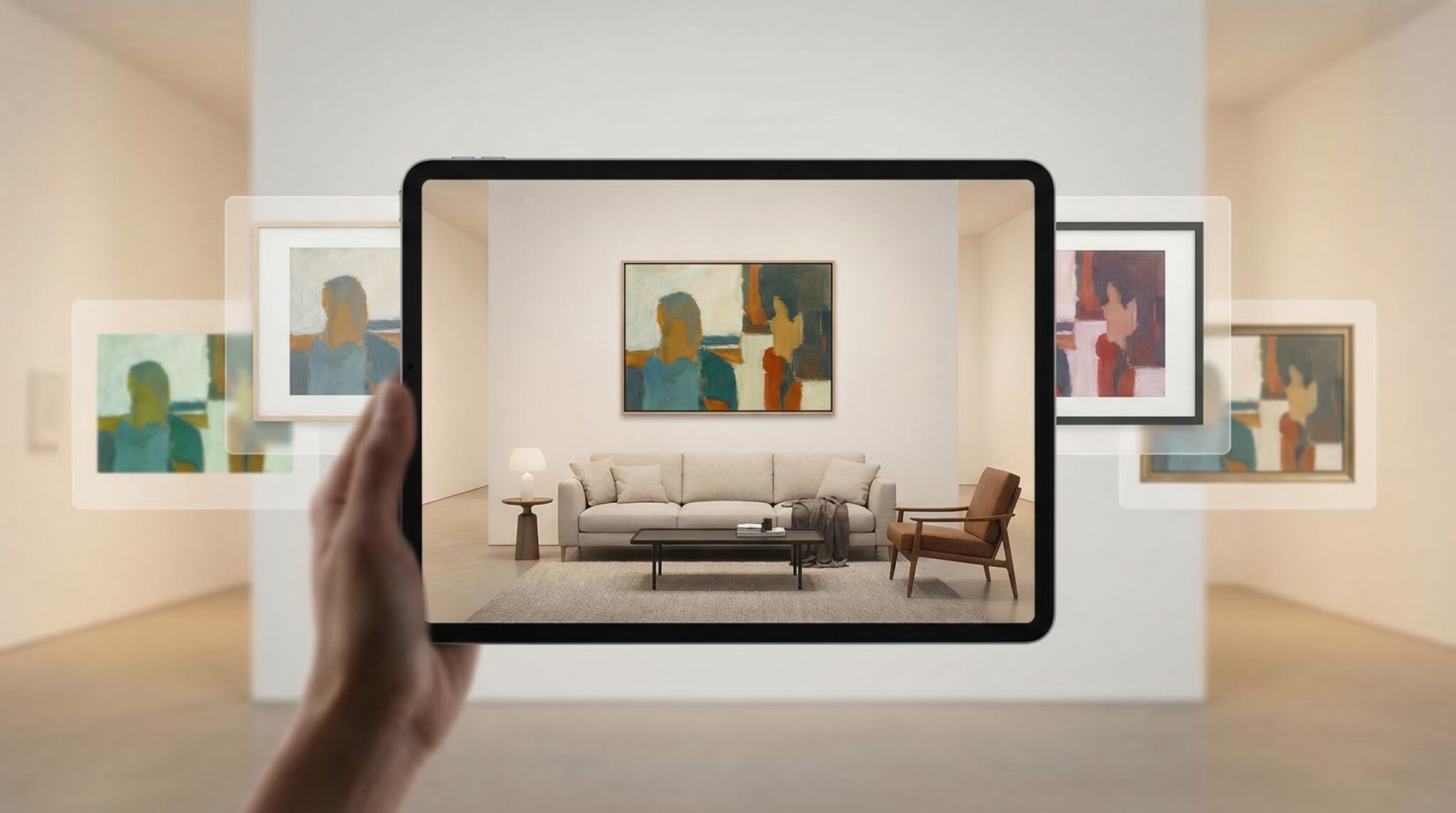
Imagine a collector walks into your studio and falls in love with a striking 40×40 painting for her mantle. You want to seal the deal, so you pull up a room visualization app to show her exactly how it will look above her fireplace. But you don’t stop there. Wanting to be as helpful as possible, you mock up three other paintings in the exact same space.
The result? The collector, previously eager to buy her initial favorite, suddenly pumps the brakes. She says she loves your work and plans to buy something within the next year, but she just can’t decide which one right now. You’ve successfully pitched yourself right out of an immediate sale.
When a buyer shows strong interest in a specific artwork, your job is to close on that single piece. Introducing competing options—even with the best intentions—breeds confusion, triggers analysis paralysis, and ultimately kills the sale.
The Trap of “Helpful” Technology
Room simulation apps are incredible tools for closing sales. They remove a massive psychological hurdle by answering the buyer’s internal question: “Will this actually look good in my house?”
However, technology is only as effective as the strategy behind it. When you use these apps to present a menu of alternatives, you shift the buyer’s mindset.
Instead of deciding whether to buy the painting they already love, they are now forced to rank multiple pieces against one another. You’ve accidentally turned an emotional purchase into an analytical homework assignment.
The Psychology of Buyer Indecision
Art collectors are naturally prone to indecision. Buying art is an emotional, high-ticket purchase, and buyers are often subconsciously looking for a safe reason to hit pause.
When you offer four different options for a single wall, you feed directly into that hesitation. The fear of making the wrong choice overwhelms the desire to own the artwork.
In the gallery, I almost hate to introduce the potential for questions, considerations, or confusion once a client has keyed in on a specific piece. The moment you give a hesitant buyer a reason to say, “I need to think about which one I like best,” you lose your momentum.
A Framework for Single-Focus Selling
To avoid triggering analysis paralysis, you need to tightly control the presentation of options. Follow these rules when a client expresses interest:
- Focus on the favorite: If they gravitate toward one piece, send them a simulation of just that one piece. Do everything in your power to close that specific sale first.
- Keep alternatives in reserve: Only mock up additional paintings if the client explicitly states the first piece isn’t working for the space and asks to see other options.
- Maintain urgency: Remind the client that your work sells and there is only one original. Letting them linger over multiple choices ignores the reality that their favorite artwork could be gone tomorrow.
How to Recover the Stalled Sale
If you’ve already triggered the dreaded “I need a year to think about it” response, all is not lost. You simply need to uncover the real reason behind their hesitation and present a targeted solution.
First, ask a direct but gentle question. You might say, “I sense how much you enjoyed that first piece, and I don’t want to pressure you, but do you mind if I ask what is causing the hesitation?”
Once they give you a concrete reason—rather than a vague delay—you can leverage your sales toolkit to move the ball forward:
- Offer an on-approval trial: If they still can’t visualize the winner, offer to bring the physical piece to their home. Seeing the actual art in their space often shatters lingering doubts.
- Propose a layaway plan: If the underlying issue is budget, offer to hold the piece for a small, refundable deposit while they make payments. This secures a micro-commitment and stops them from endlessly shopping.
One Final Takeaway
Your goal is not to present a catalog of infinite possibilities. Your goal is to help a collector overcome their own doubts so they can confidently acquire the artwork they already want. Guide them toward a single, decisive yes.
Question for Readers
Have you ever lost a sale because you gave a client too many choices? How do you keep buyers focused on a single piece when they start to waffle? Share your experiences in the comments below.