

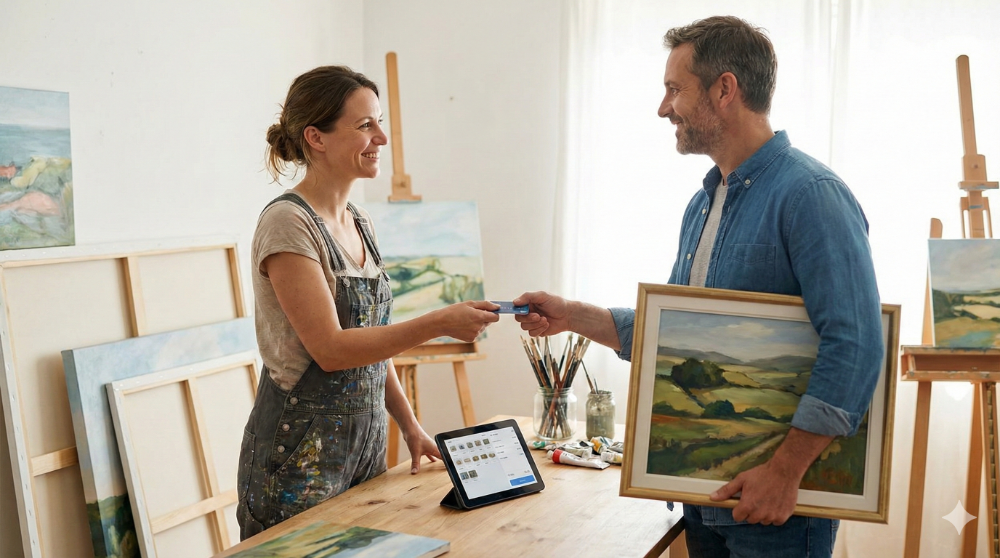
It is a scenario every artist faces eventually. You are at a gathering, or perhaps hosting an open studio, and a close friend or family member stops in front of a piece. They look at it, then look at you, and ask: “I love this. How much is it?”
For many artists, this moment triggers an immediate internal panic. A feeling of “ick” sets in. We suddenly feel like we are capitalizing on a relationship, or that charging full price to a loved one is somehow greedy.
To compensate, the artist often blurts out, “Well, it’s listed at $1,000, but for you, I can do $500.” Or worse, “Just take it, pay me for the materials.”
While this comes from a place of generosity, I want to suggest that treating your friends and family differently than your “real” collectors is actually a disservice—both to you and to them.
Respecting the Buyer
There is a misconception that “sales tactics” are manipulative tricks we use on strangers, but that we should be “authentic” with our friends.
I take the opposite view. Good salesmanship is not about manipulation; it is about service. It is about educating the viewer, sharing the story behind the work, and helping them acquire something that will bring value to their lives.
When you rush to offer a discount or shy away from the price with a friend, you are making an assumption. You are assuming they don’t value your work enough to pay for it, or that they are looking for a bargain rather than a piece of art.
My advice is to treat your friends and family with the exact same professional respect you would afford a stranger walking into a gallery. Don’t skip the “sales” part. Tell them about the inspiration. Explain the technique. And when they ask the price, state it clearly and confidently. Give them the dignity of being a true patron of the arts.
The Value of Paying Full Price
There is a psychological component to pricing that we often forget: People value what they pay for.
If you give a family member a painting for free or at a steep discount, it often ends up in a closet or hung in a spare room. But when someone pays full price—or close to it—they have made a significant investment. They have skin in the game. That artwork becomes a prized possession, not just a “favor” they did for their artist cousin.
Furthermore, your friends and family are often your biggest cheerleaders. They want you to succeed. When they offer to buy your work, they often want to support your career. By slashing the price immediately, you are denying them the opportunity to support you in the way they intended.
The “Friends and Family” Discount
Does this mean you can never offer a deal? Not necessarily. But I would urge you not to offer it preemptively. Wait to see if price is actually an objection.
If a friend loves the piece but genuinely can’t afford the sticker price, you can handle that negotiation just as you would with any other client—perhaps offering a payment plan or a modest adjustment. But do not institute a blanket “50% off for relatives” policy. It devalues your inventory and sets a precedent that can be hard to break.
I often joke with friends that my gallery has a very strict “Friends and Family Discount policy.” When they ask what it is, I tell them: “It’s $20 off.”
It always gets a laugh, especially when we are talking about paintings worth thousands of dollars. But the joke serves a purpose. It signals that this is a business, the prices are real, and while I love them, the value of the art remains the same regardless of who signs the check.
Conclusion
Don’t let the fear of awkwardness rob you of a sale or rob your loved ones of the experience of collecting. The next time a friend asks about a piece, take a deep breath, smile, and treat them like the VIP collector they are.
How do you handle this?
Do you have a set policy for sales to friends and family? Do you find it difficult to talk money with people you know personally, or do you find they are your easiest customers? Share your experiences in the comments below.