

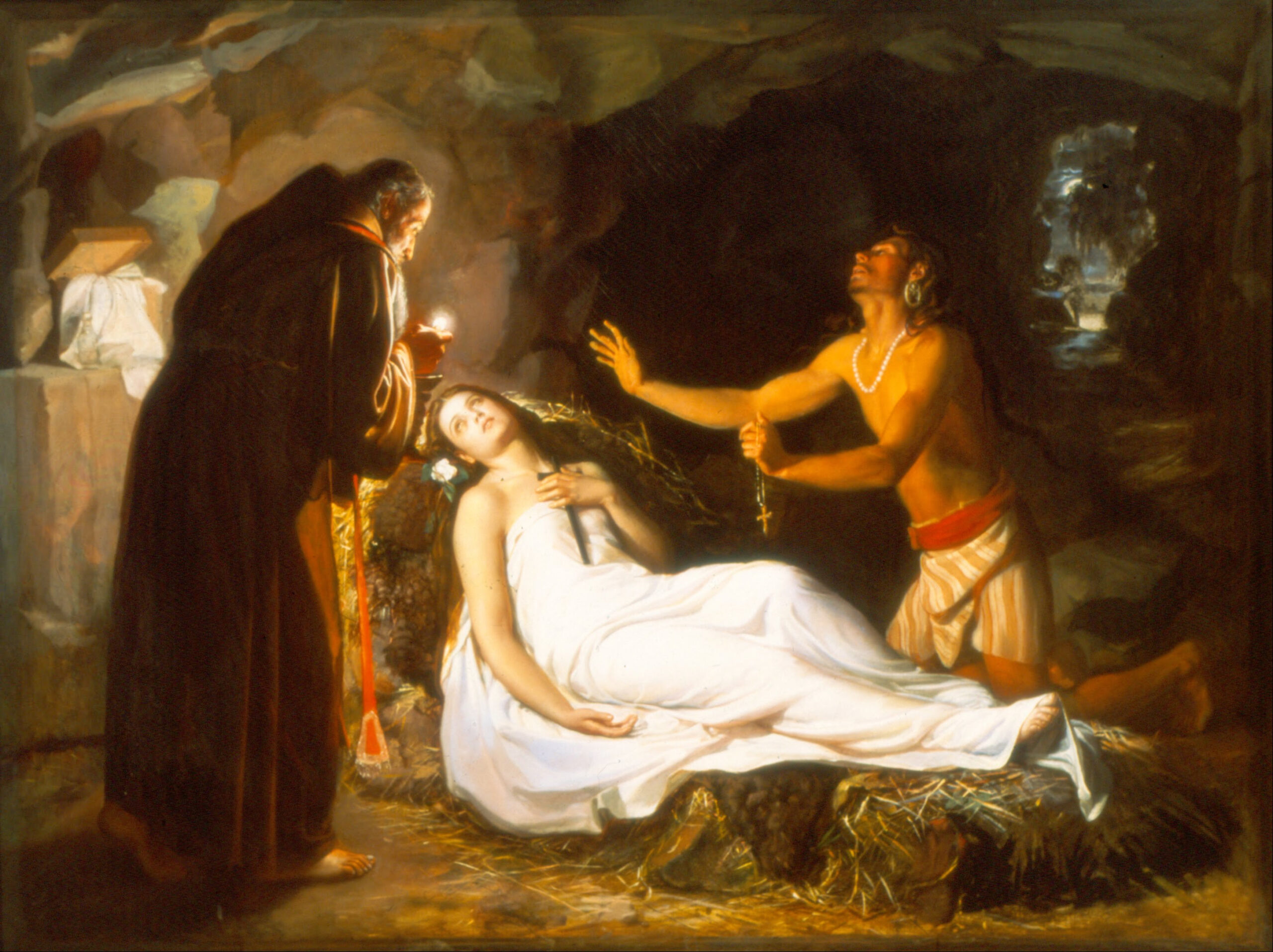
In reality, Atala’s ignorance about true Christian beliefs led her to unnecessary death. Many critics interpreted this as a warning against religious fanaticism. As the old man said:
Atala as Decoration
Another beautiful example of its popularity is this clock, made not long after its publication. Really, by the time this piece was produced, more than ten illustrated editions and translations of the book existed already. In this, we see the beginning and the end of this tragedy. On top, there is a sculpture of Atala freeing Chactas. In the plaque below, Chactas is carrying her to her tomb.
Words That Create Images
Quickly, Chateaubriand became known as the epitome of a magician due to the quality of his descriptions. Thanks to this, it was easy for artists to translate his words from the pages to the canvas. In fact, it is highly possible that this was his objective from the very beginning. On Les Martyrs, another novel, he stated:
Atala at the Salon
In this light, it is reasonable to believe he had a similar objective with this book. If so, he succeeded. During the first half of the 19th century, more than 50 paintings about one of his works appeared in the Paris Salon, 18 of them were about the two tragic lovers. Most artists chose the most dramatic moments of the tale, her agony, Chactas’ grief, and her funeral. Among them, the most important might have been Anne-Louis Girodet, who presented his The Funeral of Atala at the Salon of 1808. The painter was often inspired by literary works and even wrote poems. For instance, in his Oeuvres posthumes (1829), he dedicated some lines to the lovers. Certainly, this novel had an impact on him.
Another curious example is the one by Eugène Delacroix. Interestingly, he did not choose any of the novel’s moments. Instead, he painted a Native couple with their baby as they fled the French army. Therefore, it is not directly based on the book, but on the context. However, there is evidence that he read the book and commented on its author several times. Plus, this is his only canvas set in the Americas.
Beyond France
Naturally, the French did many of the paintings, but Italians did a few of them as well. Among them, Cesare Mussini and Andrea Gastaldi chose common moments, but with notably different styles.
Atala in American Literature
In truth, a story set in America during colonial times was bound to cross the pond. It might sound strange, but to the new Latin American countries emerging in the 19th century, Atala was a perfect model to create their own national literature. As a matter of fact, the first translations to Spanish were done almost immediately. Consequently, regional writers instantly took it as an inspiration. In Mexico, José María Lacunza published Netzula in 1837, and the Colombian Jorge Isaacs’ Maria came out in 1867. Ten years later, Juan León Mera published Cumandá, which also made it into a canvas by Rafael Salas. To different degrees, all of these books have similarities with the French novel.
Atala in Latin American Art
The story spoke to those societies as it talked about morality concerning women, death, colonialism, and mixed race. Not surprisingly, just as literature, the fine arts took European art academies as their model. For instance, in Mexico, the Academy of San Carlos brought teachers from the Old Continent and continued teaching traditional Western techniques. Furthermore, the elite loved the French story, so it was expected that paintings about it would appear. As such, the theme was depicted in an academic way, with its own Latin American mark.
For example, if we see Luis Monroy’s The last moments of Atala, we can notice differences in the depiction of Chactas from its European counterparts. His facial and body features seem more accurate with his ethnicity. At that time, Mexico had just become a Republic after Maximilian of Habsburg’s brief empire. In consequence, for the new liberal government led by Benito Juárez, the idea of a Christianized native was quite attractive. Even more, Atala represented the woman who put her chastity before her desires. Thus, the appealing theme together with Monroy’s talent earned him recognition among his teachers and critics.
Similarly, Chactas is represented more ethnically accurately in Brazilian paintings. One of them was by Rodolfo Amoedo, who chose a similar moment as Monroy, the last communion.
Atala Lives On
Although Chateaubriand’s best seller is no longer popular, it remains in the dozens of paintings, decorations, furniture pieces, and engravings that 19th-century artists made. Moreover, it is a story that speaks about European and Latin American societies, their values, interests, and history. And, it is a prime example of the relationship between literature and art.
Guest Author’s bio
Alejandra Gabriela Durán Escamilla (Puebla, Mexico, 1992) is a Music Technician, graduated in Linguistics and Hispanic Literature with a master’s degree in Hispanic American Literature and PhD candidate in Hispanic American Literature from the Benemérita Universidad Autónoma de Puebla and the University of Salamanca, Spain. Currently dedicated to the diffusion of the bolero and traditional Mexican music.