

In Saint Jerome in Meditation, Caravaggio shows the man behind the spiritual journey. He is an elderly figure, balding and gray, his body is withered, and he sits, half-dressed, leaning against his right hand in contemplation. Before him there is a bare skull, the universal symbol of the inevitability of death. His right hand touches his gray, bearded chin as he contemplates, absorbed in meditation on life and death.
In this artwork, Caravaggio removes the divine elements; St. Jerome appears as a solitary man whose flesh is failing, sitting in an empty space, considering his mortality. He appears fatigued, surrounded by darkness, yet unbroken by these circumstances. Despite his physical decline, St. Jerome continues to work on his translation of the Bible, a task some considered impossible during his lifetime.
Caravaggio depicts St. Jerome choosing a life of seclusion, and, in meditation, he confronts his evident mortality. The shadows neither hide nor emphasize the saint’s deteriorating body and mental strain, showing the man behind the idealized image. Is his dedication to his life a form of holiness or simply endurance? Has St. Jerome chosen a life of solitude and work, or is he, in his later years, trapped by his past? Caravaggio leaves the interpretation of his painting up to the viewer.
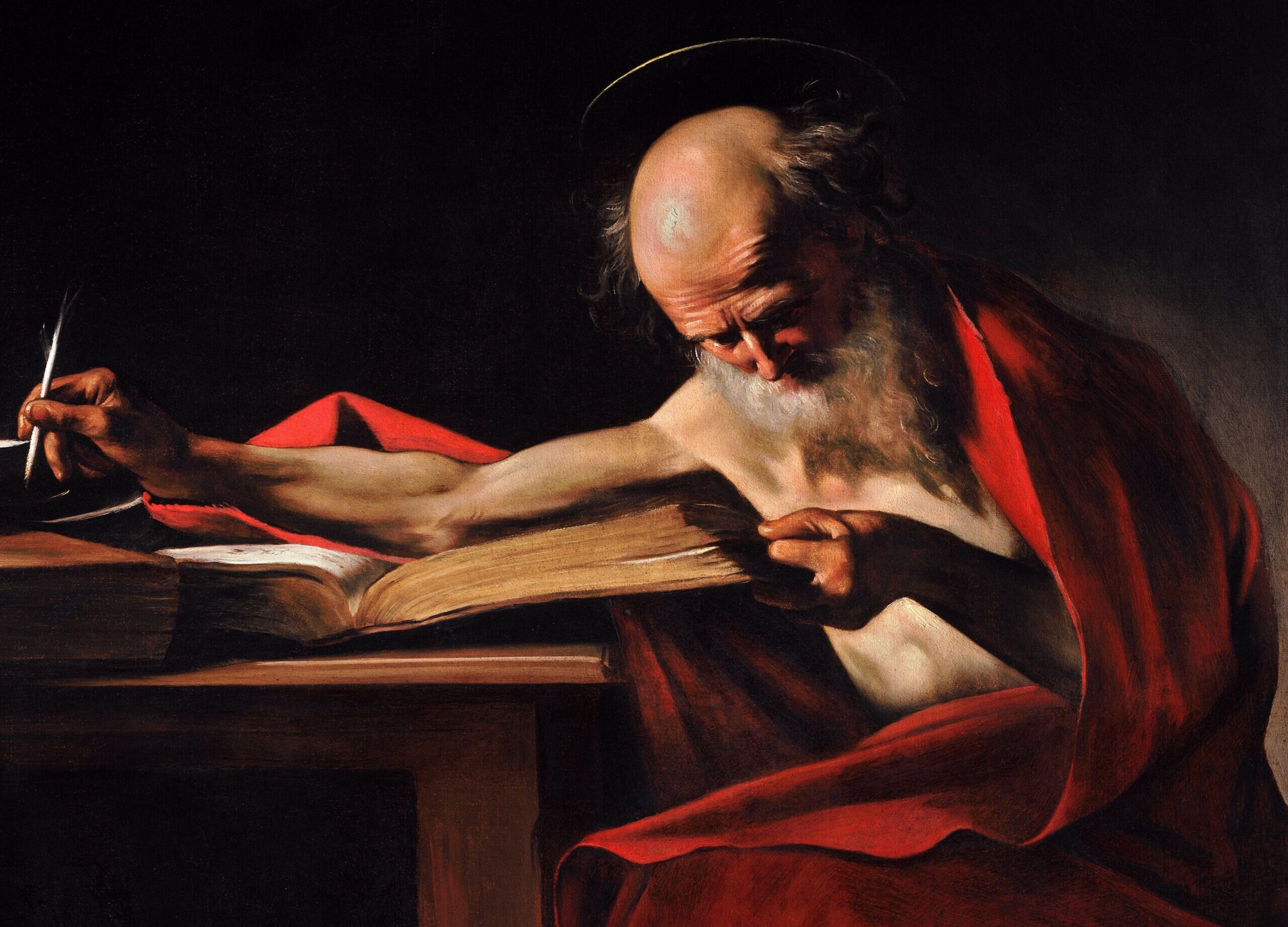
In Saint Jerome Writing, Caravaggio shows St. Jerome venerable, weakened by time, yet propelling himself forward in his work. Though less exposed than in Saint Jerome in Meditation, we do see hints of his weakened form, barely covered by his robes. St. Jerome’s gaze is fixed upon the words before his eyes as the memento mori aspect in the shape of a skull rests close to his extended arm. Death sits near him, yet he continues onward, translating words and phrases that would, by most accounts, transform the world.
In this composition, Caravaggio suggests another aspect of the saint’s fate. A sketch of a halo appears in both paintings, though it is treated with restraint in each. In Saint Jerome Writing, it hovers faintly over his bowed, bald head, more a suggestion than a declaration, while in Saint Jerome in Meditation, it offers no greater sense of elevation. In both, the mark of sanctity feels subdued, secondary to the physical and mental toll of his devotion. Despite this suggested tribute, St. Jerome appears before the viewer as a man, one who declines under his chosen vocation and commitment.
Caravaggio does not present Jerome as a saint elevated beyond the world. He presents a man still working within it, aware of death and unable to escape its inevitability. Is this strength or a form of obsession? Caravaggio leaves this question open to interpretation. The labor continues, his body fails.
In the two surviving paintings using St. Jerome as his subject, Caravaggio does not demonstrate holy transcendence. There is no sense of glory, nor a figure defined by divine calling. In Saint Jerome in Meditation and Saint Jerome Writing, the viewer observes that the cost of devotion is endurance despite decay.
Author’s bio:
Frank Schildiner is a retired probation officer and longtime martial arts instructor who writes about art, horror, and the psychology of human experience. His work examines how artists depict powerful human forces such as fear, desire, and judgment through visual imagery. He has previously written fiction and independent essays exploring the darker dimensions of human nature.