

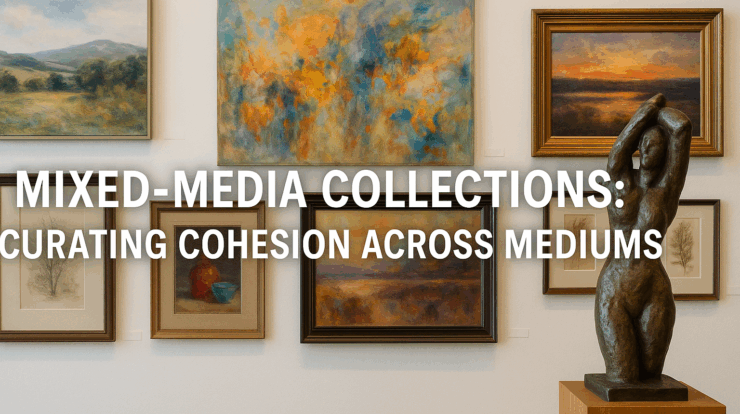
If your body of work includes more than one medium—paintings and prints, sculpture and collage, oils and encaustics—you’re not alone. Many artists today are working across disciplines, and for good reason: it keeps creativity flowing, and it opens new avenues for expression and experimentation.
But when it comes time to present that work—on a gallery wall, in a portfolio, or online—it’s easy for mixed-media collections to feel disjointed. Without care, a diverse practice can look like three artists sharing one website.
The good news: there are proven strategies for bringing cohesion to even the most varied collections.
Think Like a Curator
Galleries do this all the time. We hang abstract paintings next to representational ones. We mix ceramic, metal, and wood sculpture. We create harmony from variety.
And the trick isn’t to force sameness—it’s to find and emphasize the connections between works. Here’s how:
Use a Common Color Thread
A shared palette across mediums is one of the easiest and most effective ways to create unity. Even wildly different pieces feel cohesive if they share dominant tones. For example:
-
A warm ochre that appears in both your oil landscapes and your hand-pulled prints
-
A rich black line that threads through drawings and steel sculptures
-
A neutral ground or backdrop that links otherwise contrasting works
When shooting work for your website or a submission, consider showing a few pieces together to demonstrate this harmony.
Develop a Thematic Through-Line
Subject matter and theme can be powerful anchors. Whether you’re exploring identity, memory, ecology, or motion—highlight the common ideas across formats.
You can do this with artist statements, show descriptions, and series titles that frame your work in narrative terms. Give viewers a lens through which to understand the connections.
Even something as subtle as a recurring symbol or gesture—a circle, a slash, a motif—can act as a visual breadcrumb trail between pieces.
Use Consistent Titles and Descriptions
Your titling conventions can tie your works together. Try:
-
A series title followed by individual identifiers (e.g., Echoes I, Echoes II)
-
Consistent language or tone (poetic, minimalist, descriptive)
-
Descriptions that reference the same themes, processes, or inspiration points
Consistency here builds brand clarity, even across formats.
When Hanging, Use Rhythm and Balance
If you’re showing work in person or hanging a booth at an art fair, treat your display like a composition. Vary the scale and media, but create balance. A few pointers:
-
Group by visual weight (darker works clustered or anchored by lighter ones)
-
Place similar textures opposite each other for contrast
-
Use negative space to keep the arrangement from feeling chaotic
-
Echo shapes and forms from one piece to another
You’re not just hanging pieces—you’re choreographing how a viewer experiences your world.
Mirror the Approach Online
Your website is your gallery wall. Don’t just dump everything into one page. Curate. You might:
-
Create themed galleries that mix media around a shared concept
-
Use short headings or statements to connect what’s in each collection
-
Display thumbnails that create visual flow—similar tones or shapes adjacent
The goal: to let a visitor feel like they’re stepping into a unified body of work, not flipping through unrelated experiments.
The Power of Cohesive Variety
When mixed-media work is presented well, it doesn’t feel fragmented—it feels rich. A well-curated collection shows confidence, range, and clarity of vision.
You don’t need to make everything look the same. But you do need to help viewers understand how it all fits together.
Show them the threads—and they’ll see the tapestry.