



Life of Maira Kalman
Maira Kalman was born in 1949 in Tel Aviv. She moved with her family to the Bronx (Riverdale) in New York City when she was four years old and has lived there since. She studied English at NYU, where she met Tibor Kalman, her future husband. Together they founded M&Co.—a graphic and design firm. Their business had a significant influence in the city where they worked on projects with the Museum of Modern Art, the musical group Talking Heads, and Interview magazine.
Throughout her career, Kalman has been a frequent contributor to The New Yorker and The New York Times, has worked on over 30 books, and has collaborated with numerous brands, including Kate Spade and Isaac Mizrahi. Maira and Tibor had two children, which inspired the artist to start working on children’s books.
Dogs
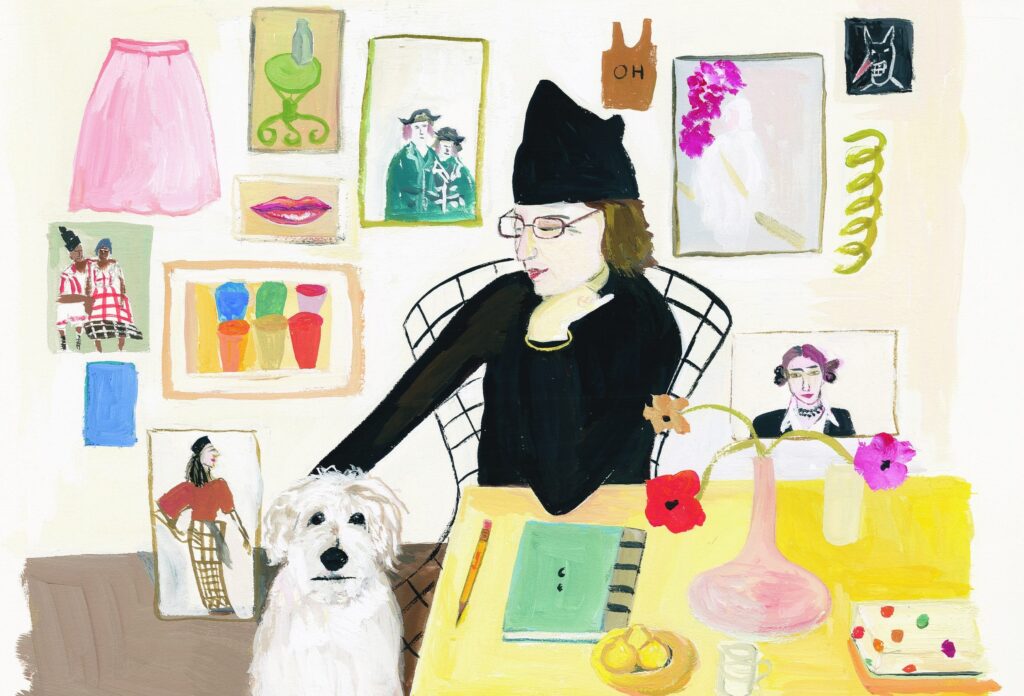
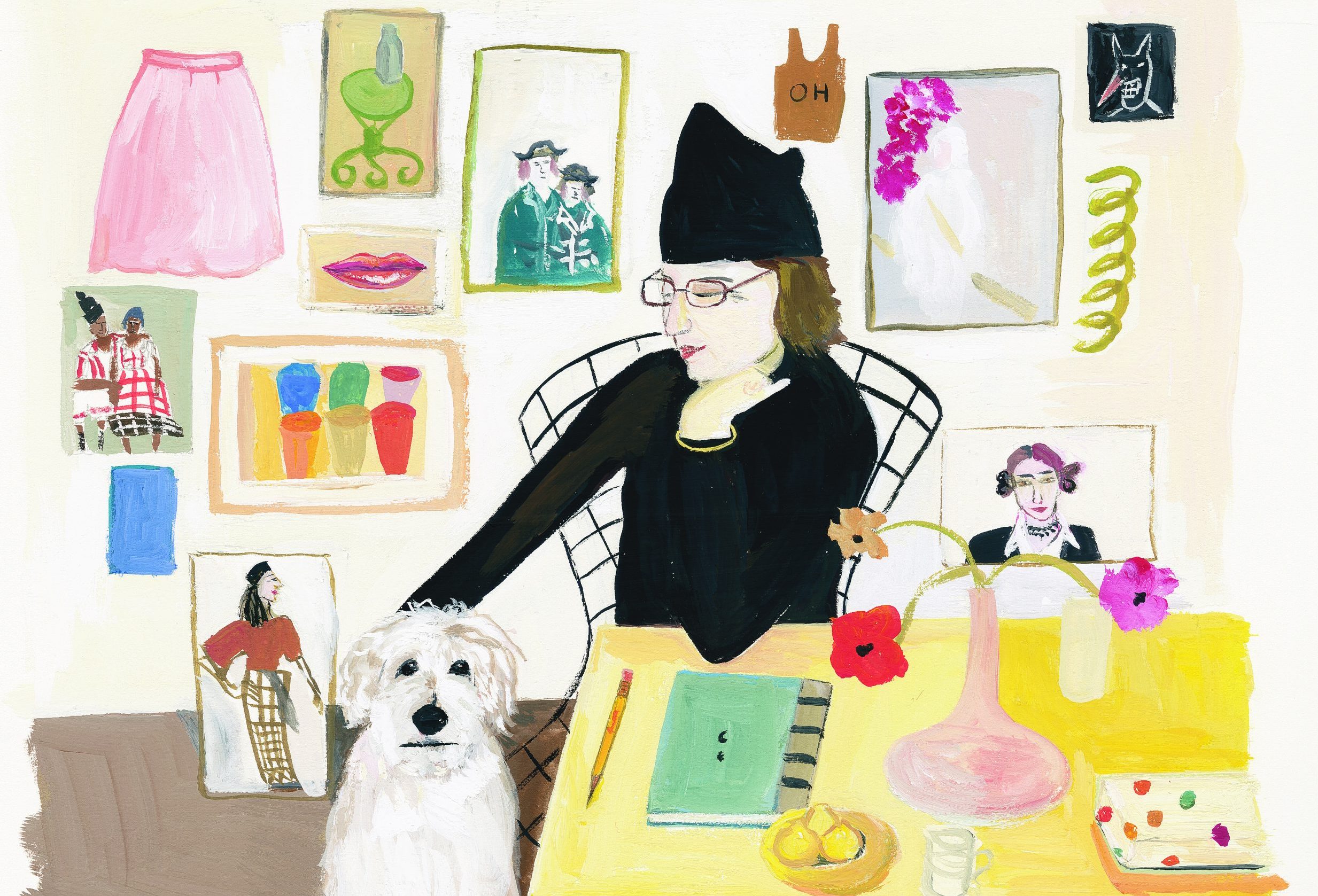
Dogs are one of the recurring subjects in Kalman’s work. Her drawings of human’s best friend perfectly reflect the character, fuzziness, and energy of the animals. Just look at their expressions and try telling me it is not how your dog looks at you when he wants to go on a walk.
Her marvelous creations are gathered in the book Beloved Dog (2017). Inside, we find famous dogs (companions of Franz Kafka and Gertrude Stein), the author’s own dog, Pete, and dogs she encountered while navigating the city.
People tend to say that dogs and their owners resemble one another. This saying becomes very relevant when we look at the portraits of Gertrude Stein and Franz Kafka. Stein is comfortably seated in a red armchair, and her wonderful white dog is majestically resting in her lap. Kalman’s sense of humor is apparent in the drawing; even though, according to the owner, her dog is “little,” Kalman depicted the animal as definitely too large to sit in one’s lap. What is more, when we look closely at the two faces, we see many similarities in their elongated shapes, long, skinny noses, and small eyes.
Women Holding Things
Another wonderful project of Kalman’s is the book Women Holding Things. As the writer describes it herself, it is:
The book and its illustrations draw attention to the importance of what we might call “unseen labor”—actions that women around the world perform multiple times per day, which are not considered work, but rather women’s duties. Kalman shows us that even though women bravely hold everything and everyone around them together, it doesn’t mean that it doesn’t personally affect them. Her work is a long-overdue and, as always, humorous appreciation of women supporting the people around them.
Kalman is a wonderful observer of everyday life. I love her image of the woman holding her hip. When I first saw it, I instantly smiled because I saw myself in this character, who takes a very typical pose for a dressed-up woman, clearly waiting for her guests to arrive for the meal she prepared. Her posture shows that she is resting, yet awaiting the invited crowd. She looks very different from the other character who is standing behind the bouquet of flowers. The woman holding her hip is almost sculptural in the beautiful interior.
Autobiography of Alice B. Toklas
One of Kalman’s most well-known projects is Gertrude Stein’s Autobiography of Alice B. Toklas. The book became an iconic work in the art history world. Stein wrote her memoir from the perspective of her partner, Alice B. Toklas. It is a fascinating story of the artistic milieu in Paris in the early 20th century. In the text, we find Picasso, Hemingway, Matisse, and Cézanne. The characters come to life with Kalman’s incredible images!
How special it is to read a book telling the tales of some of the founding members of European modernism while looking at images inspired by those very same masters. In Kalman’s illustrations, we see the clear influence of the art described in Stein’s book. However, she is not a mere follower. Her artworks are vivid, full of life and originality, because they are made with love for art.
One of my favorites from this collection is the picture depicting Stein and Toklas in their living room. The two women fit perfectly within the colorful interior. We can tell that they feel very comfortable (as they should in their own home). They are at the right place in the right composition, just as all of those portrayed by Kalman are.