

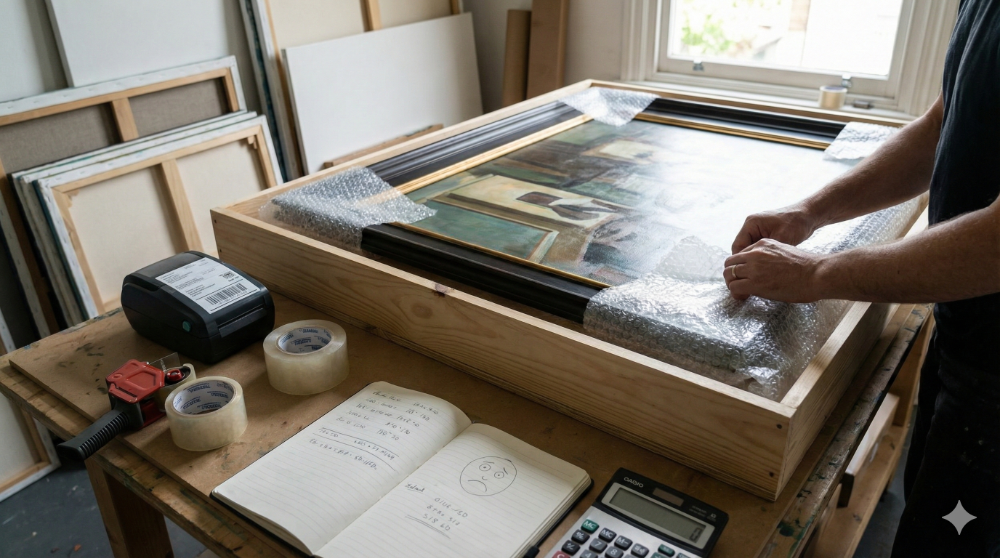
There comes a moment in every serious artist’s career where the local market simply isn’t enough. You have scoured the galleries within driving distance, and while some might be good fits, you realize they cannot provide the volume, price points, or traffic you need to sustain a full-time living.
To grow, you have to cast a wider net. You realize you need representation in art hubs that might be hundreds or even thousands of miles away.
Almost immediately, however, a new anxiety sets in. You do the math: If I have to ship my work to a gallery in another state, who pays for that? And if I pay for it, what does that do to my bottom line?
I see this mental roadblock constantly. It stops talented artists from ever reaching out to the galleries that could change the trajectory of their careers. To move past this, we need to look at three realities regarding shipping, margins, and the “paper profits” that are holding you back.
1. The Industry Standard
First, let’s address the practical question. If you are working with a gallery at a distance, who is responsible for the shipping costs?
While this can vary from venue to venue, the traditional standard in the industry is that the artist is responsible for getting the work to the gallery. You pay for the packing and the shipping to get it onto their walls.
Once the work is there, the gallery typically takes responsibility. If the piece sells, the gallery (or the collector) usually covers the cost of shipping it to the new home. If the piece doesn’t sell and needs to be returned, the gallery will often cover the return shipping to you.
There are exceptions. You may find a gallery that asks you to pay both ways. While not ideal, it is not necessarily a dealbreaker if that gallery is selling your work consistently. But generally, you must accept that outbound shipping is your cost of doing business.
2. The “Paper Profit” Trap
Here is where the psychology gets tricky. When you research successful artists in your target galleries, you see a painting listed for $4,000. You immediately do the mental math: “Okay, at a 50% commission, I would get $2,000. That’s a great margin!”
In your head, you have already spent that $2,000. You have adjusted to that higher profit margin.
But then, reality intrudes. You remember you have to pay $200 for shipping. You remember the $150 spent on framing. Suddenly, that beautiful $2,000 check starts shrinking. You look at the final number and feel a sense of despair. You feel like you are losing money you were “supposed” to make.
This is a trap. You are mourning the loss of fictitious returns.
You are worrying about the profit margin on a sale that hasn’t happened yet, regarding a career you haven’t fully built yet. It is vital to remember that the artists you are researching—the ones currently hanging on those gallery walls with the $4,000 price tags—are facing the exact same expenses. They are paying for shipping; they are paying for framing; they have studio costs. And yet, they are making it work.
3. Sales First, Optimization Second
If you focus too heavily on protecting your profit margin in the beginning, you will talk yourself out of the opportunities you need to succeed.
Your goal in the early stages is not to optimize your tax bracket or buy a Porsche. Your goal is to prove that your work has a market. You need to prove that a gallery can find buyers for your work and that you can generate sales.
Is it painful to pay a 50% commission, plus shipping, plus framing? Perhaps. You might look at the final number and realize you only netted 15% or 17% profit on that specific piece.
But realize this: 17% of a sale is infinitely better than 100% of nothing.
There is a natural order to building a business. First, you must generate activity. You need to get the work out of the studio and in front of qualified buyers, even if it costs you money to get it there. Once the sales start flowing, then you shift your focus to efficiency. That is when you start looking for economies of scale, better shipping rates, or more cost-effective framing solutions.
But you cannot optimize a vacuum. You cannot streamline a sales process that doesn’t exist yet.
Are Logistics Holding You Back? I’d love to hear from you. When you think about approaching galleries outside your local area, is it the shipping costs or the logistics that stop you, or is it something else entirely? Let me know in the comments below.