

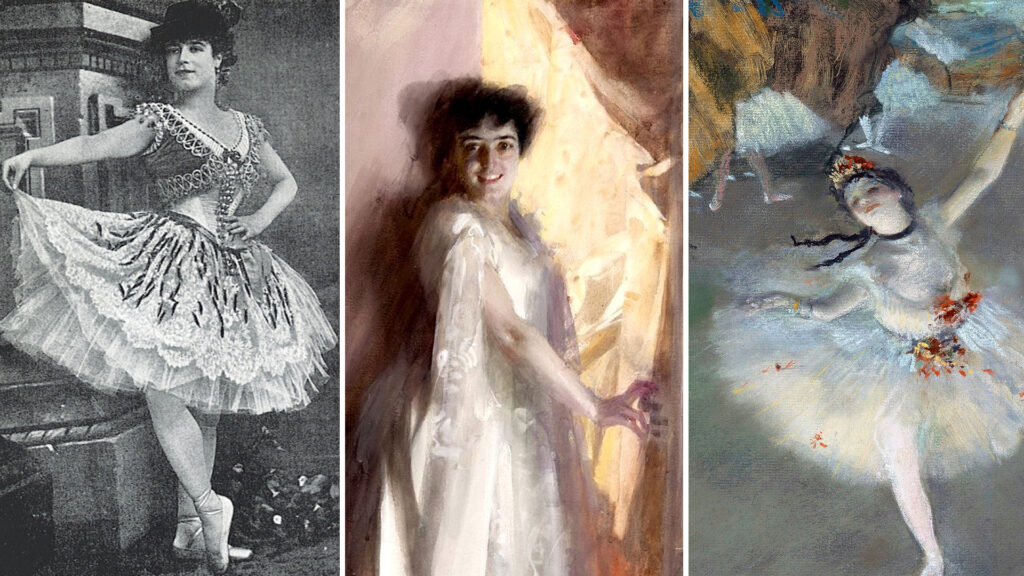
Isabel Amanda Rosa Mauri Segura (1849/1856–1923) was a Catalan ballerina and dance teacher. Although her exact date of birth is undetermined, we know she came from Reus, a city in Catalonia, Spain. Her father, Pere Mauri, performed at the Gran Teatre del Liceu in Barcelona. He taught her traditional regional dances, such as the fandango and sevillanas. Later, she trained in classical ballet under the guidance of the Belgian choreographer and dancer Henri Dervine. She showed outstanding talent from an early age, and this soon took her to the greatest stages in Europe.
This photograph by the famous Nadar (1820–1910) appeared in the weekly publication Camées Artistiques in 1881. At that time, Mauri was around 35 years old and worked as a prima ballerina at the Paris Opera.
2. One of Degas’ Dancers
In 1877, she performed at La Scala in Milan, Italy. Impressed by her talent, the French composer Charles Gounod recommended her to the Paris Opera. A year later, she was in the French capital and immediately caught the eye of Edgar Degas (1834–1917). These paintings (see one below) depict her in the middle of a performance. The asymmetry of the compositions, the off-center placement of Mauri, the empty space around her, and the bold brushstrokes are defining elements of Degas’ art, inspired by Japanese prints.
You can find more impressionist art, including Degas’ ballerinas, in one of our notebooks!
3. Mauri by Édouard Manet
Another Impressionist captivated by the Catalan dancer was Édouard Manet (1832–1883). This oil on canvas focuses on her face, leaving the rest of her body suggested with a few brushstrokes. The pink of her coat is barely perceptible against the brown-ochre background.
4. The Diva
Back in the day, Mauri’s followers, known as “mauristas,” showered her with flowers and gifts at each performance. León Comerre (1850–1916) captures this aspect of her career. She sits ready to be admired, wearing her white tutu and pink pointe shoes. Around her, three big and colorful bouquets lie on the floor. Her right hand holds a red fan, probably a reference to her Catalan and Spanish origins. This would have been particularly attractive to Comerre, as he was known for his orientalist paintings.
5. Mauri in the Eyes of Andres Zorn
The Swedish painter Anders Zorn (1860–1920) depicted her in a more relaxed and happy state, a much more personal image that revealed her personality. In these works, she is not performing or posing as a diva. She is merely smiling. She wears a white dress that appears to have an embroidered pattern. Much like Manet’s portrait, this work focuses almost exclusively on her face. Everything else is blurred, making it impossible to know for sure where she is or what surrounds her.
6. A Bust by Denys Puech
Mauri retired from the stage in 1897. By the time Denys Puech (1854–1942) made this marble bust, she may already have been working as a teacher at the Conservatory in the Opera de Paris. Nevertheless, Puech gives her a youthful look and a soft smile.
7. Words from Stephané Mallarmé
Mauri inspired more than just visual artists. After witnessing her performance in Les Deux Pigeons, the poet Stephené Mallarmé described her with the following words: “the amazing Miss [Rosita] Mauri sums up the subject by her divination mixed with troubled and pure animality.” This role, along with many others, contributed to her successful career.
Maurie died in 1923. Her resting place is in Montparnasse Cemetery, alongside other artists who shaped 19th-century Parisian culture. As dance is an ephemeral art form, only a few witnessed her artistry firsthand. Fortunately, we still have these artworks inspired by her talent.