

Banksy’s early work rewards a slower look. Before the auction-room spectacles and the images reproduced on every possible surface, there were crowded Bristol walls, cartoon animals, pencil plans, small exhibitions and objects borrowed from the street. The artist’s visual language emerged through these experiments, with traces of graffiti writing, illustration and the staging of public encounters running through the work.
StreetArtNews’ eight-part Discovering Banksy series, published in 2020–2021, brought together a particularly interesting cross-section of that material. Much of it sits outside the usual selection of famous stencils. Revisiting the archive in 2026, we have chosen 20 works, studies and installations that help explain how Banksy’s approach developed from the late 1990s into the middle of the following decade.
The sequence follows ways of working rather than pretending to be a complete chronology. Letters become characters; sketches organise a window; a painted wall hangs inside an exhibition; a line continues onto a pavement. Across these shifts, the relationship between the image and the place where it is encountered becomes increasingly important.
A note on dates: early Banksy photographs often circulate with incomplete captions. Dates below distinguish exhibition chronology from the dating supplied by our original archive. Where a date remains unresolved, it is left open. These photographs record past appearances; they do not establish a work’s present condition, location or formal authentication.
A short chronology of the early years
Bristol provides the starting point for this selection, but the early exhibition history soon extends further. Walls on Fire took place in Bristol in 1998, followed by Banksy’s Severnshed exhibition in 2000. In 2001, the Mexico visit with the Easton Cowboys and the Cargo show in London brought different audiences and settings into the picture. Hamburg’s Urban Discipline and Los Angeles’ Existencilism followed in 2002. By Turf War in London in July 2003, the ambition of the exhibition setting itself was unmistakable. The works below trace several strands of that development, alongside archive material whose exact dating remains open.
For newer work and major projects, visit our Banksy artist guide.
Bristol: letters, cartoons and a hand on the wall
1. Slick: a cartoon with a fuse
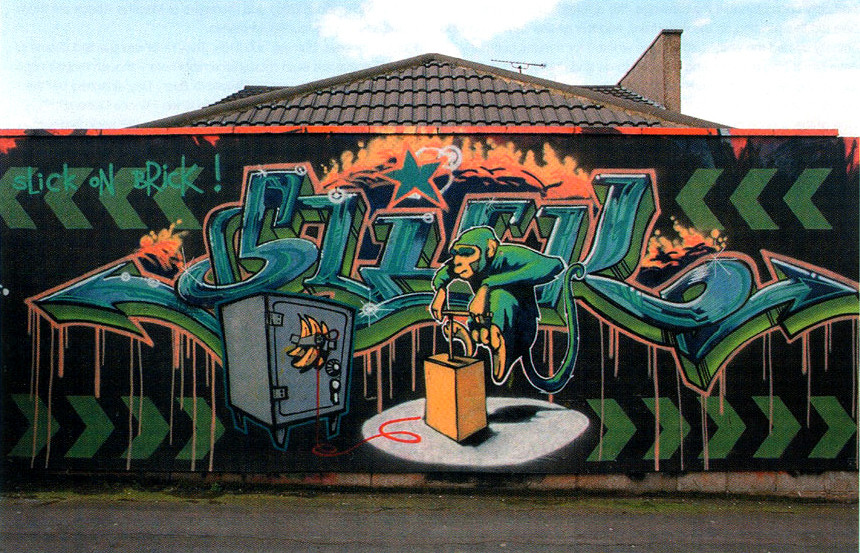
The first thing that hits you is the colour. Blue-green letters sit inside orange outlines and a field of directional arrows; beneath them, a monkey works a detonator beside a safe. The picture has the density of a graffiti production, with lettering, character and action competing for attention. The safe also gives the joke a physical centre: something is about to happen. Here are several elements that will recur in Banksy’s work—animal stand-ins, an attack on property, a comic pause before disruption—already sharing a wall. Look closely at the lettering, too. Its rhythm belongs to an artist working within graffiti’s own visual conversation.
2. Slammin: the name as an image
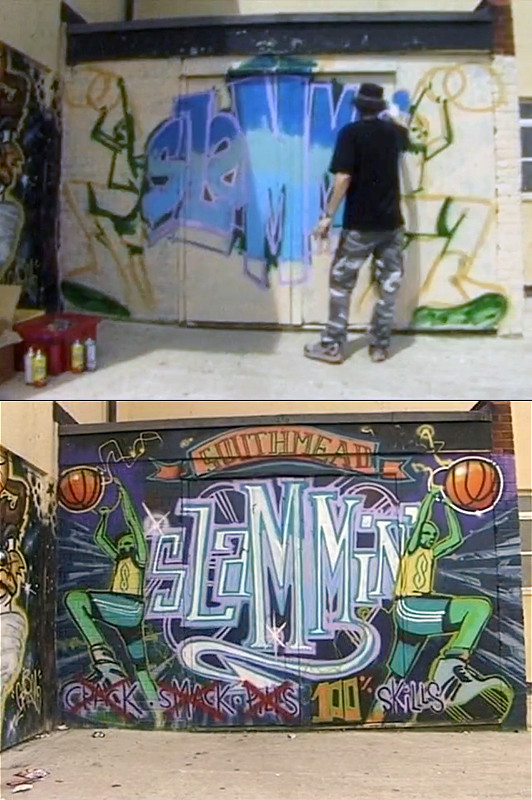
These two photographs hold onto an aspect of early Banksy that disappears in many retrospective accounts: the pleasure of a name built into a composition. Curved forms, outlines and overlapping colour make the letters behave like objects. Even when the wording is difficult to untangle, the piece announces its maker through scale and graphic confidence. For anyone arriving through Banksy’s later stencils, this is useful ground to cover. His familiarity with walls, spray paint and the culture of writing preceded the widely recognisable figure-and-punchline format. The archive lets us see that vocabulary while it is still taking shape.
3. Quakattack: cartoon energy on brick
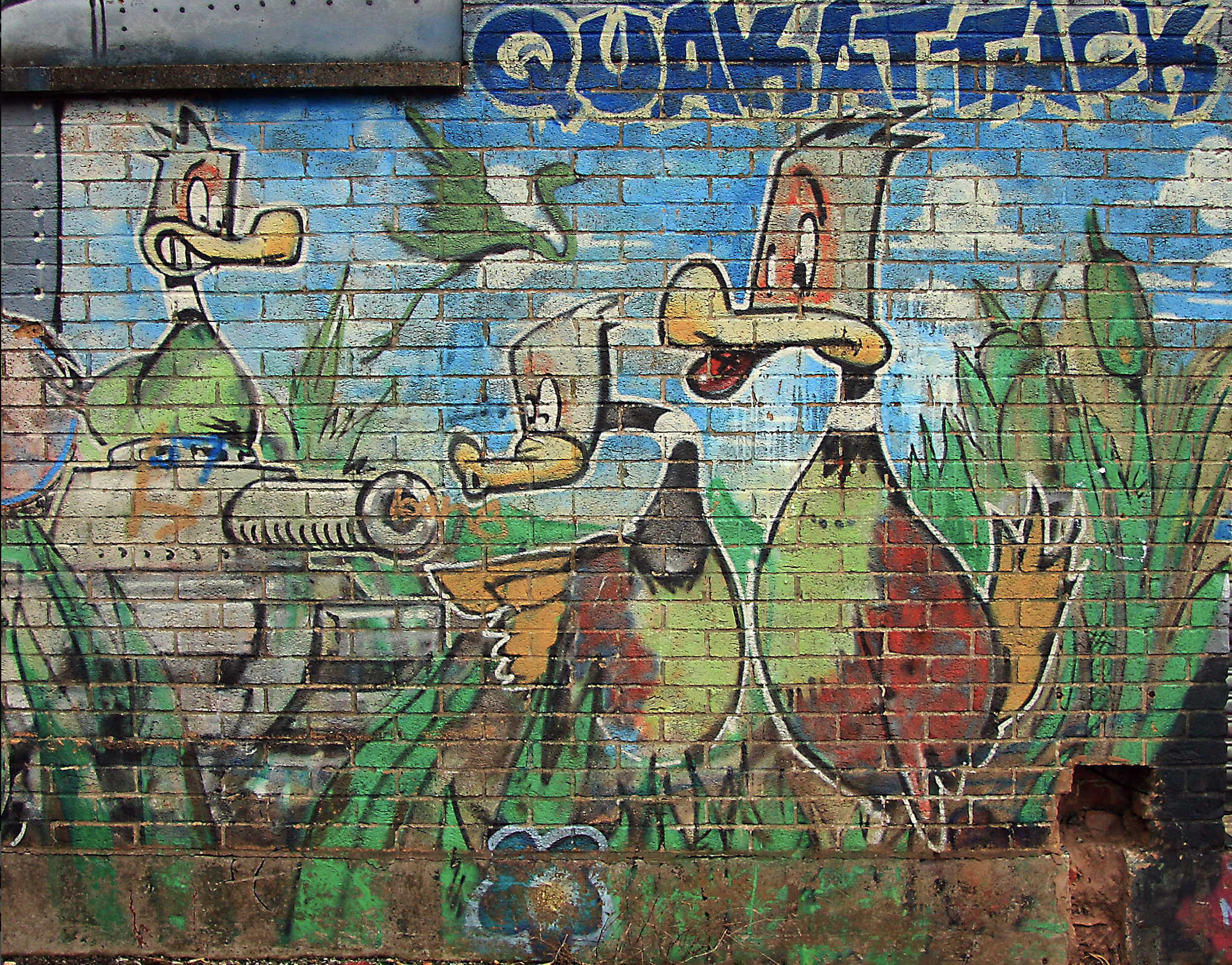
The ducks in Quakattack carry the exaggerated expressions and busy outlines of cartoon drawing. Brick joints cut through their bodies, a reminder that these characters were designed to occupy a real surface. Their energy comes from the whole painted field: colour, vegetation, lettering and poses. It would be easy to read the animals only as prototypes for later symbols. They deserve attention on their own terms. The wall records a looser, more crowded kind of image-making, one that asks the viewer to spend time with the picture rather than absorb a single message while walking past.
4. The Carlton Arms: painting around the room
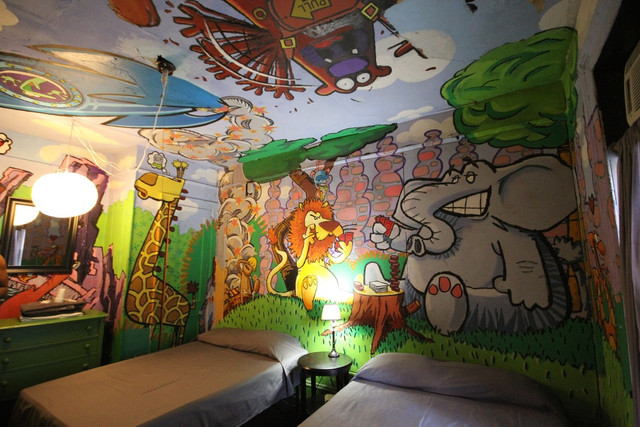
In the Carlton Arms photograph, painting extends across the walls and ceiling, surrounding the furniture and light fittings. The room becomes an environment. Characters and colour occupy corners that a framed picture would leave alone, and the domestic setting makes the work feel intimate. This is an early example in the archive of Banksy thinking beyond a flat rectangle. A viewer’s position inside the space matters. The photograph also carries a practical limitation: it documents a particular room at a particular moment. It should not be treated as a promise that a visitor today will encounter the same arrangement.
Keep exploring: View the full image selection in Discovering Banksy — Part 5.
Paintings and prints: ideas finding different surfaces
5. Easton on canvas: a crowded street
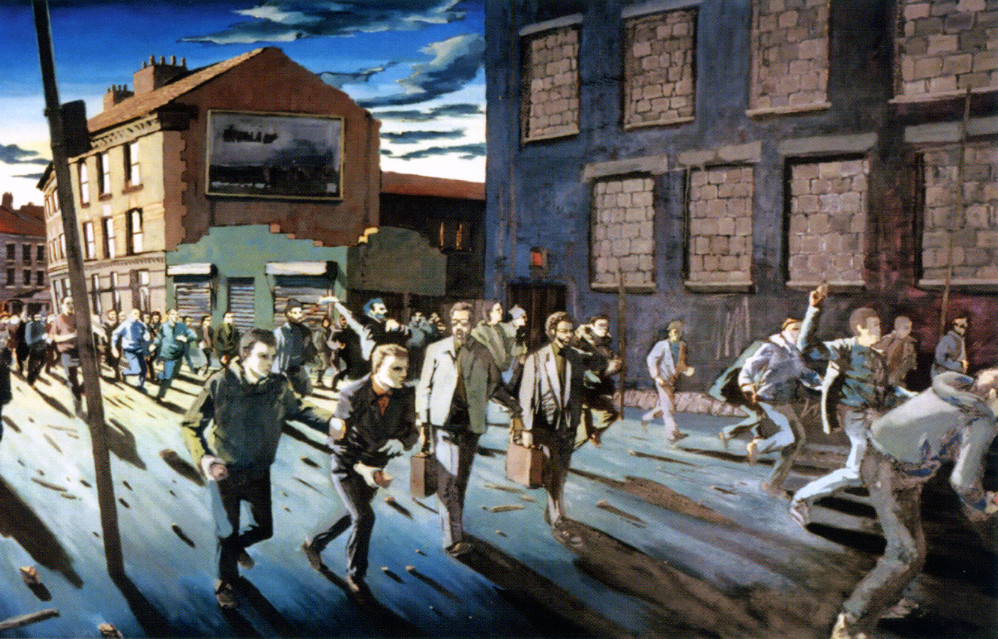
This canvas is worth pausing over because it complicates the familiar account of Banksy as an artist of isolated silhouettes. Buildings, pavement, figures and a dramatic sky form a crowded street scene. The eye moves across the picture, picking up actions and details, instead of settling on one emblem. Its interest lies in that accumulation. Streets provide a setting for human behaviour as well as a surface to paint on. Seen beside the Bristol walls, the canvas suggests an artist testing how much narrative a picture can hold, and how the everyday city can be made slightly strange.
6. Police Car: authority in a few marks
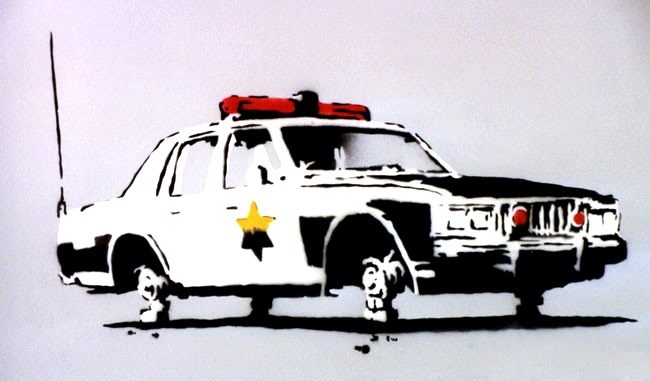
The car is reduced to a compact collection of signs: dark bodywork, a pale outline, red roof lights and a yellow star. The few coloured details do a surprising amount of work. They identify the vehicle and keep it from becoming an anonymous shape. Police imagery appears repeatedly across this selection, but the treatment changes between works. Here, the institutional presence is contained in an object rather than a uniformed body. The archive supplies no secure date for this print, so its role in this guide is visual: it shows the economy of an image made legible through a handful of carefully retained details.
Keep exploring: View the full image selection in Discovering Banksy — Part 2.
Sketches: where the image is still being worked out
7. Cat and dog: the lettering becomes a character
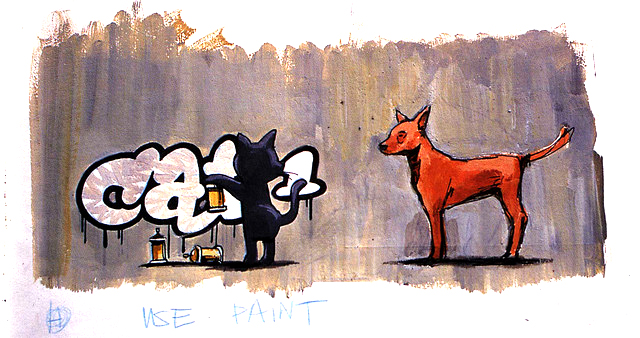
The cat sits inside the letter forms while an orange dog faces it from the other side of the painted strip. The relationship between word and animal makes this study particularly revealing. Writing can become a body, and a character can become part of the writing. The surrounding paper and faint working marks give the image a different tempo from the finished walls. You can look at the organisation of the idea without the distraction of a location. It is a small example of the overlap between graffiti lettering, illustration and the animal humour that runs through the archive.
8. Tom Tom: a sketch for an encounter
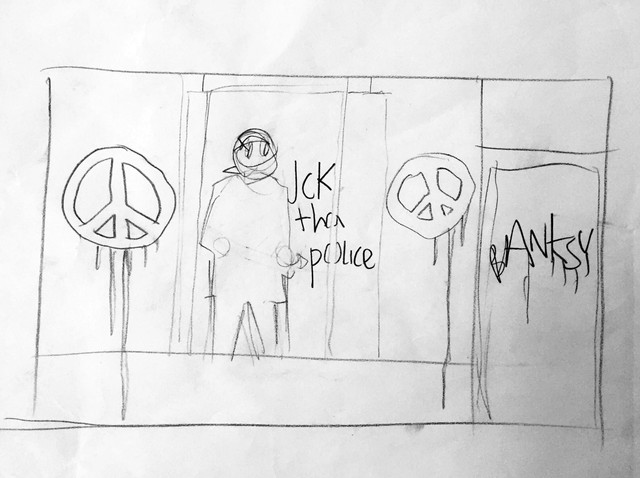
A rectangle, two peace symbols, a central figure and several rough words: this drawing reads as a plan for what a passer-by would see. The window is part of the idea. Placement gives the image a frame and turns the gallery frontage into a street-facing statement. The original article records conflicting dates for this sheet; a tidy chronology would conceal that uncertainty. What remains clear is the working method visible in the drawing. The exhibition is being considered as an arrangement of signs and surfaces, with the experience of encountering it built into the composition.
9. The Scream between two officers
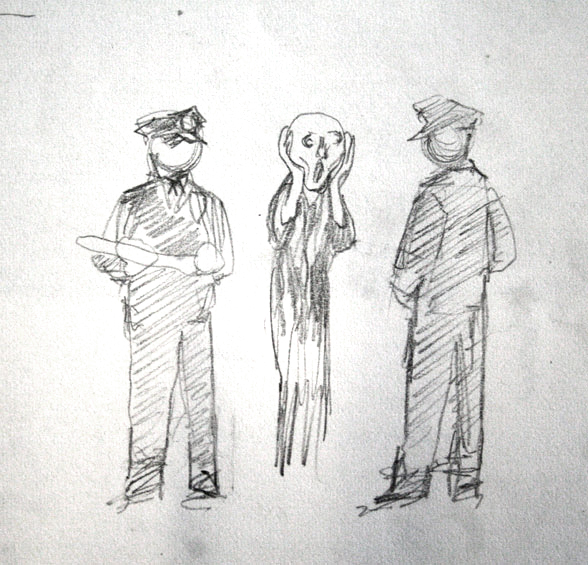
Two uniformed officers stand on either side of a figure borrowed from Munch’s The Scream. The pencil drawing allows the combination to remain spare: three bodies, recognisable poses, an uneasy relationship. An image associated with private anguish has been placed beside public authority. That pairing opens several readings without needing an explanatory slogan. The sheet is especially useful for seeing how Banksy assembles existing visual languages. Fine-art reference and the street-level presence of policing meet in one small scene. The humour is uncomfortable, and the lack of a polished finish keeps attention on the idea itself.
Keep exploring: View the full image selection in Discovering Banksy — Part 3.
Early exhibitions: building a world around the work
10. Cargo, London, 2001
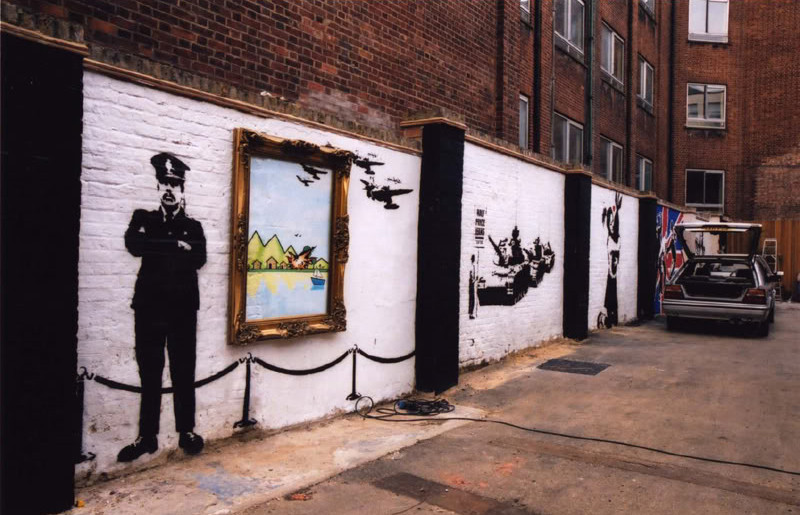
The Cargo photograph puts a uniformed figure, a framed painting, ropes and further images along an exterior wall. It borrows the apparatus of display and brings it into a yard. The frame encourages a gallery-style reading; the surrounding brick and parked vehicle immediately widen that reading back into the city. Cargo belongs to the crucial early London period, when the relationship between street work and organised exhibition was becoming increasingly inventive. The photograph rewards looking at the whole setting. A single crop would preserve the central picture while losing much of the staging that makes the encounter interesting.
11. Urban Discipline, Hamburg, 2002
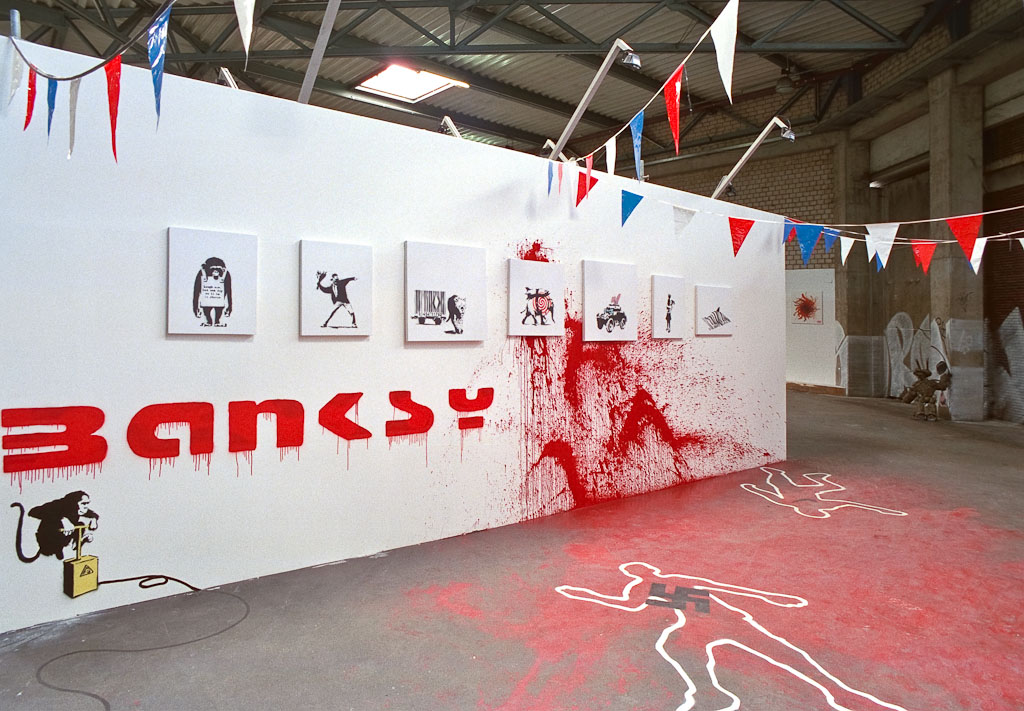
At Urban Discipline, the display spills onto the floor. Bunting hangs above small works, large lettering occupies the wall, and red paint with a white body outline pushes the presentation into the viewer’s space. The photograph places Banksy within an international graffiti exhibition, a useful reminder of the scene around these early experiments. It also shows how much meaning can come from the arrangement between objects. Paint, lettering and exhibition decoration create an atmosphere before any individual work is examined. That attention to the surroundings will become a powerful part of his later large-scale projects.
12. Existencilism, Los Angeles, 2002
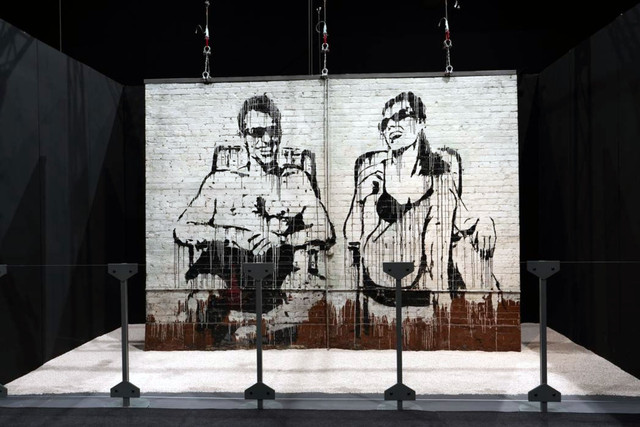
A section of wall hangs from chains, carrying two figures across its weathered surface. Three microphone stands sit in front, adding the suggestion of an address or public performance. The work asks us to consider the wall itself as an object. Material usually taken for granted in street art becomes central to the exhibition. The image is identified in the archive as the Stop Esso wall from Existencilism, Banksy’s 2002 Los Angeles show. Seen here, it demonstrates an early appetite for difficult, physical staging: the support has weight, texture and a presence that a reproduction can only partially convey.
Keep exploring: View the full image selection in Discovering Banksy — Part 6.
Beyond Britain: carrying the work into another context
13. Mexico, 2001: a small image in a larger place
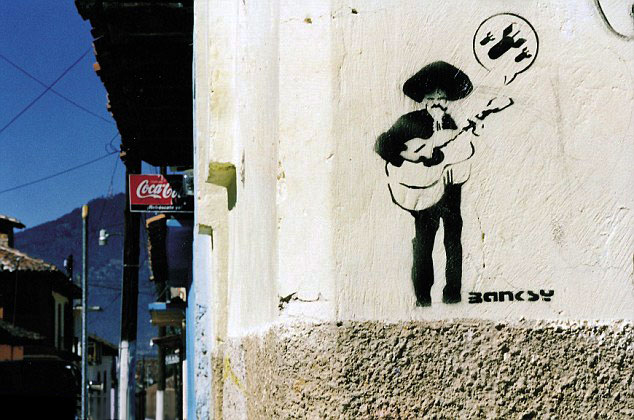
The small black figure occupies a pale wall, with an outlined balloon-like form above and nearby signage visible at the edge of the photograph. Its scale matters. The stencil shares the street with existing architecture and commercial images rather than covering them. Banksy’s 2001 visit to Mexico with the Easton Cowboys places this material within a wider history of travel, football and local encounters. Some captions in the old series conflict over the year; this selection uses the photograph labelled 2001. The location should remain part of the reading, even when the motif can travel easily as a cropped image.
14. Berlin, 2003: Every Picture Tells a Lie
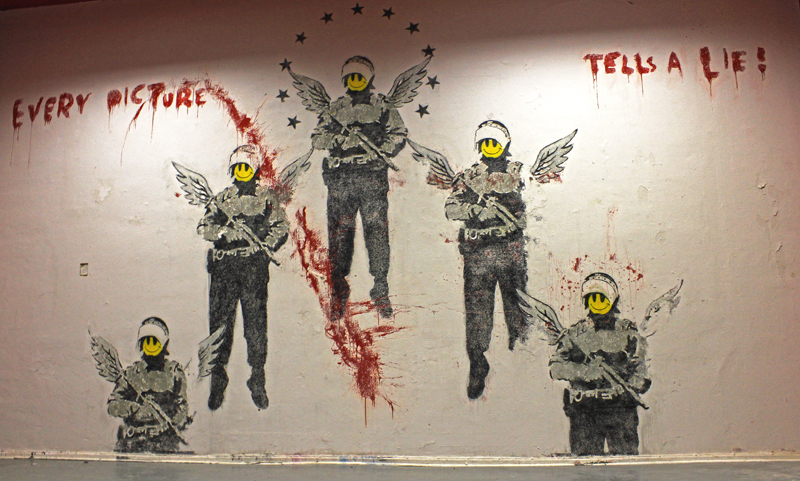
Armed figures float across the wall with wings and bright yellow faces. Red lettering sits above them, while a downward streak of paint unsettles the apparent lightness of the arrangement. The work’s title turns attention toward the reliability of pictures themselves. How much does a familiar face soften what a figure is carrying? What happens when the visual language of innocence is attached to violence? This is one of the richer early exhibition images in the selection. Its force comes from the combination of incompatible signals, and from the space between what the image looks like and what it depicts.
Keep exploring: View the full image selection in Discovering Banksy — Part 4.
London: the stencil meets the everyday street
15. A royal guard steps out of character
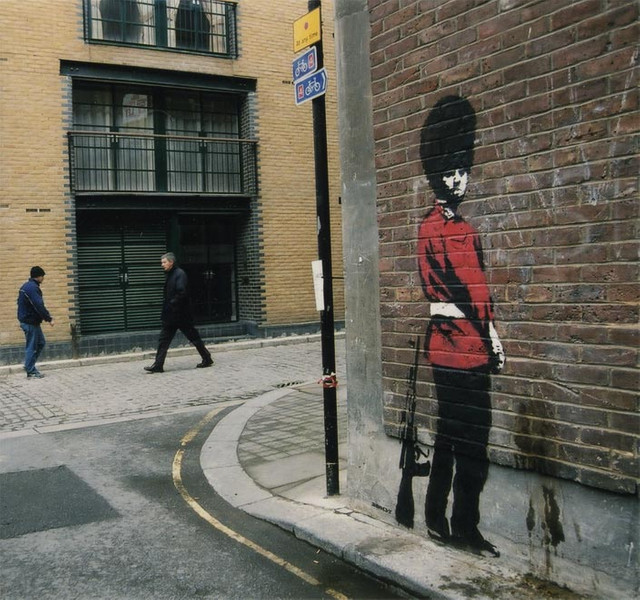
The bearskin hat and red tunic make the guard recognisable almost instantly. The action described by the work’s archive title undermines the ceremonial discipline attached to that uniform. Its setting on a corner is important: the figure seems to share the pavement with ordinary passers-by. Banksy repeatedly uses a familiar public role as a shortcut, then introduces an action that changes its meaning. The wall and the figure’s human scale help the joke land. Looking at the uncropped street photograph restores that relationship between the painted character and the people who might encounter it.
16. Girl Hugging TV, Covent Garden
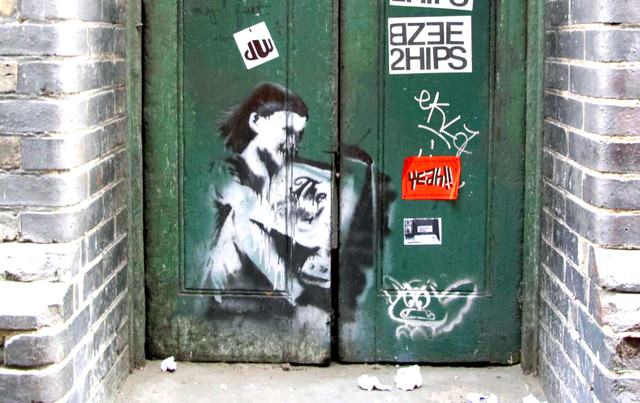
The embrace is tender, but the object receiving it is a television. That simple substitution gives the image its tension. Painted across an existing doorway, the child sits among stickers, marks and worn paint rather than on an untouched backdrop. The surface makes the image feel lodged in everyday urban life. It also prevents an overly clean reading of the photograph: other people have left their own signs in the same space. The piece is a useful example of Banksy’s ability to build an emotionally direct image around a small change in an ordinary gesture.
17. Snorting Copper, Shoreditch
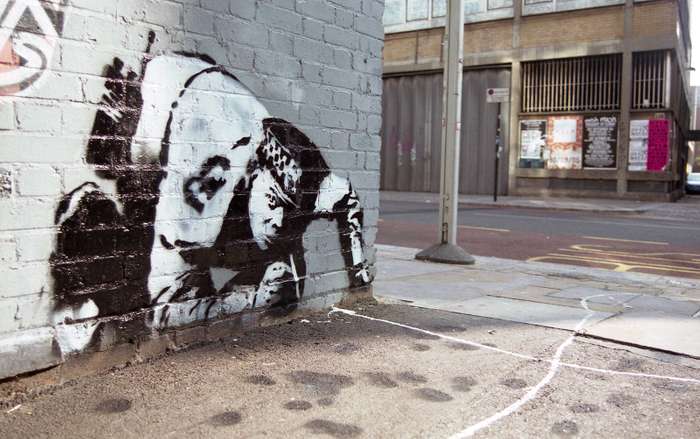
The white line carries the image off the wall and across the pavement. That extension is the detail to notice. A bent police figure becomes part of a larger physical joke, one that uses the viewer’s route through the street. The uniform supplies authority; the action supplies its undoing. This photograph documents an earlier state of a much-discussed work, and it retains the surrounding road, pole and buildings. Those details explain why the image works in place. Reproducing only the officer would remove the line’s journey and reduce an intervention in space to a freestanding graphic.
Keep exploring: View the full image selection in Discovering Banksy — Part 8.
Vehicles and street furniture: widening the canvas
18. The removal van: an image that can move
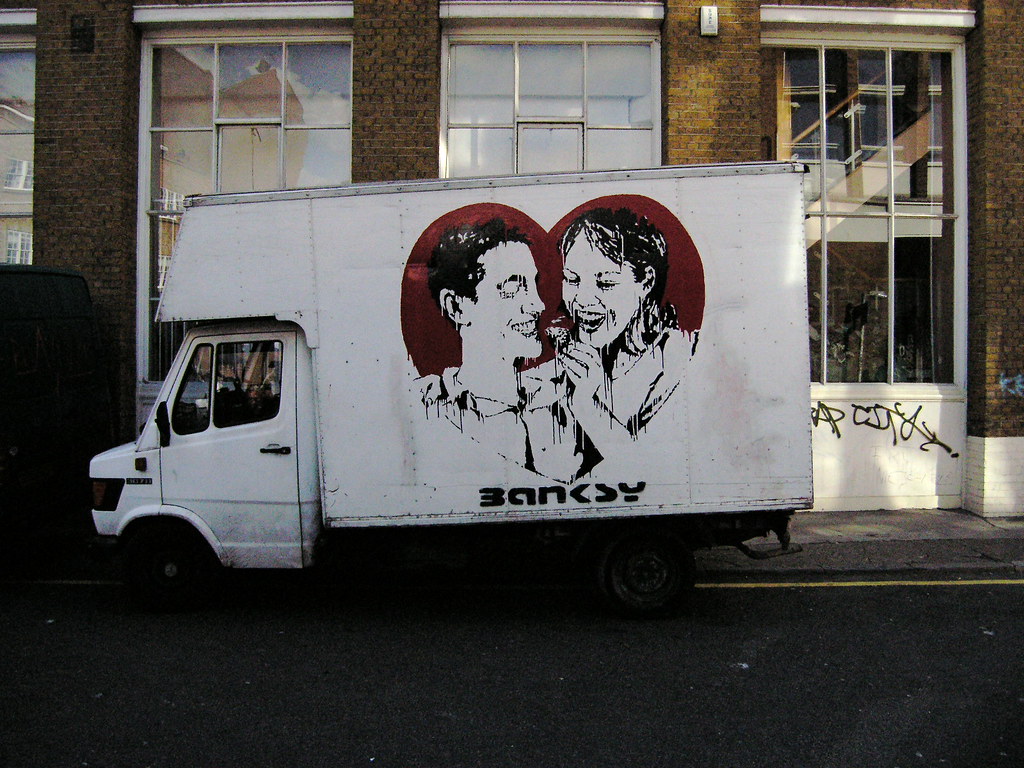
Two smiling figures appear inside a red heart on the side of a white van. The scale gives the image room to dominate the vehicle, while windows, wheels and the cab remain visible around it. A van changes the conditions of street art: the surface can move, and the same picture can arrive in a different neighbourhood. Even in a still photograph, that possibility affects the reading. This example connects the archive’s street imagery to its installations. Banksy’s choice of support is part of the work, with the vehicle lending an ordinary, functional object to the visual interruption.
19. Traffic cones: drawing with existing objects
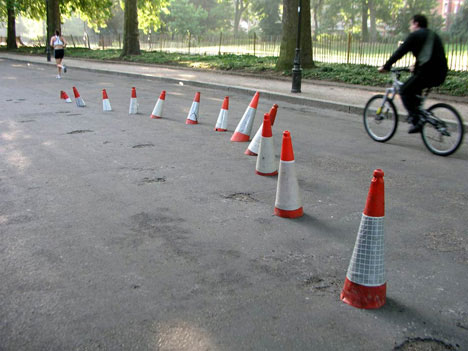
A row of orange cones occupies the road as a cyclist passes. Their arrangement turns an object normally used to regulate movement into something to look at. The intervention is modest in material and broad in effect: it changes the rhythm of an otherwise ordinary stretch of street. The archive does not provide a firm date or location, and this photograph should be read with that limitation. It remains valuable within the selection because it broadens the idea of what an artwork can be made from. Street furniture carries its own familiar meaning before an artist touches it.
Keep exploring: View the full image selection in Discovering Banksy — Part 1.
Words on walls: leaving the sentence unfinished
20. No More Heroes, Los Angeles
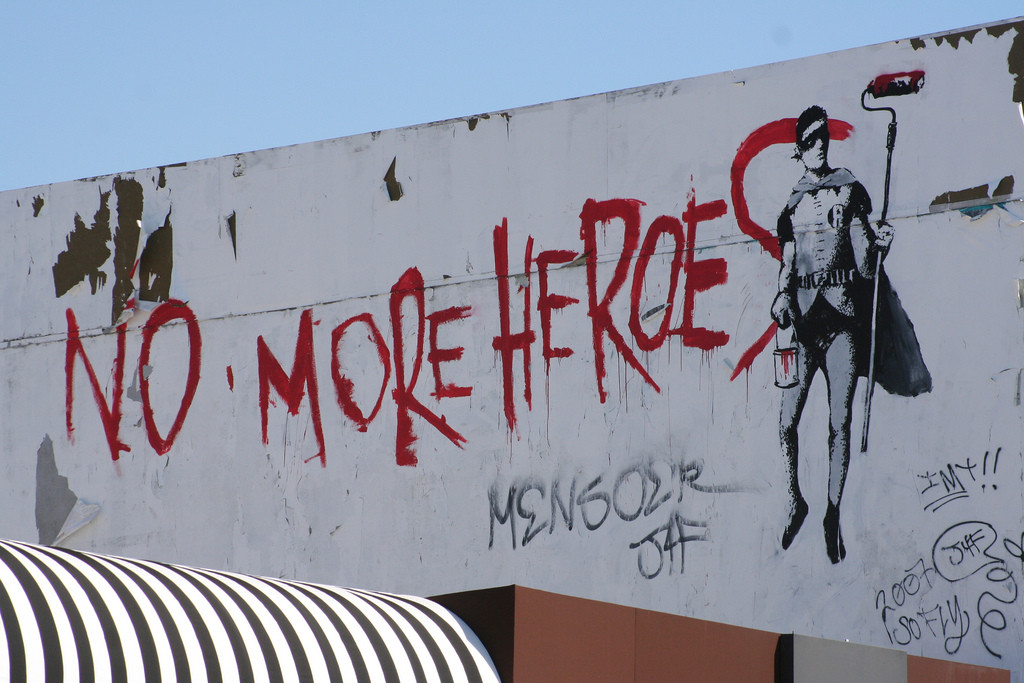
Red words run across a battered wall beside Robin, the superhero sidekick. The pairing raises a question about who gets to be heroic, and what remains when that role loses its certainty. The lettering has a rough urgency that keeps the work close to a street declaration. Yet the borrowed character complicates the declaration: the image gives the viewer someone specific to consider. It is an apt place to finish this selection. Banksy’s early archive repeatedly shows words and pictures setting each other into motion, leaving enough space for a viewer to carry the thought further.
Keep exploring: View the full image selection in Discovering Banksy — Part 7.
What the early archive tells us
Seen together, these images make the development of Banksy’s work feel less inevitable and more interesting. The freehand walls have room for detail and visual noise. The stencil images concentrate attention. The sketches reveal choices still being made, while the installations make use of the weight and purpose of ordinary things.
One consistent feature is the artist’s attention to recognition. A uniform, a cartoon animal, a television, a traffic cone or a gallery frame arrives with meanings already attached. A small change in action or setting can disturb those meanings. The early material lets us watch that process across different surfaces, before later projects enlarged its scale.
It also brings the surroundings back into view. Pavements, doorways, brickwork, yards and exhibition floors influence what the pictures do. Those details can disappear when an image is endlessly reproduced. Keeping them in the photograph preserves something essential about an artist whose work depends so often on the circumstances of an encounter.
A few questions about early Banksy
Did Banksy paint freehand before using stencils?
The Bristol works in this selection show extensive freehand lettering and cartoon painting. Stencils later became central to his public work, but the archive is a useful reminder of the wider painting practice behind that familiar visual language.
Can these photographs be used to authenticate a Banksy?
An archive photograph provides context; it is not a certificate. Pest Control is the official body responsible for authenticating eligible Banksy works. It states that it does not issue certificates for illegally created street works.
Are the photographed works still there?
This guide does not establish current access or survival. Some images document exhibitions, temporary interventions or surfaces that can change. Anyone planning a visit should check a current source for the specific work rather than use an old caption as a location guide.
Continue through Discovering Banksy
The original series remains available in full. Each part contains more images and material beyond this selection:
- Part 1 — Installations, vehicles and street interventions
- Part 2 — Paintings and prints
- Part 3 — Sketches and exhibition ideas
- Part 4 — Work beyond Britain
- Part 5 — Early freehand walls
- Part 6 — Exhibitions and festivals
- Part 7 — Words and slogans
- Part 8 — London stencils
Follow ongoing coverage in our Banksy artist guide, including recent work and essential projects.
Archive and research: this guide revisits StreetArtNews’ Discovering Banksy series. Exhibition chronology was cross-checked against Ulrich Blanché’s edited volume Banksy: The Early Shows, 1997–2005 (2023). The images and original archive captions are presented as historical documentation, with unresolved dates identified above.