

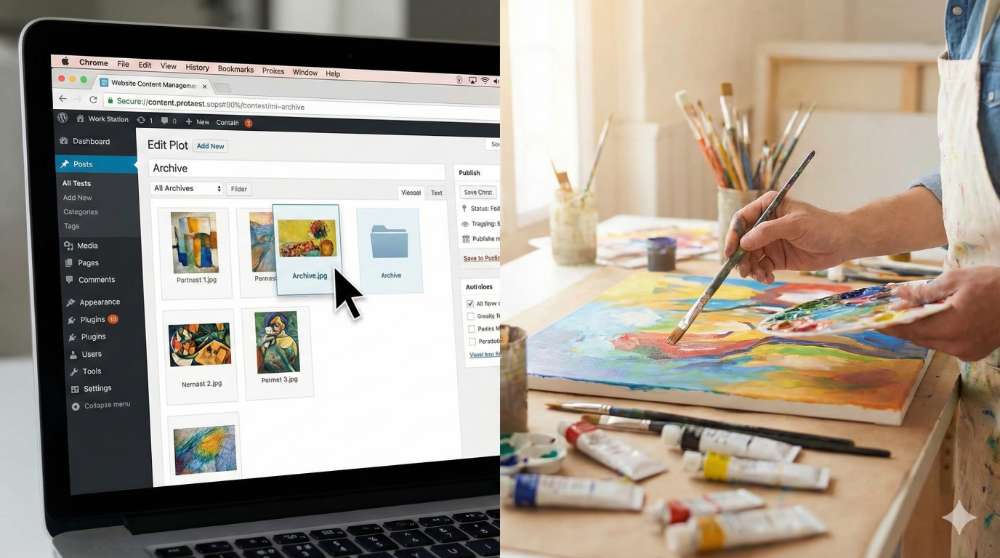
We have all felt the itch. You look at your website, and you see the same paintings or sculptures that have been there for six months. You start to worry. You think, “If a collector comes back to my site and sees the same work, they’re going to get bored. They’ll think nothing is happening. I need to shake things up.”
So, you start the “shell game.” You archive older pieces. You rotate works from the bottom of the page to the top. You take things offline with the plan to reintroduce them later as “fresh” inventory.
It feels productive. You are curating. You are managing the visitor experience.
But after decades in the art business, I can tell you that this is one of the most common forms of “productive procrastination” artists engage in. It is busy work that rarely, if ever, leads to a sale.
Here is why you need to stop curating your own history and start focusing on what actually matters.
1. The Gallery Experiment
Years ago, I became convinced that I could dramatically increase sales in my gallery by keeping the display constantly in flux. My theory was simple: if I moved the art around frequently, repeat visitors would always see something “new,” and that freshness would trigger urgency and purchases.
I committed to a grueling schedule. I decided to rehang a third to a half of the gallery every single week. It was a marathon of moving walls, patching nail holes, printing new labels, and adjusting lighting.
The result? I burned out. I dreaded walking into the gallery in the morning.
But the most important result was the financial one: sales remained flat.
Despite the massive effort, the constant rotation made zero perceptible difference to our bottom line. I eventually slowed the rotation to once a month, then once a quarter. The sales data never wavered. The “freshness” of the display was irrelevant to the buying decision.
2. The Amnesia of the Viewer
Why didn’t it work? Because we overestimate the attention span of our audience.
As the artist, you know every inch of your inventory. You know exactly how long a piece has been sitting on your homepage. You are hyper-aware of your own stagnation.
The buyer is not.
Human beings are bombarded with thousands of images every day. Their visual memory for a specific website they visited three weeks ago is incredibly porous.
I see this constantly in the physical gallery. A couple will walk in who visits us regularly. They will stop in front of a painting that has been hanging in the exact same spot for three months. They will gasp and say, “I love this new piece! When did you get this?”
To them, it is new. It is new because this is the moment it finally captured their attention.
If this happens in a physical space where people linger, imagine how much more true it is online, where the average visit lasts mere seconds. Your visitors are not memorizing your inventory. They are getting a general impression.
3. Context Creates Freshness
You don’t need to artificially hide work to make your site feel alive. You just need to keep creating.
When you add a new piece to your website, it naturally changes the context of the older work. A painting from 2022 looks different when it is sitting next to a painting from 2024. The colors interact differently; the themes shift.
If you simply add your new work to the top of the page, you have solved the “freshness” problem. The first thing the visitor sees is new. The older work is still there, waiting for the right buyer to find it.
4. The Opportunity Cost
The biggest reason to stop the “rotation game” is opportunity cost. Every hour you spend rearranging JPEGs on your website is an hour you are not spending on marketing.
We often focus on our website’s layout because it feels controllable. It is safe. Marketing—reaching out to strangers, posting on social media, emailing newsletters—is scary and unpredictable.
But your problem is rarely that a visitor is bored by your inventory. Your problem is usually that you don’t have enough visitors.
If you have 50 pieces of art on your site, that is 50 lottery tickets waiting to be cashed. If you hide 20 of them in an “archive” to make the site look tidier, you have just thrown away 20 chances to make a sale.
Stop Hiding Your Work
Unless a piece no longer represents your current skill level or style—unless it is actively embarrassing to you—leave it up.
Let the volume of work show your dedication. Let the older pieces find their owners on their own timeline. Stop worrying about the “freshness” of the arrangement and start worrying about the number of people seeing it.
How often do you update? I’m curious—do you have a schedule for updating your website? Do you cycle work in and out, or do you leave everything up until it sells? Share your strategy in the comments below.