

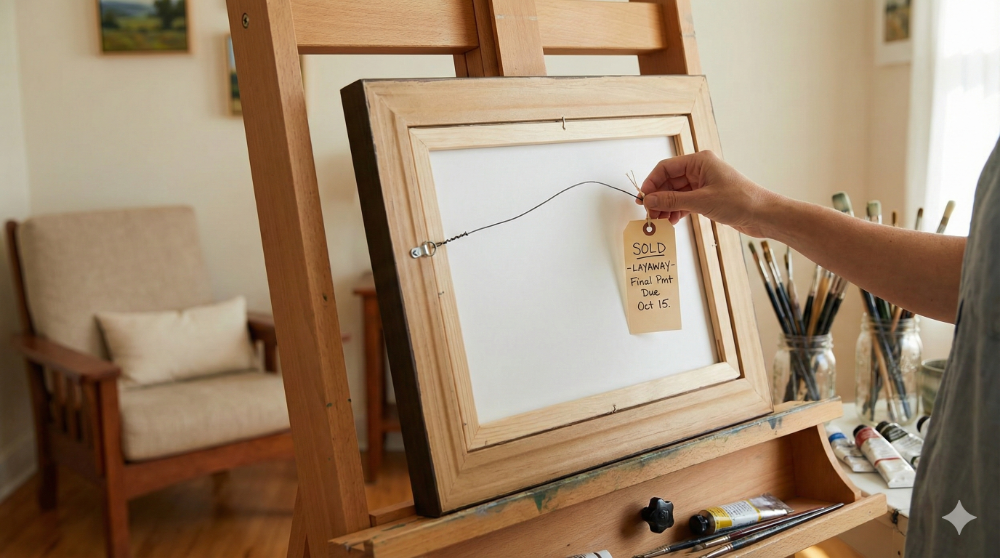
It is a scenario every artist faces eventually: A potential buyer stands in front of your work. You can see the connection happening; they are emotionally invested, they are asking the right questions, and they clearly love the piece. But then comes the hesitation. Finally, they ask, “Do you offer a layaway plan?”
For many artists, the immediate internal reaction is resistance. We want the sale closed, the money in the bank, and the artwork shipped. A payment plan feels complicated. It feels like administrative bloat. It feels risky.
However, if you dismiss layaway out of hand, you might be walking away from one of the most passionate segments of your audience.
The Profile of the Layaway Buyer
To understand the value of layaway, you have to understand who asks for it.
In my experience, the client requesting a payment plan isn’t usually a “tire kicker.” They are often younger collectors or people on a fixed budget who are deeply passionate about art. They are willing to stretch their finances and sacrifice in other areas of their lives to own your work.
These are not casual purchases. When someone commits to paying off a piece of art over three or six months, they are demonstrating a serious commitment to your work. These are exactly the kinds of clients you want to cultivate. They may not have the disposable income of a high-net-worth collector right now, but they have the enthusiasm—and often, they grow into your best collectors over time.
The “Risks” Are Lower Than You Think
The biggest fear regarding layaway is usually financial risk. What if they stop paying? What if they disappear?
The reality is that layaway is one of the safest transactions you can make because of one simple rule: The artwork does not leave your possession until it is paid in full.
Unlike selling on credit (where the client takes the art and bills you later), layaway keeps you in control. If a client pays for two months and then ghosts you, you still have the artwork. You can refund their payments (minus a restocking fee, if stated in your terms) and put the art back on the market. In all my years of selling art, this has happened so rarely it’s barely a statistical blip.
Keep It Simple
Another barrier is the paperwork. Artists often feel they need a complex, attorney-drafted contract to offer a payment plan.
While it is always good to have things in writing, you don’t need to overcomplicate it. In my gallery, we handle layaways with a surprising amount of informality—sometimes even “by the seat of our pants.”
We simply ask the client what works for them. “Would three months work? Six months?” Once we agree on the term, we take their credit card information and set up a recurring charge, or simply invoice them monthly. We agree that the piece ships when the final payment clears.
You can find templates online if you want to be formal, but a simple email exchange outlining the dates of payment and the final shipping date is often enough to establish the agreement.
A Tool, Not a Strategy
While I am an advocate for accepting layaway, I don’t necessarily recommend making it the headline of your sales strategy.
I prefer to keep my business life simple. I want clients to buy outright whenever possible. Therefore, I don’t splash “Payment Plans Available!” all over the website or the gallery walls. If you advertise it too heavily, you might encourage people who could have paid in full to drag out the payment instead.
Instead, keep layaway in your back pocket. Treat it as a closing tool. When a client is teetering on the edge—when they love the piece but just can’t make the math work today—that is the moment to gently offer, “If it helps, I’d be happy to split this into a few monthly payments for you.”
It’s a bridge that allows passion to overcome budget, turning a “no” into a “yes.”
Do You Offer Layaway?
Have you ever utilized a payment plan to close a sale? Was it a smooth process or did you run into administrative headaches? Share your experiences with layaway in the comments below.