


If we break down the pillars of a successful art business, we usually focus on the creative side: mastering a medium, developing a style, and producing the work. Or, we focus on the sales side: building relationships with collectors, hanging a show, and closing the deal.
But there is another pillar—one that is significantly less glamorous, yet absolutely critical to your survival as a professional artist: Logistics. Specifically, the ability to move artwork from Point A to Point B without destroying your profit margin.
All the effort put into creating and selling art is rendered moot if you cannot physically get the work to the client efficiently. Too often, artists view shipping as an afterthought, only to be hit with a “shipping nightmare” that eats up hundreds of dollars of profit.
We have all felt that sinking feeling. You sell a medium-sized painting—perhaps a 24″ x 30″ canvas. You take it to a local retail shipping store, ask them to pack and ship it, and are handed a bill for $400. If that painting sold for $1,200, you have just lost a third of your revenue to a cardboard box and a truck.
It doesn’t have to be this way. With the right context and a few strategic adjustments, you can cut those costs dramatically.
A Tale of Three Quotes
To understand how widely shipping costs can vary based on who you ask and how you ask, let’s look at a recent real-world example from the gallery.
We recently sold a life-size bronze sculpture. This was a massive piece—roughly 52 inches tall and weighing in at 475 pounds. We needed to move this quarter-ton of metal from Arizona to a client in New Jersey.
Because we hadn’t shipped a piece of this specific weight and dimension in a while, we decided to shop around. We solicited quotes from three different logistics companies. The difference in pricing illustrates exactly why you must never accept the first number you hear.
-
Quote #1: $11,265. This company proposed sending a team to build a custom wooden crate and potentially hiring a crane to lift the piece into the crate. Their approach was maximum liability protection, but it was complete overkill.
-
Quote #2: $1,950. This quote came from a specialized mover. It was significantly better, but they still insisted on a crating fee that drove the price up.
-
Quote #3: $1,291. This quote came from a shipper we had worked with previously. They understood that bronze is durable. It didn’t need a wooden fortress; it needed a “blanket wrap” service. They strapped it to a pallet, wrapped it in moving blankets, and put it on the truck.
The spread between the highest and lowest quote was nearly $10,000.
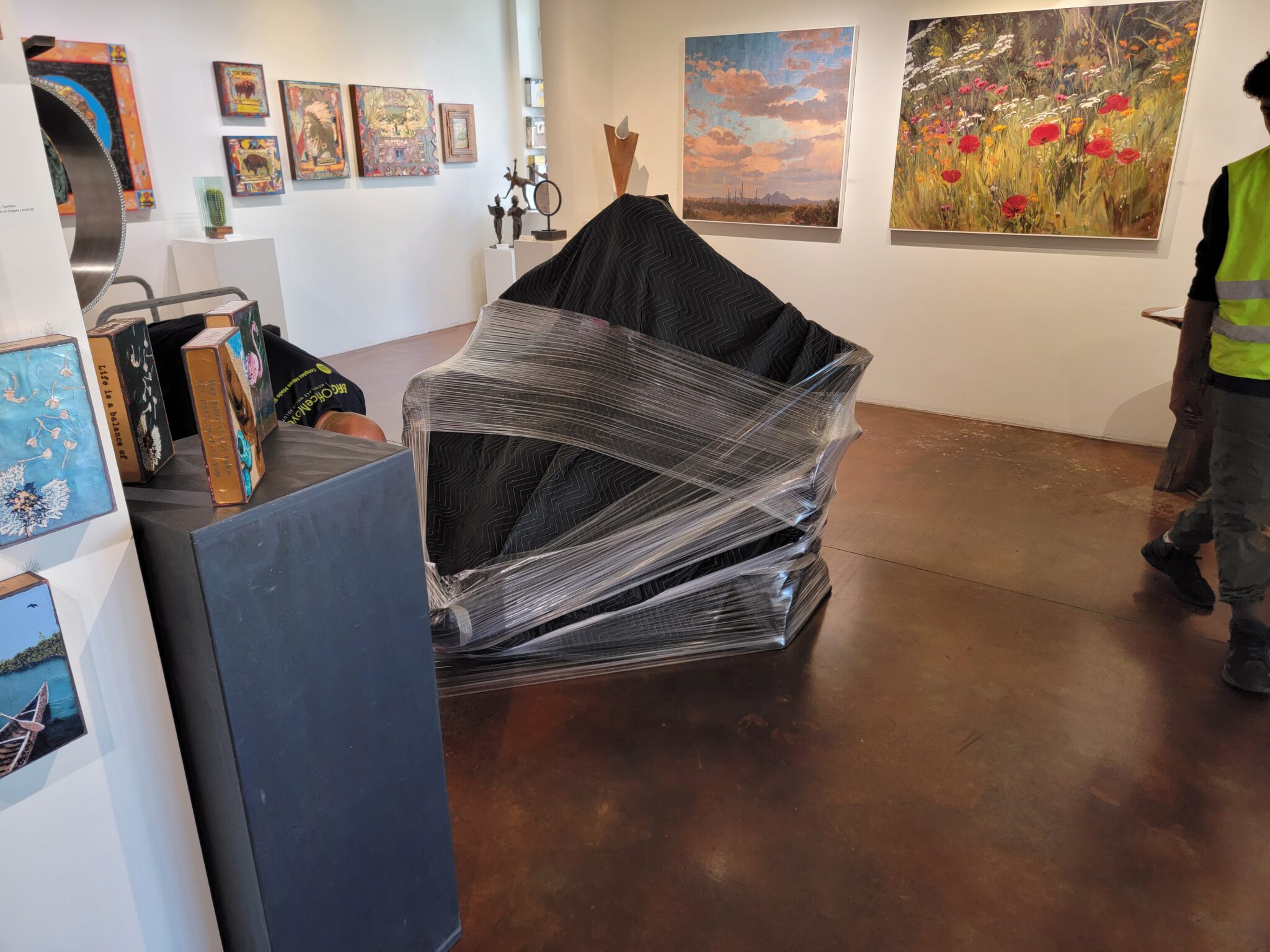
The cheapest option was actually the better experience for the client. Had we gone with the first quote, the collector would have received a massive wooden crate the size of a small car in their driveway, requiring tools and labor to dismantle. Instead, the piece arrived wrapped, was unstrapped, and was ready for installation immediately.
The lesson here is context. Retail shippers and risk-averse logistics companies will often default to the most expensive, labor-intensive method to cover their own liability. As the artist, you need to know what your work actually requires and shop around until you find a partner who aligns with that reality.
The Trap of “Dimensional Weight”
When shipping two-dimensional work (paintings, photography, prints), the biggest enemy of your wallet is not weight—it is volume.
Carriers like UPS and FedEx utilize a pricing model based on Dimensional Weight. This means they calculate the cost based on how much space the package occupies in the truck, not just how heavy it is.
This is why the “pack and ship” service at a retail store is often so exorbitant. To be safe, they will often place a 24″ x 30″ painting into a 40″ x 48″ box and fill the massive empty void with packing peanuts. You are then charged for shipping that massive box filled mostly with air.
To control costs, you must minimize the package size while maintaining safety. You want a tight fit. By modifying boxes (telescoping them or cutting them down) to fit the artwork snugly—with just enough padding for safety (usually 2 inches on all sides)—you avoid paying to ship dead air.
Stop Paying Retail Rates
If you walk up to the counter at a shipping store, you are paying the highest possible retail rate. However, high-volume shippers (like online retailers) pay a fraction of that cost.
You can access these commercial rates without shipping thousands of packages a year. Services like Pirate Ship, ShipStation, or even the shipping backend of your own website (like Shopify) allow you to print labels at a “commercial” discount.
It is not uncommon for a label to cost $100 at the retail counter but only $55 when purchased through one of these platforms. If you pack the work yourself and print your own label, you bypass the retail markup entirely.
The Goal: No Surprises
We are not in the shipping business; we are in the art business. We don’t need to make a profit on shipping, but we certainly shouldn’t be taking a loss.
A good rule of thumb for estimating shipping when pricing your work is 4% to 7% of the retail price. While this varies by size and distance, it provides a healthy baseline.
As you gain more experience, you should treat shipping data like any other business metric. Track your material costs. Track your freight costs. Get multiple quotes for large or unusual items.
When you handle logistics with the same professionalism as your brushwork, shipping stops being a nightmare and becomes just another routine, manageable part of your success.
What Are Your Shipping Secrets?
Do you have a favorite resource, tool, or hack that helps you keep your shipping costs under control? I’d love to hear what strategies are working for you.