

Going deeper in the religious analogy, British art historian Susan Compton interpreted the Black Square in the light of the mystical idea of the fourth dimension proposed by Russian religious thinker P.D. Uspensky. In Uspensky’s theory, there existed a fourth dimension that contained the three-dimensional world that humans were living in, and this fourth dimension represented the higher consciousness of humankind.
This idea was certainly familiar to Malevich, as it was of great interest to his friend Kruchenykh, with whom he had worked on the opera Victory over the Sun. The notion of a transcendent dimension resonates with Kandinsky’s belief in an inner essence or intuitive core of the human spirit. Interpreting Black Square through this lens suggests that, despite their differing approaches, both artists were engaged in a shared spiritual pursuit through abstraction.
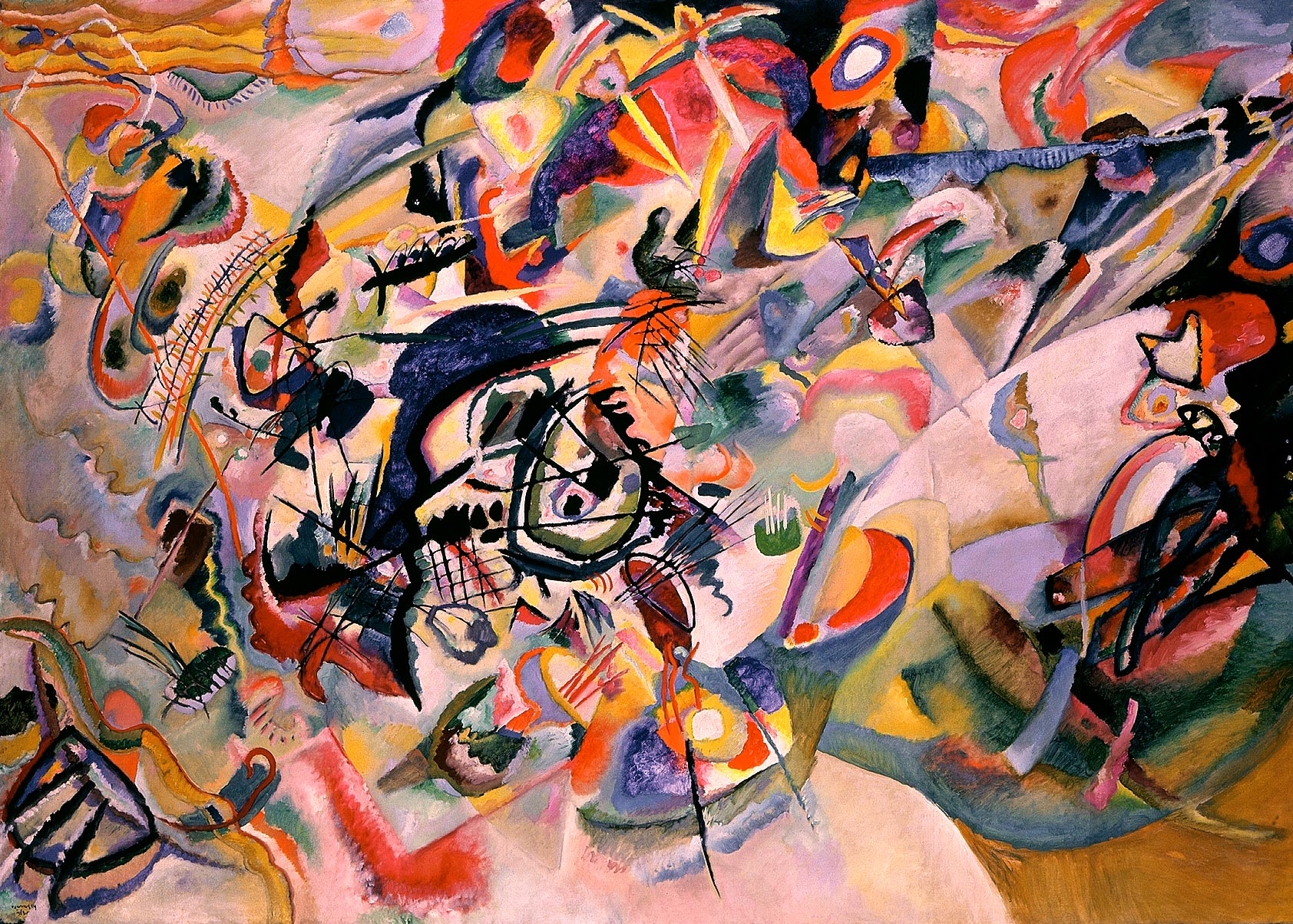
Though their paths to abstraction occasionally overlapped, Kandinsky and Malevich ultimately arrived at very different destinations. Kandinsky embraced a non-geometrical form of abstraction, distancing himself from representation but never fully abandoning it. For him, art remained a vehicle for emotional and spiritual expression—a way to communicate inner experience. Malevich, by contrast, broke entirely with representation. His vision led to a stark, geometrical abstraction where pure form reigned supreme. What’s striking is that even after the upheaval of the 1917 Russian Revolution, both Kandinsky and Malevich—key figures in the rise of abstraction—occasionally returned to figurative art. Beneath their radical innovations lay a quiet pull toward representation, suggesting that their break from tradition was never total, but part of a deeper, ongoing inner dialogue between image and idea, form and meaning.