



A Walking Poison
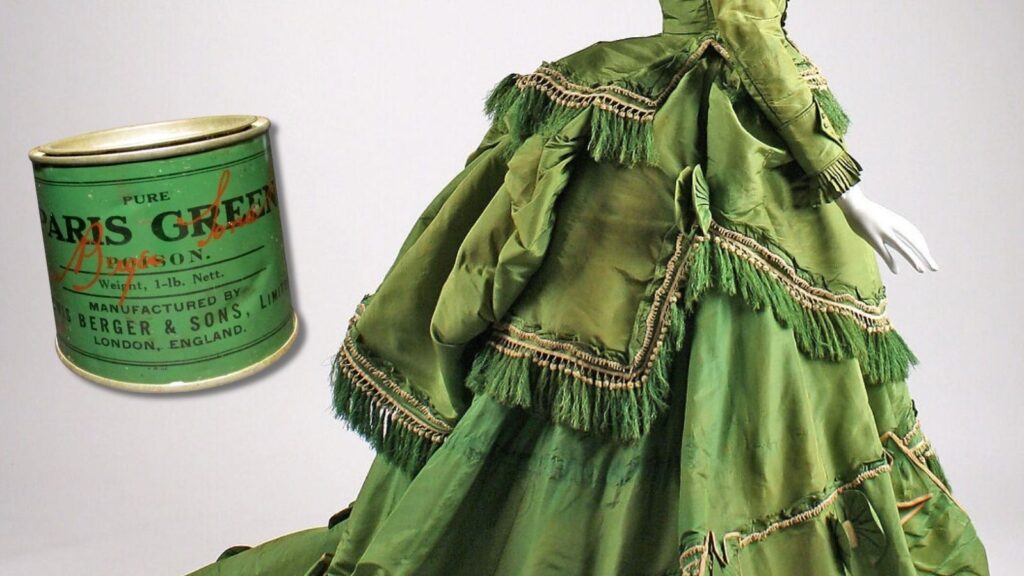
By the mid-19th century, the risks of arsenic pigments became already widely recognized. The first medical warnings date from the 1830s–1840s, thanks to chemists such as Leopold Gmelin. And in 1861, the death of Matilda Scheurer, a young worker who made artificial flowers dyed with arsenical green, shocked the press and made the real danger of the pigment absolutely impossible to ignore. But these warnings did not have as much impact as we would imagine…
The pigment continued to be used because it was inexpensive, visually striking, and (of course) highly fashionable—three deadly incentives. It was in this climate that the Victorian satirical press began portraying women who wore dresses dyed with arsenical green as true “victims of fashion” in the literal sense. Caricatures in publications such as Punch depicted elegant women transformed into “walking poison,” highlighting the lethal nature of the pigment and showing just how far fashion could push the human body toward physical ruin.
2. Lead White
Known since antiquity, lead white was one of the most prized and important pigments of occidental painting for its luminosity and exceptional hiding power until the 19th century, when zinc white and titanium white became more prevalent. Used in painting, ceramics, and decorative objects, it also became the basis of a deadly aesthetic ideal when incorporated into cosmetics.
The Greeks and Romans produced it by exposing lead plates to acetic acid vapours and carbon dioxide, yielding a very fine white powder. During the Renaissance, it became the preferred white for oil painting, particularly for the initial layers (or underpainting) and flesh tones. Moreover, we can find it in some of the most popular pieces, such as Vermeer’s Girl with a Pearl Earring.
Lead white was also used as a cosmetic. Popular makeup such as ceruse or Venetian ceruse was, in fact, a mixture of lead and vinegar. Its use is associated with prominent figures such as Elizabeth I of England, who is believed to have applied it to achieve a pale, uniform complexion. Although the dangers of lead were only vaguely recognized at the time, those who relied on these products often became victims of their own pursuit of beauty.
Lead is a powerful neurotoxin. It can cause tremors, fatigue, memory loss, and kidney damage. It is known that painters and manufacturers inhaled or ingested particles during the preparation and application of the pigment. As mentioned earlier, artists such as Caravaggio and Goya have been the subject of medical studies suggesting possible cases of saturnism, although no diagnosis can be considered conclusive.
Industrially, lead white continued to be used on a massive scale until well into the second half of the 20th century, when it began to be progressively restricted in paints and domestic products. Even today, it appears in the restoration of historical artworks and in certain traditional artistic practices.
3. Cinnabar Red/Vermilion
Lastly—though certainly not least in impact—we arrive at cinnabar, an intense red pigment used from the Neolithic period to the present day. It appears at sites such as Çatalhöyük (Turkey) and across Mesoamerican cultures, where it was applied to bodies, bones, and sarcophagi as a symbol of life and renewal. In ancient Rome, it was the quintessential imperial red.
From Late Antiquity onward, alchemists such as Zosimos of Panopolis and Jabir ibn Hayyan described methods for synthesizing vermilion, a purer and more brilliant artificial form of the pigment. In China, cinnabar was essential in the production of red lacquer and in the paste used for imperial seals, carrying strong ritual and alchemical connotations.
Although cinnabar (mercury sulfide, HgS) is less bioavailable than other forms of mercury and poses relatively limited danger in its stable, finished state, its extraction, grinding, and occasional contamination with other materials—such as red lead—have historically presented significant risks. The danger was already recognised in ancient Rome. Pliny the Elder describes rudimentary masks worn by workers to prevent them from inhaling the dust.
A well-known modern example was reported in The New Yorker in 1986. A conservator identified under the pseudonym “Laura McBride” fell ill while working at home on a funerary textile from the Chancay period (1000–1500 CE). She developed fatigue, dizziness, and muscle pain, and medical tests revealed anaemia with basophilic stippling, a classic sign of lead poisoning. Further analysis showed that the pigment she believed to be pure cinnabar was, in fact, contaminated with red lead. Handling and preparing this mixture had caused her symptoms—a reminder that even ancient pigments can pose serious risks when used today.
At The Met, we also find the Damascus Room (1707), a reconstruction of Syrian winter reception chamber (qa’a) typical of the late Ottoman period in Damascus, Syria. The room is decorated using the ajami technique, which combines gesso reliefs, metal leaf, enamels, and pigments such as cinnabar red. It stands as an extraordinary example of Ottoman luxury and of the longevity and danger of these materials.
Valencina: Mercury in a Chalcolithic Community
To understand the most catastrophic consequences of using this material, we turn to the large prehistoric site of Valencina de la Concepción (c. 2900–2650 BCE) in southern Iberia. Here, researchers have documented intensive use of cinnabar in funerary and ritual contexts. Human remains mostly associated with high-status women show extraordinarily elevated levels of mercury in their bones, in some cases hundreds of times higher than what is considered normal in modern populations.
The pigment was likely inhaled or ingested during ritual or technical activities involving its handling. This chronic exposure may have caused tremors, memory loss, fatigue, or kidney damage. The application of cinnabar to bodies and objects underscores its symbolic and aesthetic value, despite the lethal risks it carried.
The story of toxic painters’ pigments reveals a striking paradox: the pursuit of beauty often came at the cost of the artist’s health and safety.