


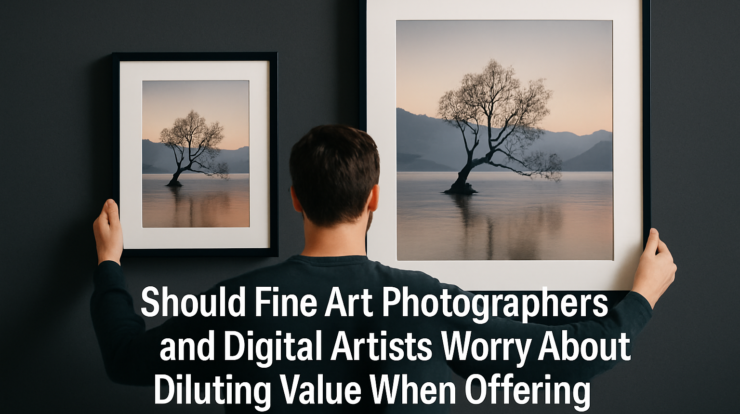

One of the questions that often surfaces, especially among photographers and digital artists, is whether offering artwork in different formats—cropping to square, resizing, or even printing at different dimensions—somehow dilutes the value of the original image.
It’s a fair question. After all, most of us want our work to be seen as distinctive, meaningful, and worth collecting. And we worry that if it seems too malleable or “adjustable,” buyers might not view it as serious or valuable.
But in practice? Most collectors don’t think that way.
Buyers Don’t Overthink Format
In decades of working with collectors, I’ve rarely—if ever—had someone express concern that a photograph was available in more than one size or that a digital work could be printed differently. Buyers tend to be focused on a handful of key questions:
-
Do I love it?
-
Will it look good in my space?
-
Can I afford it?
They’re not analyzing whether an image was cropped from a rectangle to a square, or whether it might exist in another format elsewhere. They’re responding emotionally, practically, and visually—not philosophically.
To the buyer, it’s about fit—both aesthetic and spatial. They’re trying to imagine the piece in their home or office. If they see a square version and it looks perfect above the sofa, that’s what matters.
Don’t Fear Flexibility—Use It Intentionally
Photographers and digital artists have a unique advantage: they can adapt their work to fit the context. And when used thoughtfully, that flexibility doesn’t weaken the work—it broadens its reach.
Let’s say you have two images that work beautifully together, but one is naturally a horizontal rectangle and the other is vertical. Cropping them both to square to create a unified grouping for a show or fundraiser isn’t compromising your integrity. It’s simply presenting the work in a way that makes sense for that moment.
Likewise, offering your work in multiple sizes gives you access to different segments of the market. Some buyers want a small piece for a niche space. Others are looking for a larger impact. Being able to offer both doesn’t cheapen the work—it increases the likelihood it will find a home.
Finding Your Comfort Zone
Of course, all of this should be done within the bounds of your artistic intent. If resizing a piece undermines its composition or core message, you’re under no obligation to force it into a new format. But more often than not, the limitations we place on ourselves are based on fears that aren’t grounded in how buyers actually behave.
Here’s the truth: as artists, we often spend far more time worrying about these things than our collectors ever do. And especially in the early stages of your career, when your name isn’t yet widely known, you have a tremendous amount of freedom to experiment. You can test what works, iterate, and adapt—without the baggage of an established market to protect.
If you’ve created something you’re proud of, and you see an opportunity to present it in a new format that could open new doors—take it. The risk of devaluing your work is far lower than the risk of missing a connection with a potential collector.