


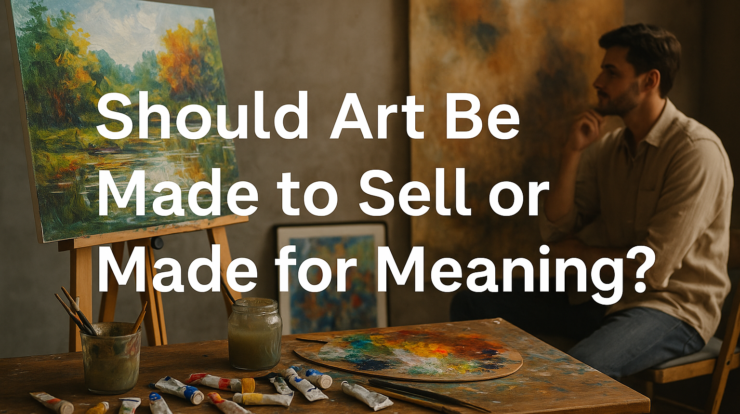

This is one of those questions that tends to circle in an artist’s mind during quiet moments in the studio—often when a piece that felt deeply personal doesn’t sell, or when a more decorative piece flies off the wall.
Should I be making art that sells? Or should I be chasing something more meaningful?
It’s easy to frame these two goals as opposites. But they’re not. In fact, some of the most celebrated artists in history managed to strike a balance between the two—and so can you.
The False Divide
The idea that meaningful work can’t sell—or that sellable work can’t be meaningful—is a modern invention. The art world loves to divide things into categories: fine art vs. commercial art, high art vs. decorative, personal vs. marketable. But in practice, the line is rarely that clean.
Artists like Monet, Rembrandt, and John Singer Sargent all made work that appealed to collectors and still reflected their deep artistic vision. They weren’t “selling out”—they were making a living while refining their voice.
And that’s a healthy thing to aim for.
Making Work That Sells Isn’t a Compromise—It’s a Strategy
There’s no shame in creating art that resonates with buyers. If a certain subject, color palette, or format sells consistently, that’s not a signal to stop—it’s a signal that you’ve found a connection point.
That doesn’t mean you have to limit yourself to only that kind of work. In fact, many successful artists build a “bread and butter” body of work that supports their practice financially, allowing them to take risks in other areas. The sales become the fuel that powers deeper experimentation.
This is one reason I often encourage artists to work in series. You can explore multiple directions without jumping around randomly, and you can identify which ones spark the strongest response from collectors. That feedback loop helps you shape your body of work with both integrity and momentum.
Personal Vision Is Still the Foundation
Of course, meaning matters. When artists abandon their voice completely in pursuit of sales, it becomes obvious—and usually unsatisfying for everyone involved. The work loses its energy. Collectors can feel it. So can galleries.
The sweet spot is when your personal vision intersects with your buyer’s desire. When you’ve developed a point of view and can express it across formats and subjects. That’s when you become not just an artist with talent—but an artist with staying power.
Making Both Kinds of Work Is Smart Business
Here’s what I see from the gallery side: artists who are thriving long-term often have two gears. They have work that is accessible and proven—it sells steadily, looks great in a home, and appeals to collectors. And they also have work that challenges, explores, and pushes their boundaries.
Sometimes those two bodies overlap. Sometimes they’re entirely separate. The important thing is that both are respected, and neither is dismissed as lesser. You need both. The balance allows you to survive, grow, and evolve.
Final Thought
Art made for meaning and art made to sell are not mutually exclusive. You can do both. In fact, doing both may be the most sustainable path forward.
So if you’re working on a series you know will connect with buyers, lean into it. If you’ve got an experimental piece in your studio that’s challenging you—don’t abandon it just because it’s harder to price. Let one fund the other. Let one inform the other.
You don’t have to choose between meaning and market. You can build a career that honors both.