


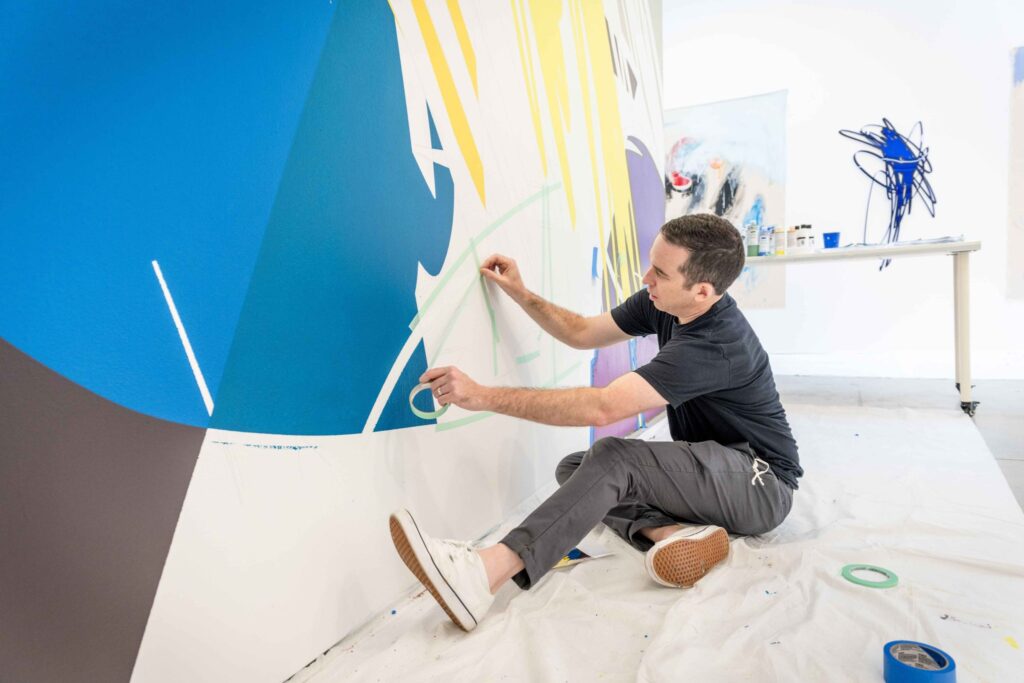
There’s a dash of childlike wonder in Ryan Coleman’s works that gives them their draw (pun intended). Not long ago, he began experimenting with what would become a defining part of his practice: lifting gestural strokes off the canvas and turning them into wall sculptures. His scribbles are so much more, hanging on their own as bold, larger-than-life tributes to a universal mark we’ve all left behind.
Between large-scale murals and studio work, he’s been busy, and we’ve been watching for a while. We’re excited to introduce him properly. He talked with us about his studio, his influences, and the show he has coming up in Atlanta.
Can you tell us a little about your artistic career so far?
Quite a journey, full of ups and downs, wins and losses, excitement, dread, and everything in between! I knew from an early age I was an artist and wanted to pursue it as a career, though exactly what avenue took a few years after high school and college (undergrad) to figure out.
The opportunity arose to move to New York City in 2003 with my good friend Todd Wahnish, and I jumped on it. I worked full-time as an artist assistant for Jeff Koons in Manhattan for the next eight years, then relocated to Atlanta with my wife, where I began working full-time for myself as an artist around 2012.
You definitely develop a thick skin and learn to accept rejection as an artist, which makes the wins that much more rewarding. I’ve also learned not to take anything for granted.
What’s your studio like, and how does your environment influence your work?
My studio is in my home, which I really like. Much of my artistic practice is also computer-based, whether it’s formatting wall sculptures for production, designing mural projects, writing proposals, invoices, or designing new paintings.
A lot of my work is about exploring gesture, teetering between an abstracted chaos and a sense of control/order. So in some ways my studio is a reflection of that. I like things tidy and organized, with the environment as clean and neutral/minimal as possible. While the work itself, whether it’s a painting, mural, or a wall sculpture, is borderline chaotic and expressive.
What drew you to your material?
I’ve always been a painter at heart, though my practice extends into materials like plexiglass, mirrored plexi, wood, and fabricated steel for outdoor installations. My wall sculptures grew organically out of doing large-scale mural work, where I began isolating bold, gestural scribbles into standalone dimensional forms. Utilizing materials outside of traditional wood and canvas, such as plexiglass and mirrored surfaces, allows me to push color intensity and aesthetics in ways traditional paint alone can’t.
How does scale influence the way you think about a piece?
It influences quite a bit in regards to composition and overall approach, like how much visual information to include, for example. This is where the art of balancing the macro with the micro comes in.
How would you describe your style or approach to someone who hasn’t seen your work?
Abstract expressionistic with hints of comic, historical, and philosophical influence. I explore the power of gestural mark-making and color, whether in the form of a painting, mural, or wall sculpture.
How do you see your work evolving in the next few years?
There’s a quote attributed to De Kooning about how artists tend to lean toward simplicity as they get older. I’ve felt myself condensing what I want to achieve with my work into a more streamlined aesthetic over the past handful of years.
One of the hardest things to do as an artist is to create a signature visual style that is unmistakably your own, completely recognizable and unique to the artist. This is something I am focusing more and more on.
Is there anything our collectors should be on the lookout for, whether it is a body of work, exhibition, press, etc.?
I’m excited to share that I will be exhibiting my work at Kai Lin Gallery in Atlanta in early 2027, featuring a body of work pairing wall sculptures with paintings.
Alongside preparing for the show, I’m currently working on several new mural projects and continuing to expand my studio practice.
If you could collaborate with any artist, living or dead, who would it be?
Cy Twombly or Jean-Michel Basquiat.
If your art could be displayed anywhere in the world, where would it be?
In the Metropolitan Museum of Art in New York, because it’s my favorite place in the world!
The post Ryan Coleman Turns Scribbles Into Sculptures appeared first on Canvas: A Blog By Saatchi Art.