


Construction of the Gallery of Modern Art (GOMA) began in 2004 and was completed in 2006 for the launch of the ‘The 5th Asia Pacific Triennial of Contemporary Art’. Displayed in both Gallery sites, the exhibition was instantly twice the size of its previous incarnations, this second building devoted to contemporary art is often cited as a catalyst for a cultural shift in Brisbane and Queensland.
The growth of the Asia Pacific Triennial over its first four chapters was part of the impetus for the Queensland Art Gallery’s second site, so it was appropriate that GOMA opened on 2 December 2006 with the fifth Triennial.
Since then, GOMA’s foyer, Long Galley, and River Room has housed expansive projects and installations, perfect for the display of spectacular contemporary art. Has a Triennial artwork had an impact on you?
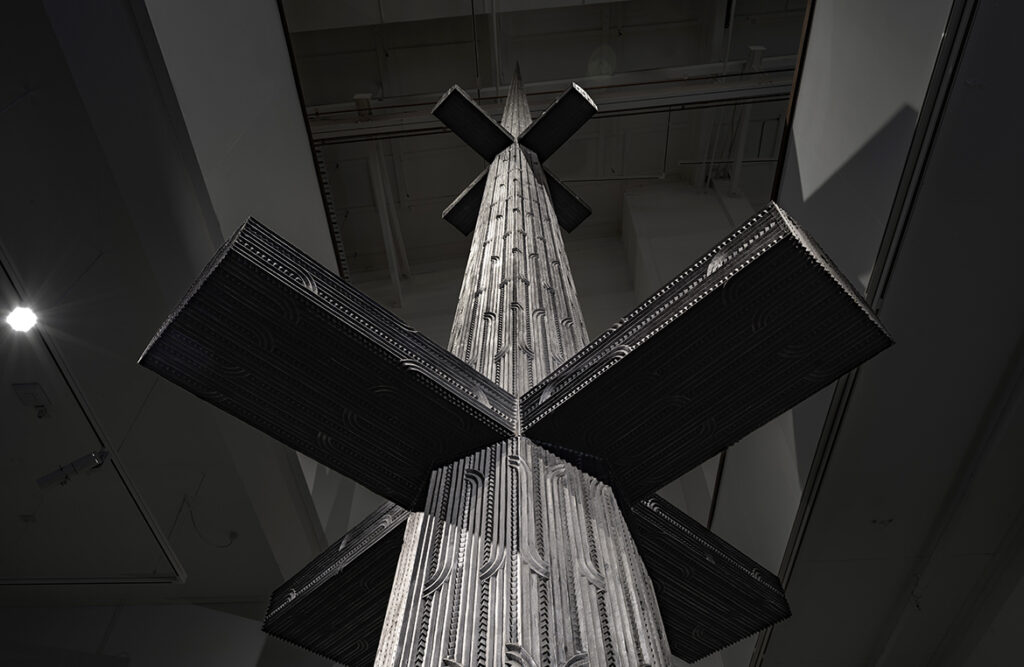
Currently our team are preparing for the 11th chapter of QAGOMA’s flagship exhibition series opening Saturday 30 November 2024 across the Queensland Art Gallery and Gallery of Modern Art. In GOMA’s Long Gallery we’re assembling Aotearoa New Zealand artist Brett Graham’s monumental installation Tai Moana Tai Tangata combining moving image and five superbly crafted sculptures, here’s a peek of what to expect.
11th Asia Pacific Triennial | 30 November 2024 – 27 April 2025


10th Asia Pacific Triennial | 4 December 2021 – 25 April 2022

With a collaborative process rooted in respect and care, Aotearoa New Zealand–based artist Shannon Novak’s work manifests as a socially engaged practice that extends beyond traditional exhibition spaces. 81 Percent (Australia): Someone you know aimed to increase awareness of the challenges faced by the LGBTQI+ community. The title refers to the 81% of Australian youth who experience high or very high levels of psychological distress; the number made visible in 80 windowpanes in GOMA’s River Room for the tenth Triennial.

9th Asia Pacific Triennial | 24 November 2018 – 28 April 2019

Chinese artist Qiu Zhijie’s absorbing wall painting Map of Technological Ethics had its origins in Chinese ink painting and calligraphy. Painted directly on to the expansive Long Gallery wall at GOMA for the nineth Triennial, the enormous map depicted an archipelago of scientific moral quandaries, with landmarks named for activists and political lobbies, contentious issues in medicine and biology, looming fears of technocracy and climate change, and implications of artificial intelligence and computer technologies. The map’s interdisciplinary character offered a graphical account of the potential for technology and its conundrums to pervade every aspect of human life.

8th Asia Pacific Triennial | 21 November 2015 – 10 April 2016

In the lead-up to the eighth Triennial, Indian artist Asim Waqif visited Brisbane to explore the history of building and demolition in the city, all as inspiration for his site-specific work that towered over GOMA’s Long Gallery. Its title, All we leave behind are the memories, borrows the catchphrase of the Deen Brothers, the demolition company associated with the destruction of iconic Brisbane landmarks during the Bjelke-Petersen premiership. Waqif’s installation was constructed from the aged timber of demolished Queensland structures and embedded with electronic sound, light and kinetic sensors that encouraged interaction. Designed to be entered, this installation explored concepts of waste, sustainability, heritage and the contrast between the industrial and the handcrafted.
7th Asia Pacific Triennial | 8 December 2012 – 14 April 2013


The carvings and paintings created by Kwoma Arts respond directly to the koromb (spirit houses) found in the Upper Sepik villages of Tongwinjamb and Mino. Each Kwoma village has at least one such koromb, a place for the discussion of issues affecting the community and for ceremonial displays and ritual performances. In a palette of black, white, red and yellow, the vibrant ceiling created for the seventh Triennial in 2012 comprised over 200 panels. This architectural structure was translated by the artists into an installation using new materials, each panel painted with a design from individual artists’ clan totems.
Aotearoa New Zealand artist Richard Maloy transforms humble materials —cardboard boxes, plastic bags, tape and timber — into sculptures and installations that draw viewers into spaces where they find themselves immersed in an unexpected environment. His massive, vivid yellow installation Big Yellow measured thirty metres in length, filling almost the entirety of GOMA’s River Room with its brightly coloured angular shapes that created new visual and spatial possibilities for the visitor.

6th Asia Pacific Triennial | 5 December 2009 – 5 April 2010

Japanese artist Yoshitomo Nara’s collaboration with the design firm graf, under the shorthand YNG, for the fantasy automobile Y.N.G.M.S. (YNG’s Mobile Studio) created for the seventh Triennial in 2012, draws together several strands of Nara’s practice, including his interest in the realm of private space and evocations of rebellious freedom. Along with children, huts have been a recurring motif in the artist’s drawings since the 1990s. Usually constructed from recycled materials, these structures are where secrets are safe and play is unfettered and free.
Thai artist Wit Pimkanchanapong’s works often combine playful and simple elements, united through his singular understanding of elegant forms, and his interest in space and repetition. Composed of A3 paper, bulldog clips and metal wire, his dramatic site-specific installation Cloud for GOMA’s foyer responds to and transformed the entry for the sixth Triennial.

5th Asia Pacific Triennial | 2 December 2006 – 27 May 2007
Indonesian artist Eko Nugroho’s art is acutely attuned to contemporary events. When GOMA opened in 2006, Nugroho’s towering free-range cartoon-like mural It’s all about the Destiny! Isn’t it? created for the fifth Triennial greeted the visitor as they entered the building for the first time. The artist’s passion for playing with text and visual style originates from diverse sources: speech balloons parodying the rhetoric used by many public figures, conversations with people around him, and techniques of production such as sewing, painting, silkscreen printing, copying and redrawing.
Curatorial extracts, research and supplementary material compiled by Elliott Murray, Senior Digital Marketing Officer, QAGOMA
Art that empowers
Asia Pacific Triennial
30 November 2024 – 27 April 2025