


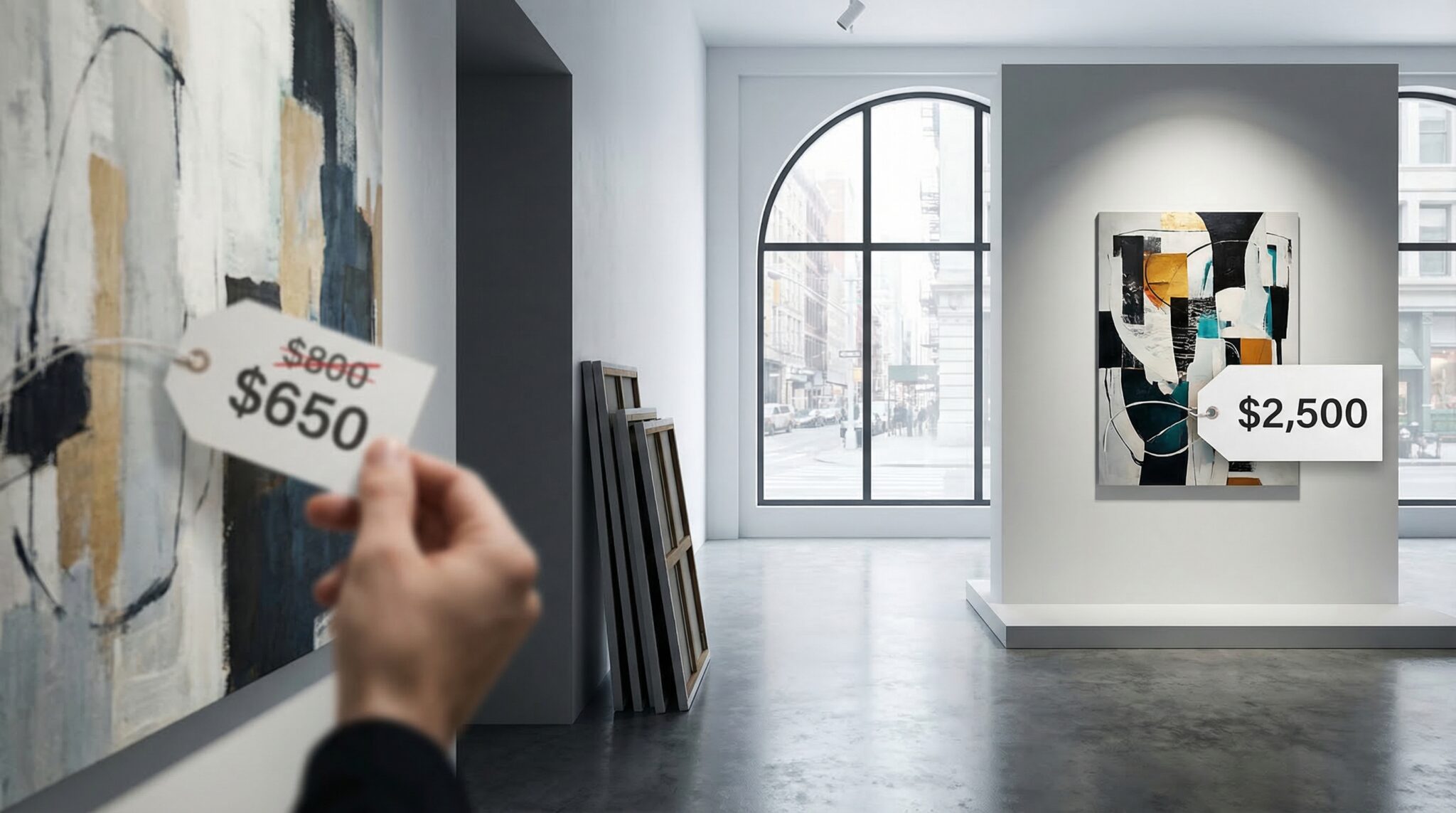

Imagine this scenario: your gallery contacts you to say your work is beautiful and clients love it. But there’s a catch. “Your prices are just too high for our current buyers,” they tell you, politely suggesting you slash your rates to stay on the wall.
It’s enough to send any working artist into a tailspin of self-doubt. Should you concede to keep the relationship, or pack up your portfolio and walk away? The golden rule here is simple: When your art isn’t selling at a researched market rate, you don’t have a pricing problem. You have a venue problem.
1. The Real Reason Galleries Complain About Price
Let me translate what it actually means when a gallery owner blames your price point. What they are really communicating is a lack of sales activity. They are attributing that silence to the price tag, but let’s be honest. If your art was flying off the walls, the gallery would be thrilled to collect their commission on those higher price points.
Often, the issue has nothing to do with the numbers on the wall labels. Instead, it’s about the mix of art in the gallery, the lack of qualified foot traffic, or even the staff’s sales skills. It is much easier to tell an artist, “Your work is too expensive,” than to admit the gallery is struggling to attract serious collectors.
2. Why Slashing Prices Won’t Magically Create Sales
If you find yourself in a situation where a gallery wants you to lower a price—say, dropping an $800 painting down to $650—you might assume the new price will open the floodgates. I have found this is rarely the case. A minor reduction almost never results in a sudden spike in sales.
However, it is generally better to have representation than to have your art sitting in a dark studio. If you are pressured to make a concession, treat it strategically:
-
Agree to a trial: Treat the price reduction as a strict, temporary experiment to let the gallery prove that price was actually the barrier.
-
Protect your market: Only agree to this lower price if you are not currently showing similar work at higher price points in other venues.
-
Prepare to pivot: If the work still doesn’t sell at the discounted rate, you have objective proof that the venue—not the valuation—is the real issue.
3. Focus on the Venue, Not the Price Tag
When we have these discussions, we tend to obsess over the price. I suggest you redirect that energy toward finding the right venue. Even if a gallery is located in an incredibly wealthy zip code, that doesn’t guarantee they capture a buying clientele.
Highly affluent professionals are often running between offices and appointments in their daily lives. They rarely have the time to casually stroll through a local gallery. Instead, they make their major art purchases while on vacation in established art destination markets.
If you have done your pricing research and know your rates are competitive, stick to your guns. There are galleries out there that will look at your portfolio and say, “We love your work, and we can’t believe how reasonably priced it is!”
One Final Takeaway
Don’t let the comments of one gallery owner dictate your entire business strategy. There is no purely objective “expensive” or “inexpensive” in the art world; it is entirely relative to the buyer’s income and the gallery’s market positioning.
Keep your existing representation while they run their pricing experiment. But while they do, start aggressively seeking relationships with new galleries capable of sustaining your true market value.
Question for Readers
Have you ever had a gallery ask you to lower your prices to fit their specific clientele? How did you handle the negotiation, and did the price drop actually lead to more sales? Share your experiences in the comments below!