


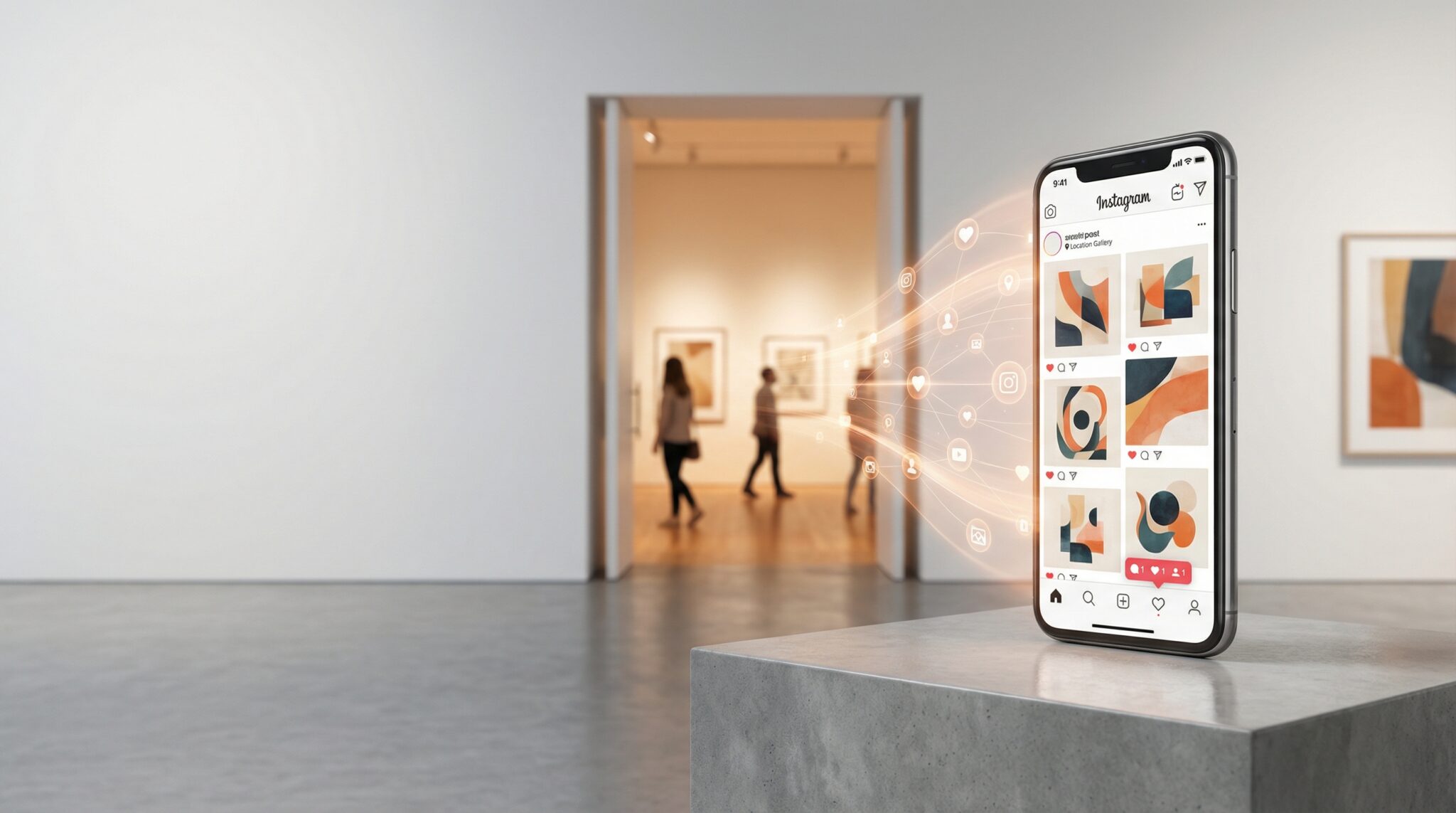

You sit down with a gallery owner, portfolio open, and the work is a hit. Then comes the inevitable question: “What does your Instagram presence look like?” It is a loaded question. On one hand, galleries increasingly mandate that artists maintain active social media accounts. On the other hand, many gallerists are quietly terrified of the exact monster they are asking you to feed.
They worry that a strong online following means you will sell directly to collectors, bypassing the gallery entirely. They fear your Instagram is a competing storefront rather than a promotional tool.
Your golden rule in these negotiations is simple: You must actively frame your social media presence as a dedicated funnel for the gallery’s physical space, not a competitor to it. It is up to you to reassure the gallerist that your digital audience will be leveraged to drive local foot traffic, boost show attendance, and generate mutual sales.
The Gallery’s Secret Fear
Before you can leverage your following, you have to understand the psychology of the person sitting across from you. I can tell you from the gallery side of the desk, the fear of being bypassed is very real.
When a gallerist looks at an artist with a massive online following, their internal monologue often shifts. “Are my collectors just going to message this artist directly?” they wonder. “Will I spend money marketing a show, only to have the artist sell the best pieces through an Instagram Story?”
You have to address this elephant in the room proactively. Do not wait for the gallery owner to voice their insecurities.
Reframe Your Following as a Collaborative Asset
To turn this dynamic to your advantage, you must change the narrative. If you don’t have a presence, your advantage is that you aren’t competition. But if you do have a strong digital footprint, your advantage is that you bring a built-in collector base.
Here is how to communicate your digital value:
-
Emphasize mutual success: Tell the gallery explicitly, “My ultimate aim is to ensure we are successful together.” Clear communication prevents fearful assumptions.
-
Pitch your audience as their audience: Explain that your online followers are hungry to see the work in person. Your Instagram is the bait; the gallery is the destination.
-
Highlight local targeting: Remind them that you can use your platform to alert local followers whenever you deliver fresh inventory to their specific physical space.
Actions That Build Immediate Trust
Talk is cheap in the art business. The fastest way to quell a gallery owner’s fear of competition is to demonstrate your collaborative spirit through concrete actions.
Consider these proactive strategies:
-
Run collaborative ads: I recently watched an artist run a small social media ad targeting her local area, specifically pointing buyers to her upcoming show at our gallery. The gallerist will be absolutely thrilled to see you working in tandem with their goals.
-
Tag aggressively: Whenever you post a piece that resides in their inventory, tag the gallery and mention them in the first line of the caption. Make it explicitly clear where the work can be purchased.
-
Redirect inquiries: When a collector inevitably slips into your direct messages asking about a gallery piece, publicly and politely hand that lead over to the gallerist. Nothing builds trust faster than a commission check the gallery didn’t have to chase down themselves.
Navigating the Social Media Mandate
Sometimes, an artist simply wants to paint and has zero interest in maintaining a digital presence. Yet, you may encounter a gallery that makes an Instagram account a strict stipulation for representation.
If you find yourself in this position, roll with it. Do not let a rigid social media mandate cost you a valuable gallery relationship.
You do not have to become an influencer. Keep the account strictly professional. Use it exclusively as a digital portfolio and a bulletin board for your gallery announcements. The goal isn’t to go viral; it is to check the gallery’s marketing box while keeping your focus on the easel.
The Final Takeaway
Ultimately, the proof is in the pudding. If your digital outreach results in physical sales at the gallery, any lingering concerns about competition will evaporate instantly. A collaborative approach turns your smartphone from a threat into the gallery’s favorite marketing asset.
Question for Readers
How have you handled conversations about social media with your gallery partners? Have you ever had a gallerist express concern about your direct-to-consumer sales?