




A Moment of Stillness, A Glimpse of Genius
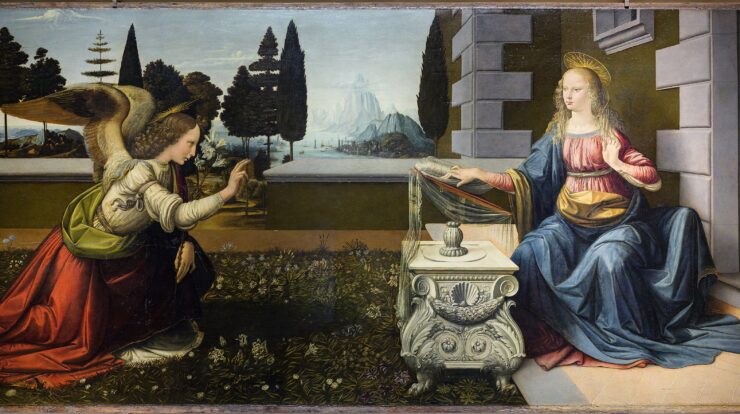
Leonardo da Vinci’s The Annunciation (c. 1472–1475), housed in the Uffizi Gallery in Florence, is considered his earliest surviving major work. Painted when he was barely in his twenties, this scene of Gabriel visiting Mary to deliver world-changing news carries a calm that stands in contrast to many other renditions of the event. It’s restrained, luminous, and quietly groundbreaking.
Though created in the workshop of Andrea del Verrocchio, Leonardo’s mentor, the painting bears many marks of Leonardo’s emerging style: attention to natural detail, curiosity about light and perspective, and a deep sensitivity to emotional tone.
The Context: Florence in Transition
During the early 1470s, Florence was a center of artistic experimentation. The Renaissance was in full swing, and artists were exploring linear perspective, the natural world, and the use of oil paints alongside tempera.
Leonardo, still an apprentice at this point, was absorbing these innovations—and adding his own insight. The Annunciation was likely commissioned for a monastery and may have been a collaborative project in Verrocchio’s studio. But the painting’s unity of composition and mood suggest a strong guiding hand—likely Leonardo’s.
What Stands Out in the Work
Even without standing in front of the original, one can see the care in how Leonardo constructed the image:
-
Gabriel and Mary are poised in a balanced composition—Gabriel kneeling with a white lily in hand (a symbol of Mary’s purity), Mary seated behind a marble lectern.
-
The garden setting suggests an “enclosed garden” or hortus conclusus, a symbol of Mary’s virginity.
-
The background landscape fades into blue-gray hills, an early use of atmospheric perspective that gives a sense of real space and distance.
-
Every element—Gabriel’s feathered wings, the architecture, the flora—is handled with care and realism, pointing to Leonardo’s fascination with how things work and appear in nature.
-
A preparatory drawing of Gabriel’s sleeve, attributed to Leonardo, supports the idea that he painted at least the angel and parts of the scene. The debate continues about how much of the work was done by others in the studio.
Why It Still Matters
This isn’t just a beautiful early Renaissance painting—it’s a blueprint of where Leonardo was headed. His later works, like The Last Supper and Mona Lisa, would build on the foundations visible here: the soft transitions of light, the emotional subtlety, and the harmony between figures and setting.
There’s something compelling about seeing a young artist wrestle with a big subject and bring something new to it. The painting doesn’t overwhelm—it invites. Its calmness is what makes it powerful.
What Do You See?
Art invites us into a conversation, and I always find that different viewers notice different things first.
Is it Mary’s expression? The delicate detail in the wings? The sense of quiet between the figures?
I’d love to hear your thoughts in the comments below. What stands out to you in this painting—and why?
Some of the Research Resources for this Presentation
Several years ago, I read Walter Isaacson’s superlative book on da Vinci, and it served as a jumping-off point for this post. If you haven’t read it, check it out on Amazon (affiliate link) or at your local library.
I also drew from:
https://en.wikipedia.org/wiki/Annunciation_(Leonardo)#:~:text=to%20a%20son%20to%20be,scholars%20have%20suggested%20that%20it
https://www.pbs.org/kenburns/leonardo-da-vinci/famous-works
https://www.sparknotes.com/biography/davinci/section2/#:~:text=but%20a%20skilled%20teacher%2C%20and,Verrocchio%27s%20works%20and%20other%20models
https://www.uffizi.it/en/artworks/annunciation
https://www.thehistoryofart.org/leonardo-da-vinci/annunciation