

From painted apartment blocks to skate parks, local craft and the Kremlin: a two-day guide to Ryazan through its artists.
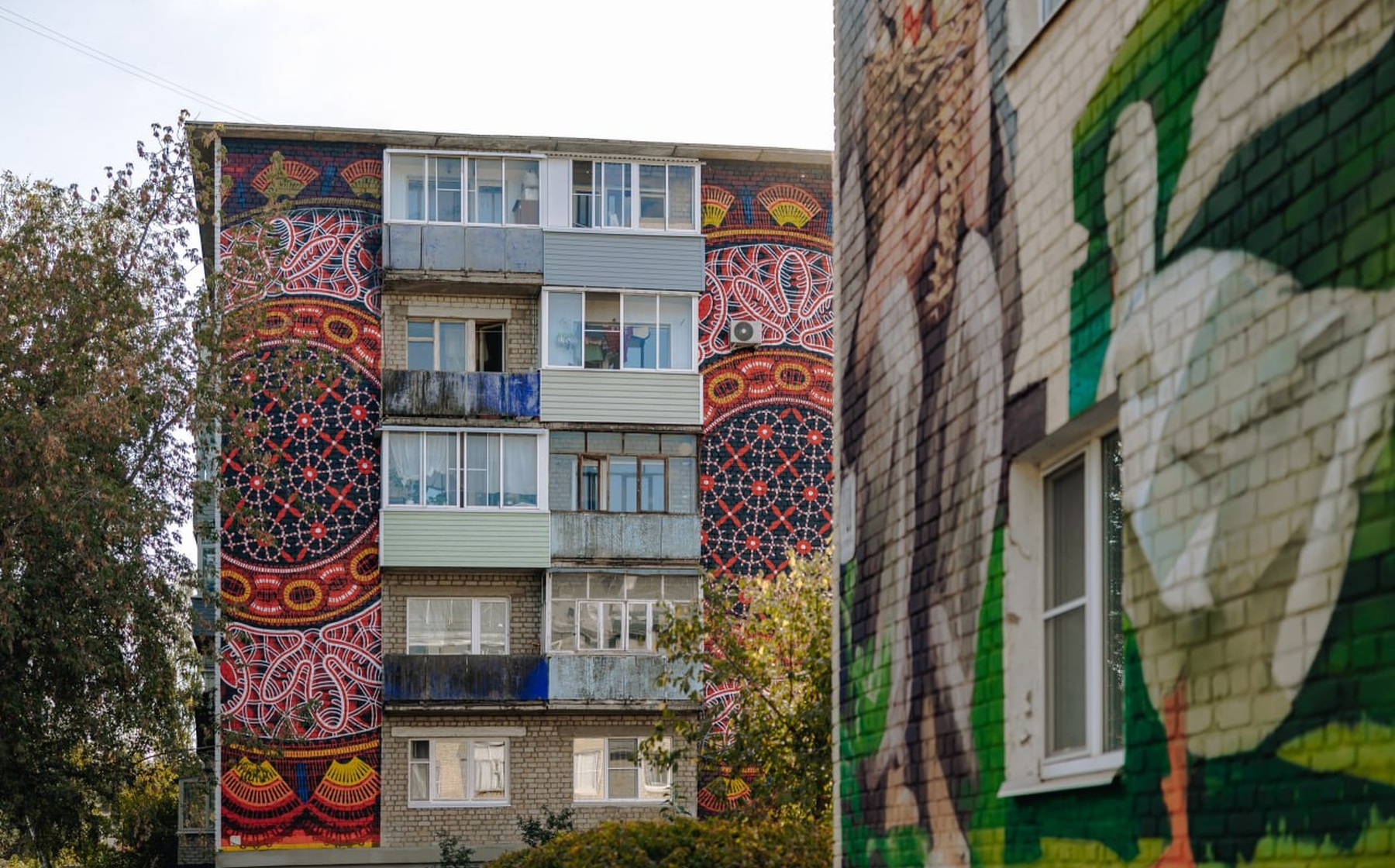
A nurse towers above a residential street. A cellist dissolves into blue spray paint. In the Art Quarter, enormous geese and bands of ornament climb around balconies and kitchen windows. About 200 kilometres southeast of Moscow, Ryazan has a growing collection of walls that takes you well beyond the familiar cathedral skyline.
Much of it leads back to Alexander Demkin, also known as Dyoma21, and fellow artist Andrey Kalugin. Their murals bring portraits, childhood memories and regional craft onto buildings across the city. A business centre becomes a canvas for the strange, sculptural forms of Skopin pottery; a former power station supplies the subject for a painting about light. These are local references with enough visual force to catch your attention before you know their stories.
Ryazan’s recent BRICS Skate Cup brought an international crowd into that setting, with riders, artists and designers sharing the programme. The event is over, but there is plenty to stay for. Between the murals are the Kremlin, the restored pavilions of VDNH, places to eat and makers working with traditions that stretch far beyond spray paint.
We’ve put together two days around that mix. Start on foot in the centre, following the walls towards the Art Quarter and VDNH. On day two, head into the outer districts for some of Demkin’s largest works, then come back into town for dinner. The map connects the stops; how long you spend between them is up to you.
Open the complete art route in Google Maps →
 Tap to enlarge photographClose photograph ×
Ryazan in two days
DAY ONE / ON FOOT
Murals in the historic centre, coffee on Polonskogo or Pochtovaya, then the Kremlin and Art Quarter. Finish at VDNH with local craft and a meal at Gorodok.
DAY TWO / BEYOND THE CENTRE
Take transport between the outer-city walls, from Nevod to The Nurse and The Cellist. Return to the centre for dinner at Park. If the dates work, add an evening at the ballet.
Alexander Demkin: a city in paint
Born in Shilovo in 1994, Demkin started with graffiti in 2007 before studying at Ryazan’s G. K. Wagner Art College. He now works across murals, painting and graphic art. The figure runs through much of his practice, though he rarely leaves it entirely intact: faces blur, colour breaks away, and recognisable subjects take on an unsettled, dreamlike quality.
Scale changes the experience of these paintings. A portrait that reads clearly from across the street can break into loose marks as you get closer. On a narrow end wall, the figure seems compressed by the building; across a broader façade, it has room to drift. Seeing several works in a day gives a much fuller picture of his approach than any single photograph.
Demkin also leads the Art Quarter with invited artists, bringing that interest in place to a whole neighbourhood. Kalugin is another recurring name along the route, from Appearance as History on Radishcheva Street to The Dreamer, painted in 2026 and curated by Demkin. Together, their works give the walk its strongest thread.
BRICS Skate Cup: beyond the competition
From 27–30 August 2026, Ryazan hosted the second BRICS Skate Cup, a StreetArtNews partner event. Argentina’s Matías Dell Olio took first place in the street skateboarding contest, followed by Thailand’s Jarudech Saejao and Russia’s Semyon Kutuzov.
There was plenty happening off the course, too. Egor Bakhtov showed artworks made from used skate decks, Denis Simachev brought a Ryazan landscape onto a collaborative skateboard, and StreetArtNews publisher Rom Levy joined the talks programme. Painting, design and skateboarding have long shared artists and audiences; here, they also shared a city.
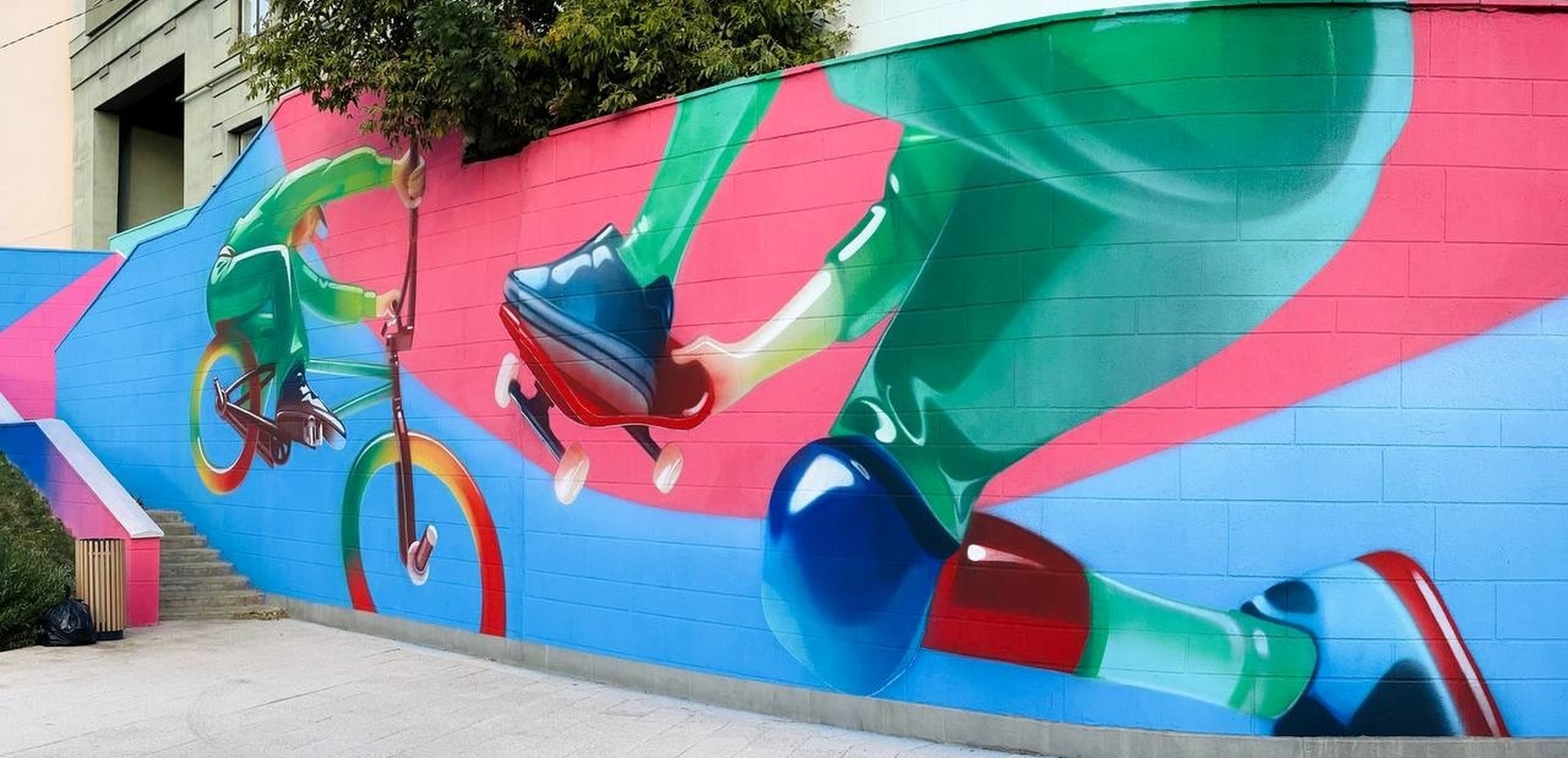
That connection carries into the route. Demkin’s Fragility, beside the Lybedsky Boulevard skate park, puts action sports onto the wall next to the ramps. It is our first mural stop. Read our full BRICS Skate Cup coverage.
Day one: the city on foot
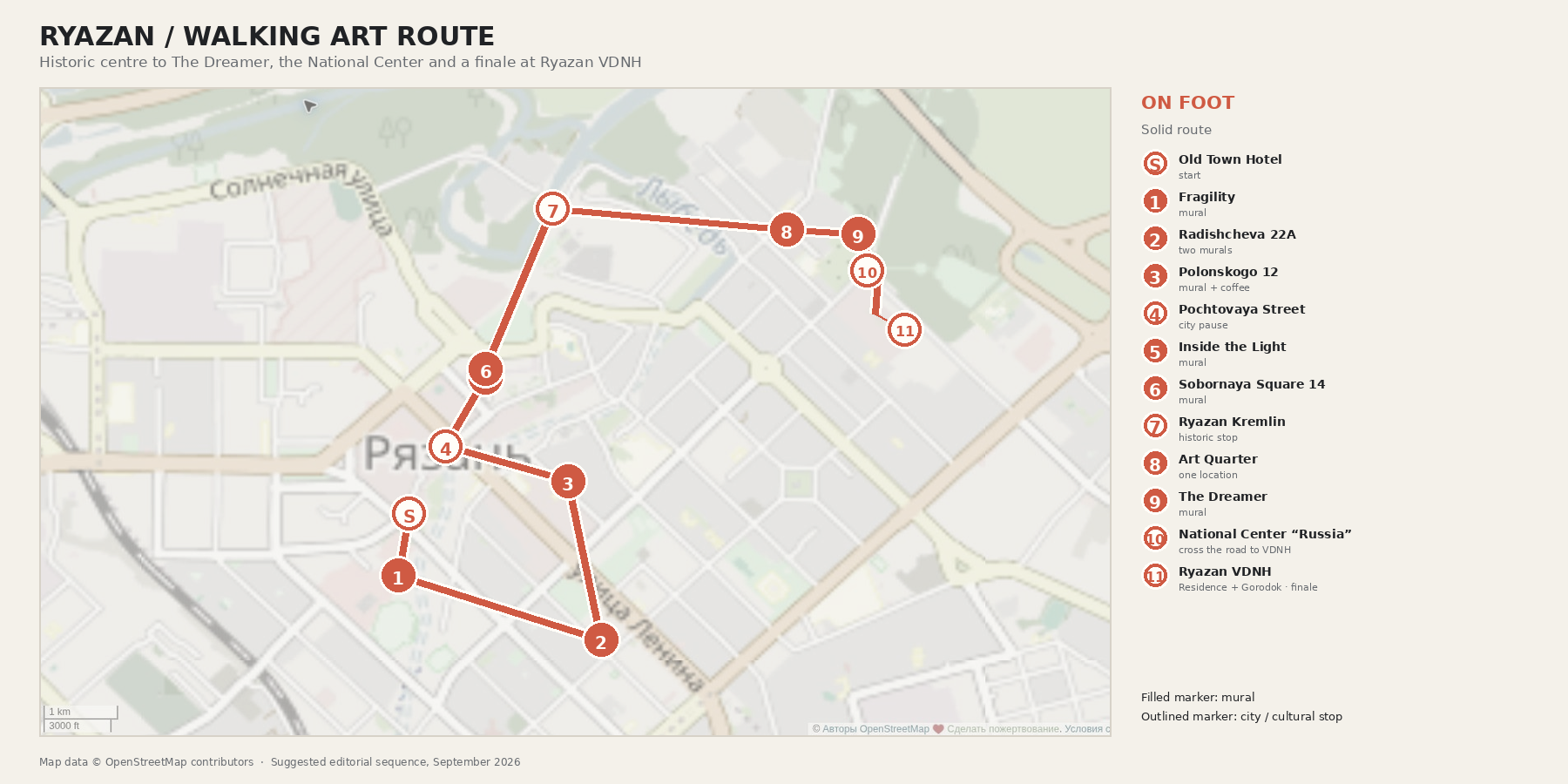
Open the walking route in Google Maps
The first day runs from the historic centre to VDNH, taking in the Kremlin and Art Quarter along the way. Leave room for coffee and a long lunch. The numbers below match the map; its connecting lines show the order of stops, so use street navigation for the walk itself.
A base in the old town
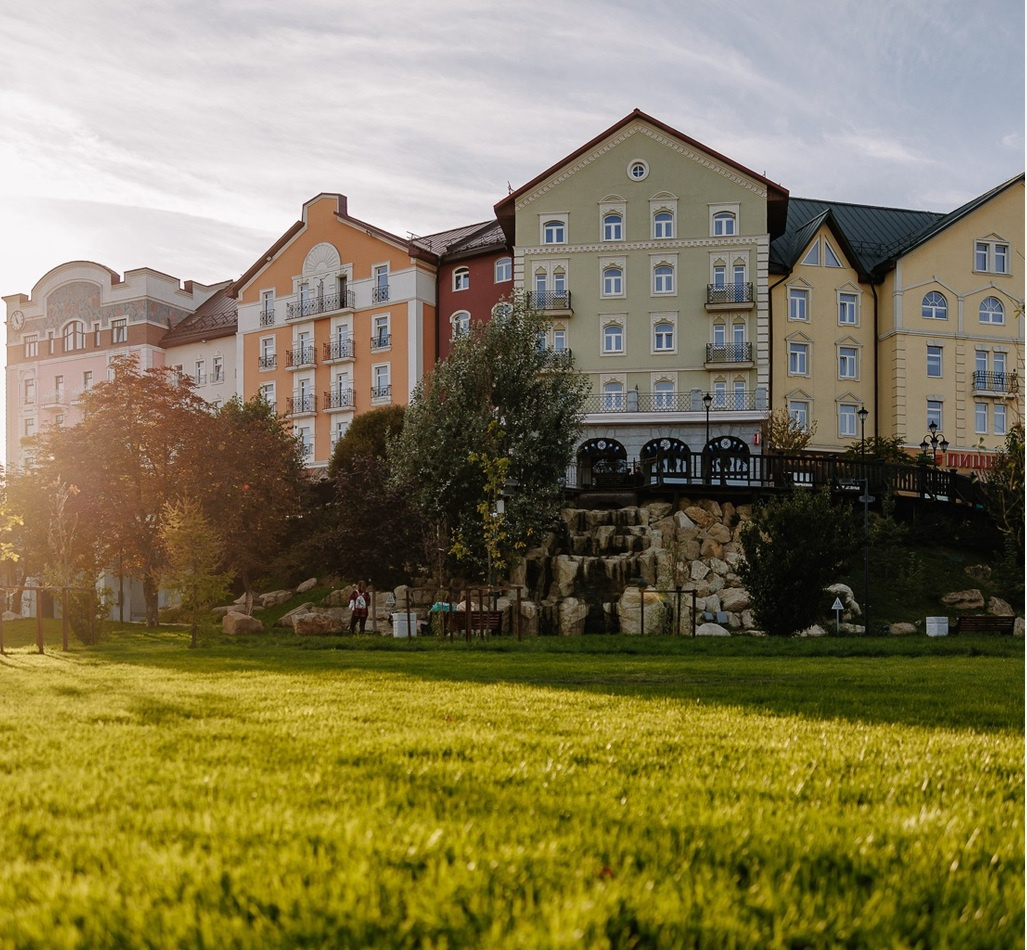
Old Town Hotel, at 2 Myunsterskaya Street, puts you close to the start of the route. Its central location is the draw here: Lybedsky Boulevard and the first mural are nearby, and you can spend the opening part of the day on foot. Have a look at the rooms on the hotel’s website, or simply use it as a meeting point if you’re staying elsewhere.
 Tap to enlarge photographClose photograph ×
1. Fragility — Lybedsky Boulevard
The bright colour and airborne movement in Demkin’s Fragility feel at home beside the skate park. Painted bodies are caught in the kind of suspended moment a rider knows well: the trick is underway, the landing still to come.
The title gives that energy an edge. For all the confidence of the image, the body is vulnerable. With the ramps beside it, the idea needs little explanation. Take in the wall from outside the skating area and let the setting do the rest.
 Tap to enlarge photographClose photograph ×
2. Two artists on Radishcheva Street
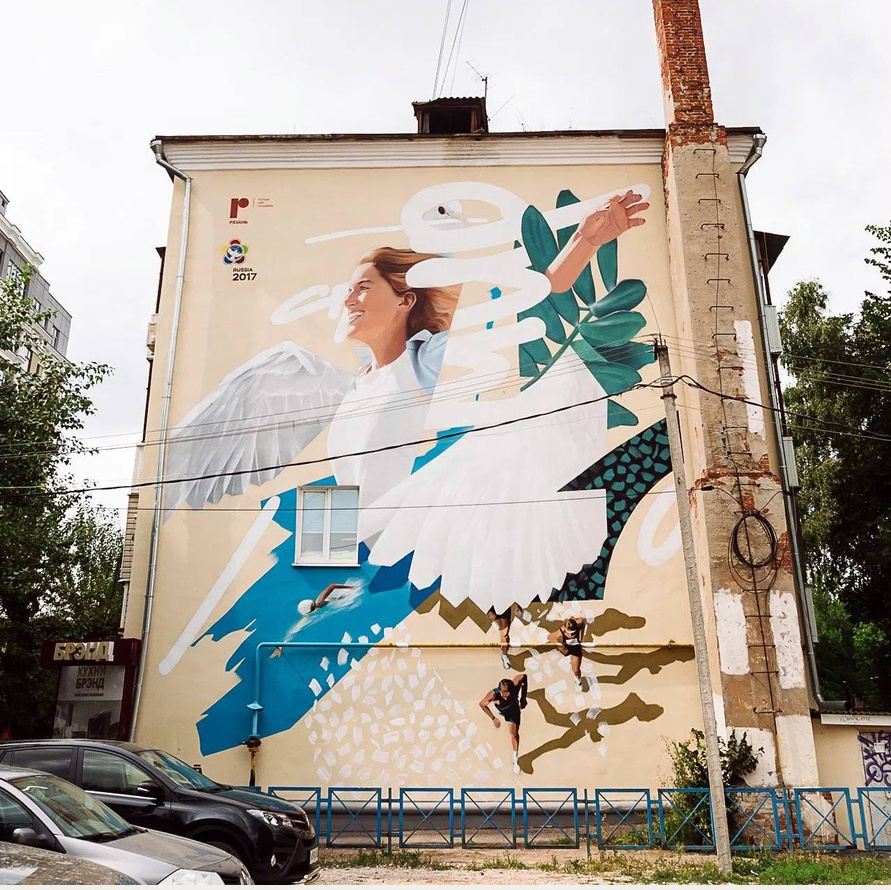
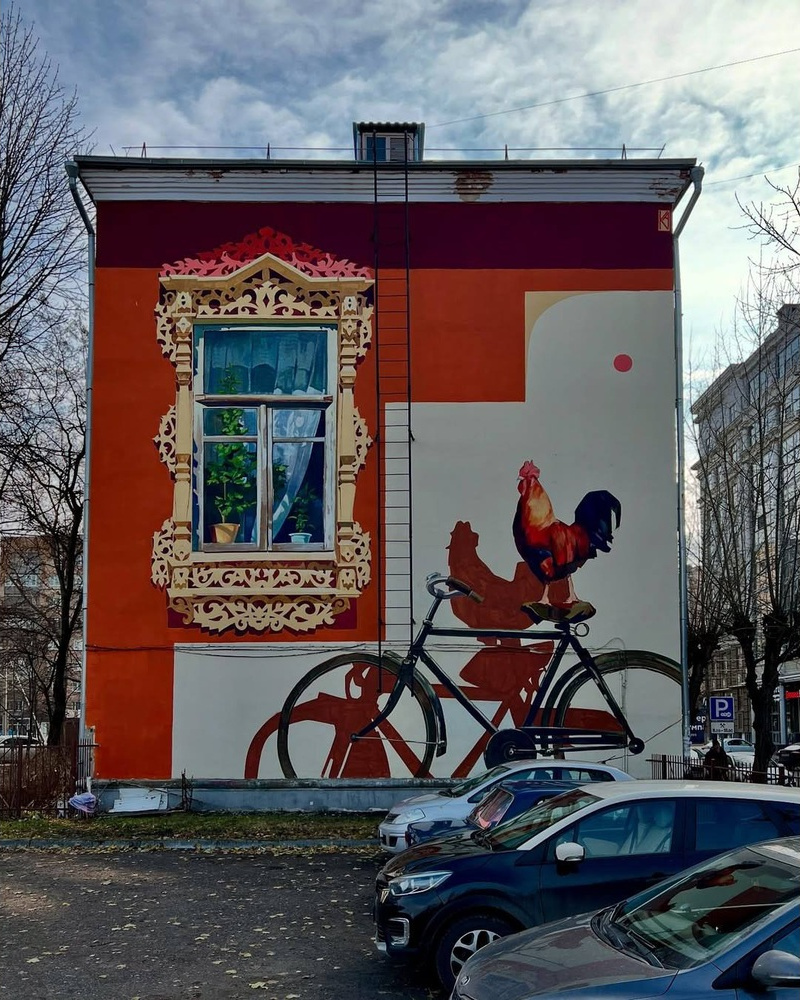
At 22A Radishcheva Street, Demkin’s Mir (Peace), painted in 2017, shares an address with Kalugin’s Appearance as History, from 2024. The pair brings two artists and two moments in the city’s mural history into the same stop.
Demkin’s light, graphic composition opens the wall up. Kalugin’s painting is more closely tied to memory and local identity, bringing the past into the surface of an everyday building. Give both a look before moving on; their differences are part of the appeal.
 Tap to enlarge photographClose photograph ×
 Tap to enlarge photographClose photograph ×
3–4. Coffee on Polonskogo, a walk along Pochtovaya
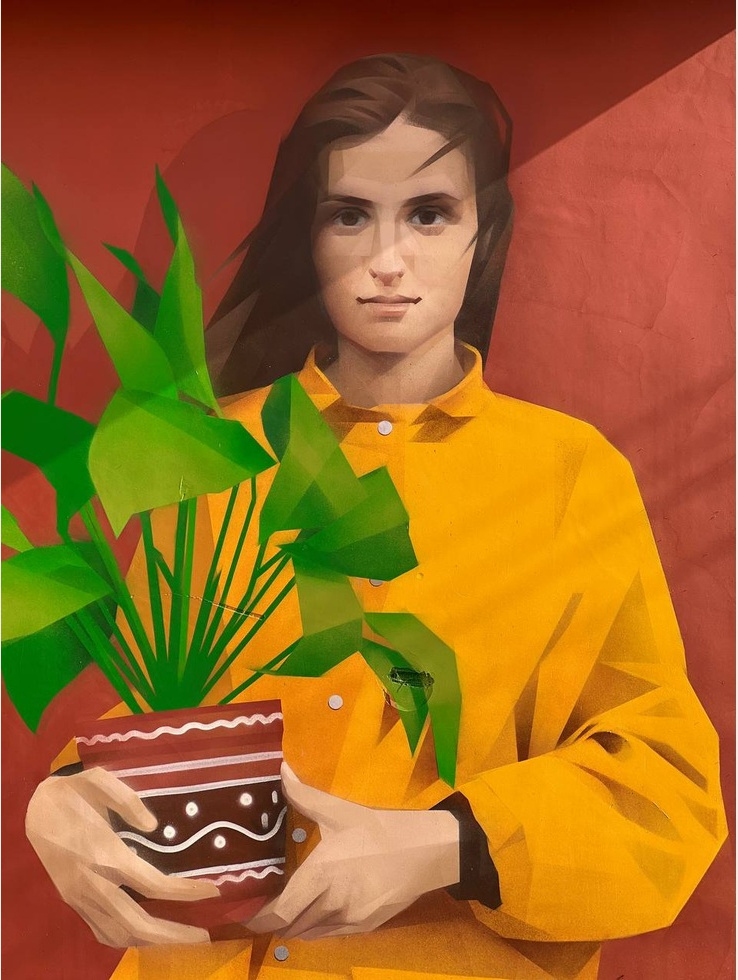
Demkin’s 2023 mural at 12 Polonskogo Street is quieter: a young woman holds a plant, its leaves set against the warm colour of her clothes. The simple gesture has a stillness that stands out after the action at the skate park.
There are cafés in the building and nearby, so this is a good point for coffee. Then head towards Pochtovaya Street, the central pedestrian street, for restaurants and a little time away from the map. Stop for lunch here if you’re hungry; Gorodok at VDNH is another option later in the day.
 Tap to enlarge photographClose photograph ×
5–6. Inside the Light, on Sobornaya Square
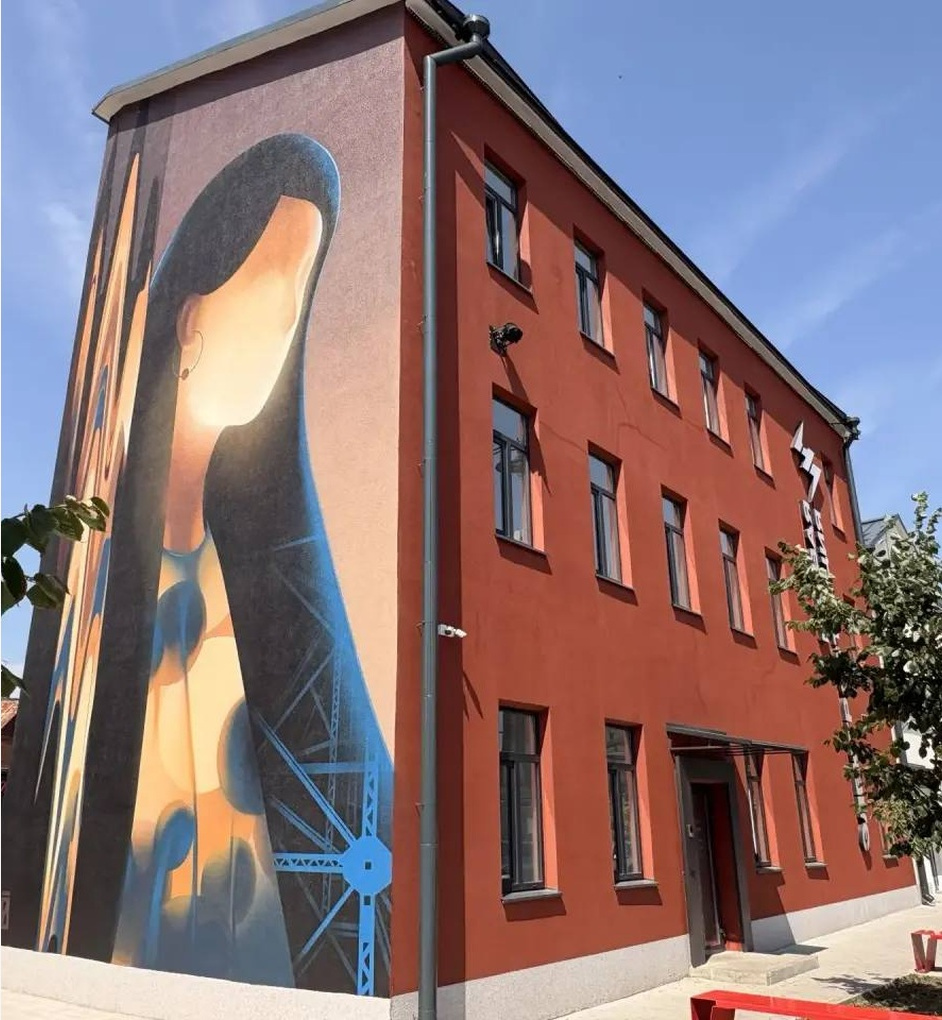
At 18 Sobornaya Square, the First Power Station Creative Cluster has given Demkin an unusually fitting subject. His 2026 mural, Inside the Light, places a young woman among glowing forms and a geometric framework. Warm colour spills around the figure, turning the site’s electrical past into something visible from the street.
A few doors away, at 14 Sobornaya Square, his untitled 2024 mural stretches across a much wider façade. The two walls show how differently he can use a building: one image gathers around a figure, while the other pulls your eye sideways. From here, continue towards the Kremlin.
 Tap to enlarge photographClose photograph ×
7. A pause at the Kremlin
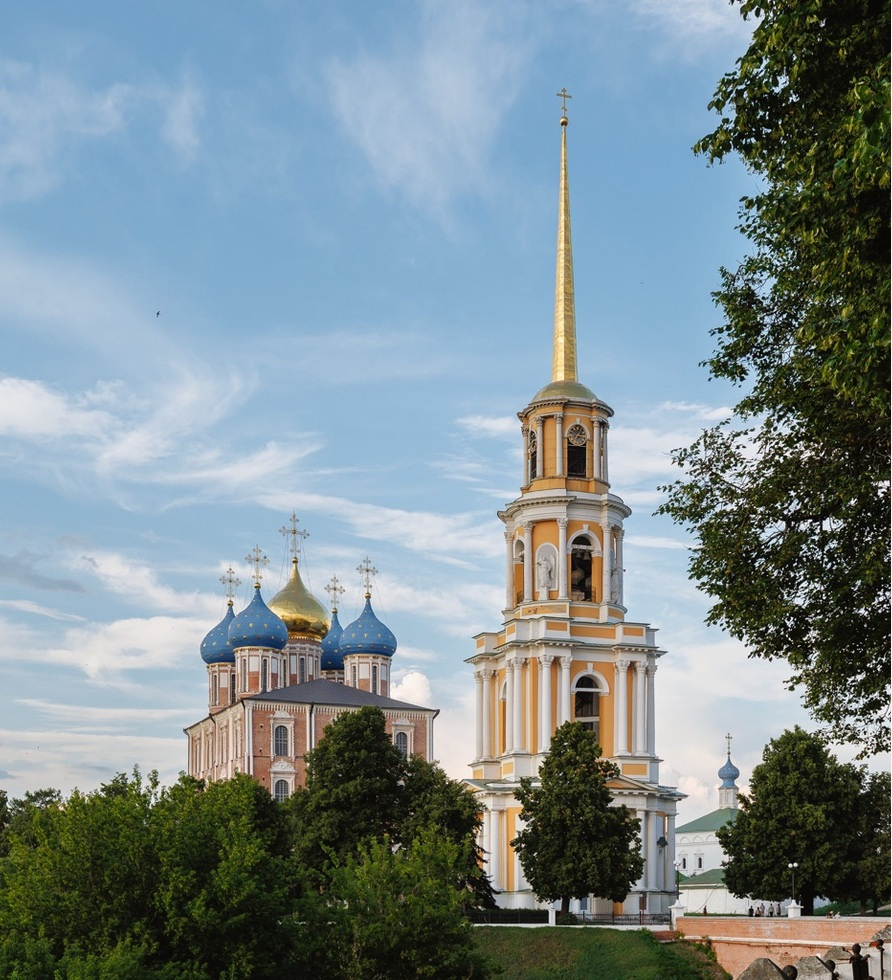
Give the Ryazan Kremlin some time. After a morning of painted façades, the Glebovsky Bridge and cathedral skyline bring the city’s older architecture into view. Half an hour is enough for a short walk, though you may want longer for the museums.
The contrast is part of what makes this route interesting. You move from recent paintings on working buildings into the historic heart of the city, then back out towards an art project spread across apartment blocks. For exhibitions and tickets, check the Kremlin’s visitor information.
 Tap to enlarge photographClose photograph ×
8. Into the Art Quarter
The map brings you into the Art Quarter around 10 Rybatskaya Street / 5 Rechniki Passage, with more works nearby on Lesoparkovaya Street. This is a place to wander. A single pin marks the neighbourhood, but the paintings are spread across several residential buildings.
Demkin and the invited artists draw on rural life, family memories and regional craft. Geese, figures, balloons and ornament share the façades with windows and balconies. The everyday details matter: these images are seen while people come home, open a window or cross the courtyard.
Move between the buildings and the scale of the project becomes clear. A photograph can isolate a mural; walking through the quarter brings the neighbouring walls into the frame. Keep to public paths and leave the residents’ entrances clear.
9–10. The Dreamer, then the National Center
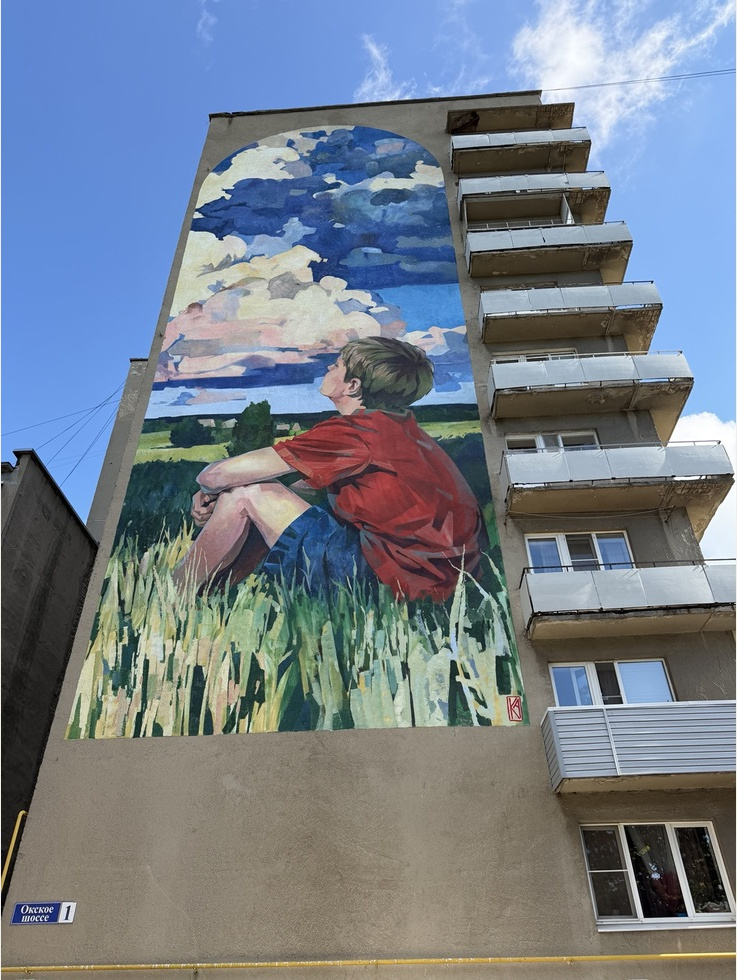
Kalugin’s The Dreamer waits at 1 Okskoye Highway. Painted in 2026 and curated by Demkin, it centres on a boy absorbed in his own imagination. The project’s account describes childhood as a time before possibility has acquired its limits. Against the height of the apartment block, that small, private world becomes an enormous public image.
Nearby, the National Center “Russia”, at 6 Prioksky Lesopark, brings together displays on the region’s history, culture and life today. Check what’s on if you want to stop inside, then continue across to VDNH.
 Tap to enlarge photographClose photograph ×
11. VDNH: craft, design and a table at Gorodok
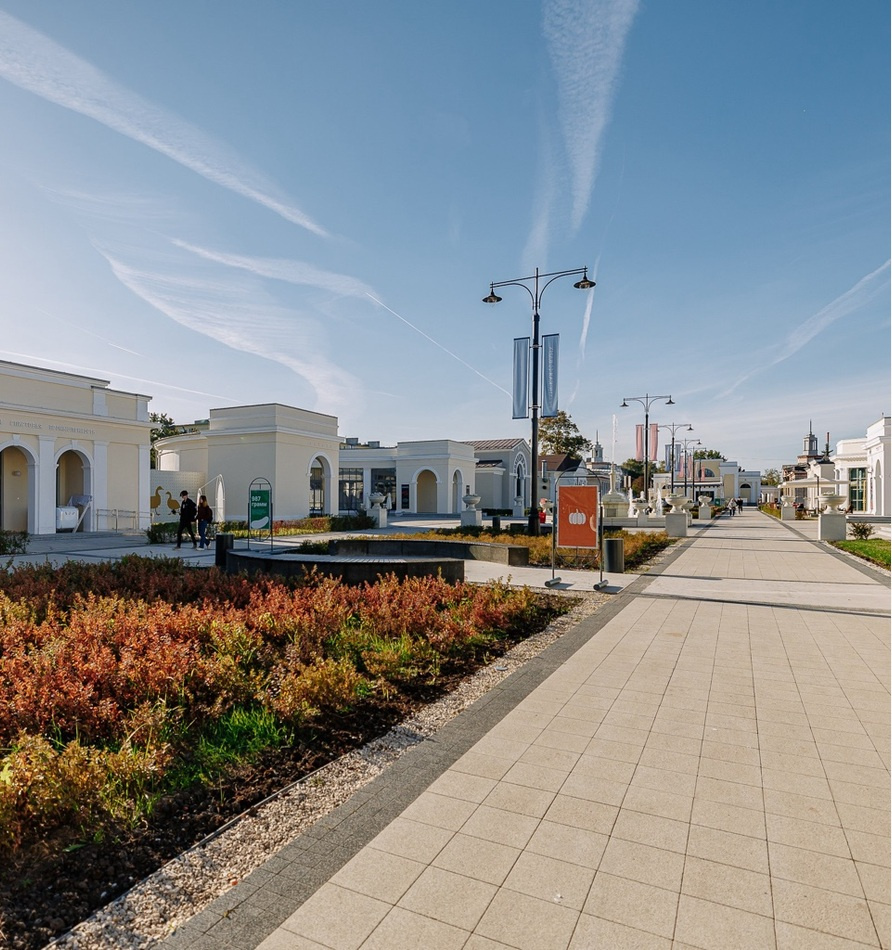
The walking day finishes at Ryazan VDNH, at Territory Torgovy Gorodok, 1. The restored Trade Town pavilions now house exhibitions, cafés and local cultural projects. After several hours looking up at walls, there is a different scale of work to explore here.
 Tap to enlarge photographClose photograph ×
Start at the Residence of Traditions in Pavilion 23, a gallery of local brands and makers. The selection brings Skopin ceramics, Mikhailov lace, Kadom veniz embroidery and Shilovo basketry together with work by contemporary designers. The names may be new to an international visitor; the forms and patterns help explain some of what you’ve been seeing on the walls.
That connection becomes particularly clear on the second day’s route, where Demkin takes Skopin pottery onto the façade of a business centre. Here, there is time to look at the craft at close range and explore the current selection from local makers.
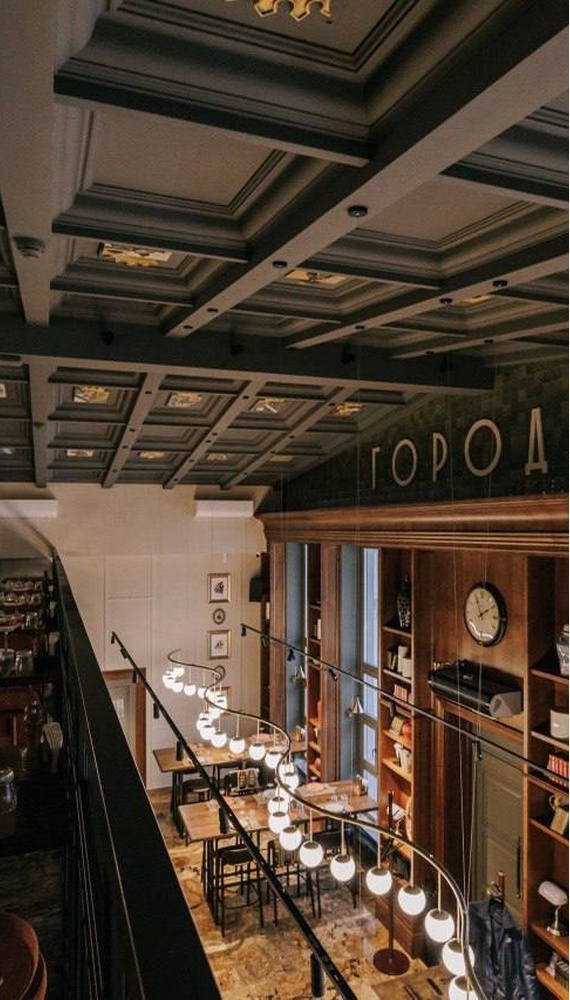
For food, head to Gorodok in Pavilion 2. The café’s 1950s-inspired interior continues the atmosphere of the restored pavilions, with district coats of arms across the ceiling and familiar dishes given a contemporary treatment. It’s a good place to settle in at the end of the walk.
 Tap to enlarge photographClose photograph ×
Day two: beyond the historic centre
Open the route on wheels in Google Maps
Some of Ryazan’s most striking walls are spread across the outer districts. This second route starts around VDNH and the National Center, heads southeast, then works west before returning to the centre for dinner.
Take taxis between stops for the full circuit, or pick a few walls for a shorter day. If you’re cycling, check the roads first: the dashed line on our map connects the destinations and isn’t a designated cycle route.
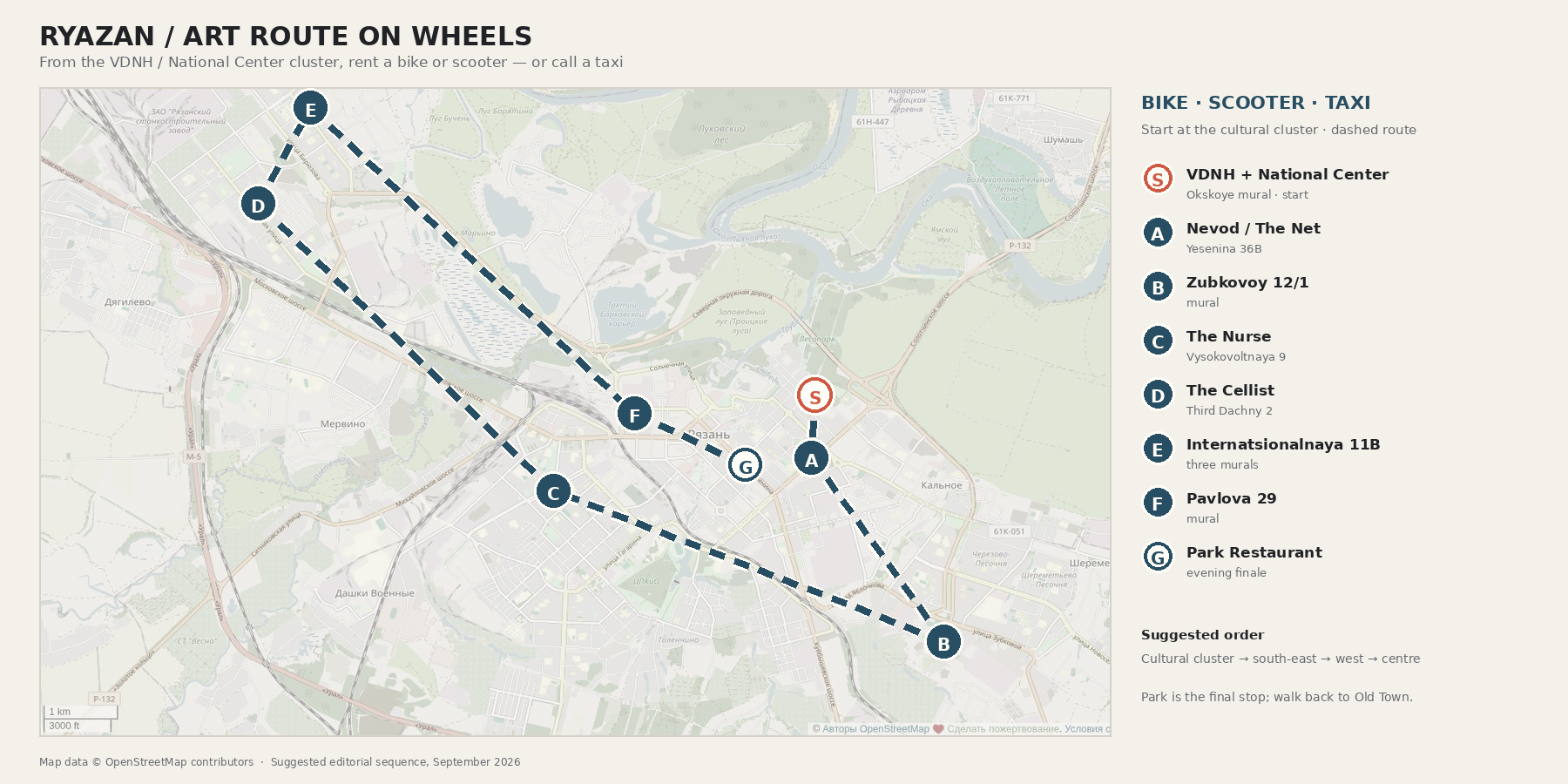
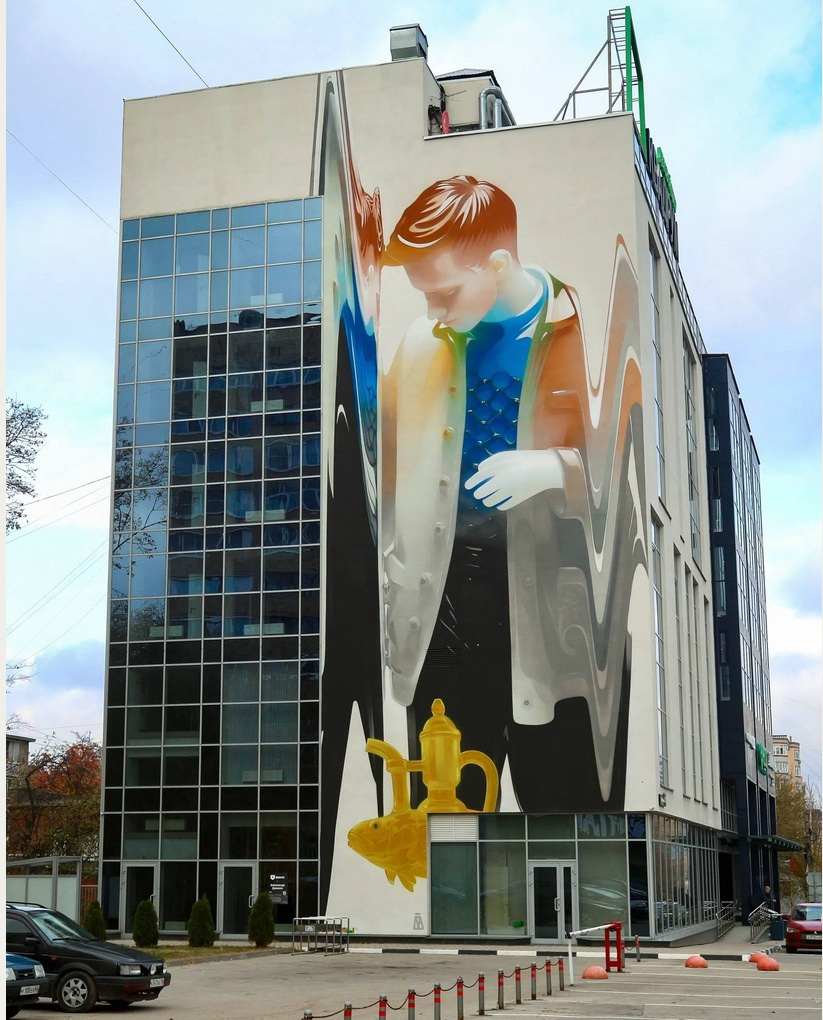
A. Nevod / The Net — 36B Yesenina Street
At the Kvadrum Business Centre, 36B Yesenina Street, Demkin’s Nevod — also known as Souvenir — takes its cues from Skopin pottery. Painted in 2024, it brings the craft’s sculptural forms and ornament into an altogether different setting, alongside the building’s glass and straight edges.
It’s one of the most direct links between the murals and the traditions on show at VDNH. A form associated with a handmade ceramic object takes over a commercial building. Demkin keeps the strangeness of the original reference and lets the jump in scale do much of the work.
 Tap to enlarge photographClose photograph ×
B–C. From Zubkovoy Street to The Nurse
Demkin’s untitled 2019 mural at 12/1 Zubkovoy Street stretches across a long façade in the southeast. Stand back to see the whole composition before heading west to a very different wall.
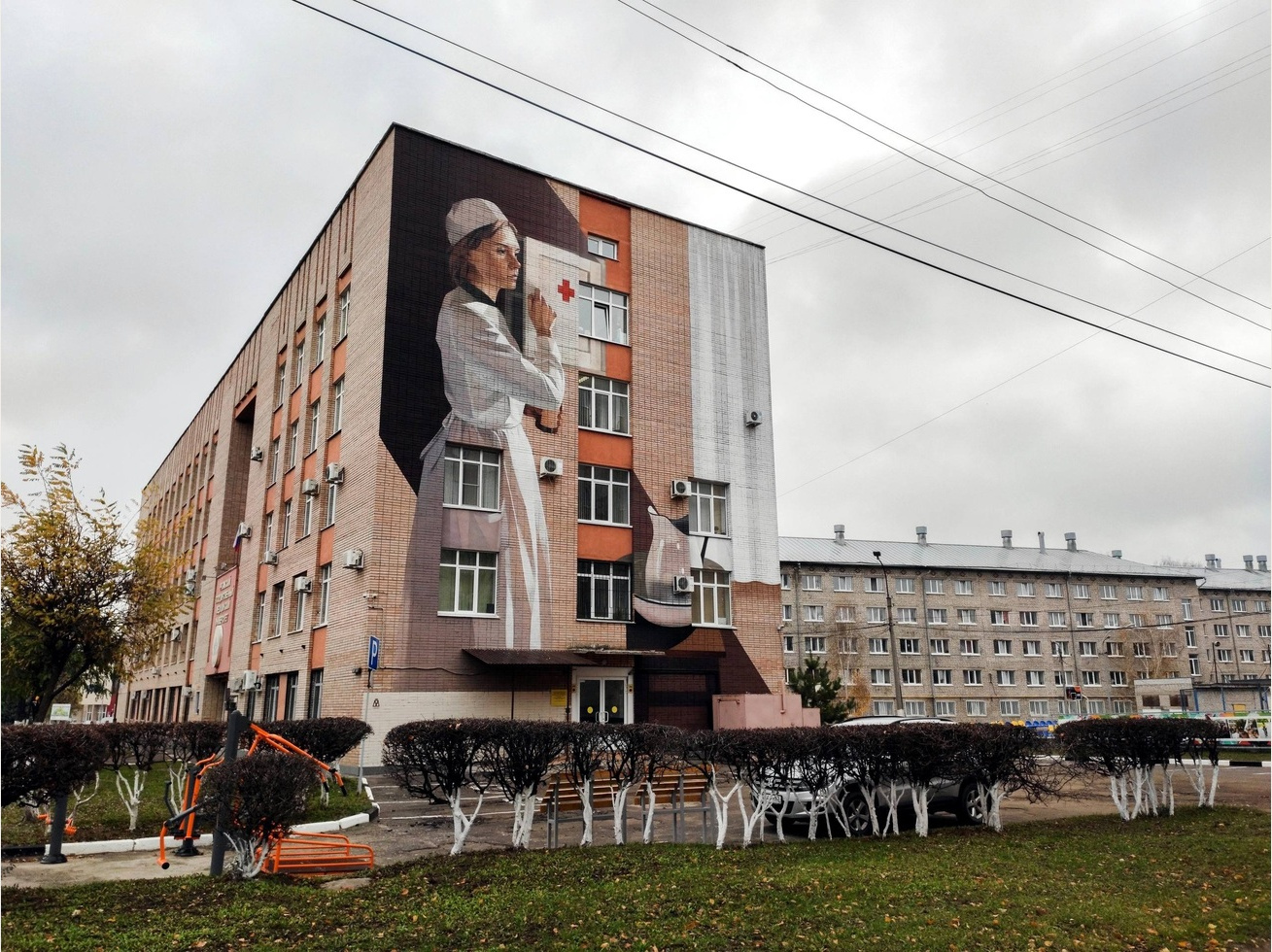
The Nurse, also painted in 2019, rises up the building at 9 Vysokovoltnaya Street. The figure occupies almost its full height, turning an ordinary residential block into the support for a monumental portrait. Seen with the surrounding windows and neighbouring buildings, the scale is startling.
 Tap to enlarge photographClose photograph ×
D. The Cellist — 2 Third Dachny Lane
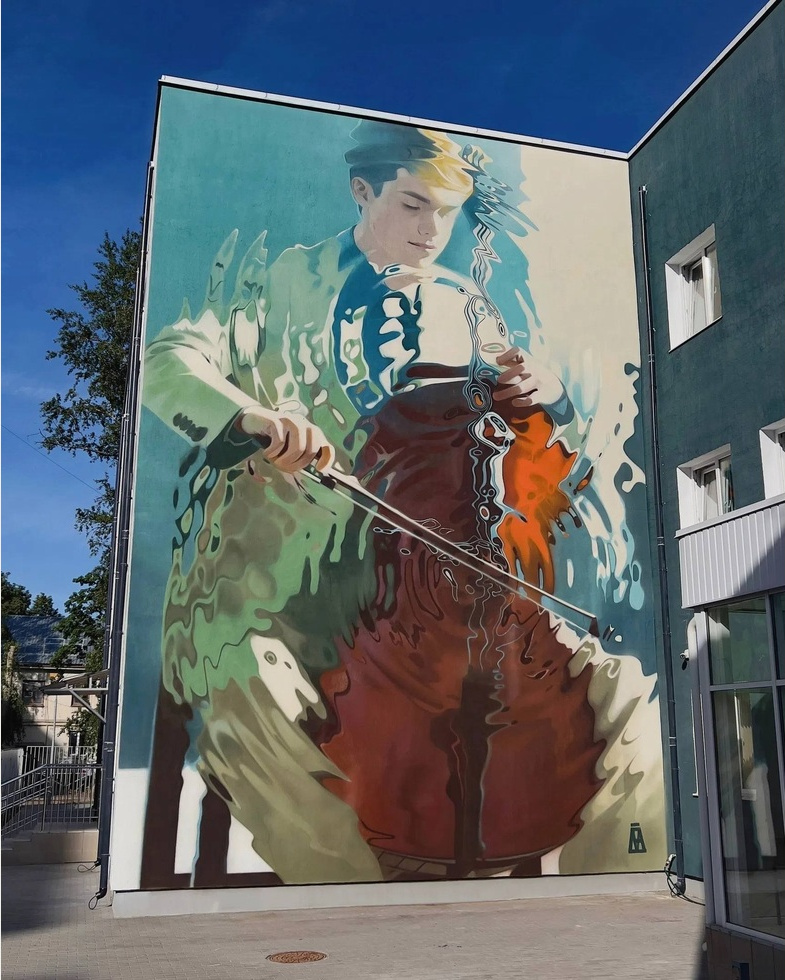
Children’s Art School No. 5, at 2 Third Dachny Lane, is home to Demkin’s 2024 mural The Cellist. Blue paint softens the musician’s outline, giving the image an almost underwater feel. The figure seems to emerge from the colour and disappear into it again.
The school is a fitting setting for the work. Music becomes the subject of a painting on the outside of a place devoted to teaching art, visible to anyone passing. You can see the mural from the street.
 Tap to enlarge photographClose photograph ×
E–F. Three walls at one address, then Pavlova Street
At 11B Internatsionalnaya Street, look for Bicycle, Shukher! (Lookout!) and Thursday, three works associated with Demkin and Kalugin. They share an address, making this a compact cluster within the wider circuit.
On the way back towards the centre, stop at 29 Pavlova Street. Demkin’s untitled 2021 portrait fits a fractured image into a narrow façade. After the broad sweep of Zubkovoy Street and the height of The Nurse, this final wall brings the focus back to the face.
G. Back to town for Park
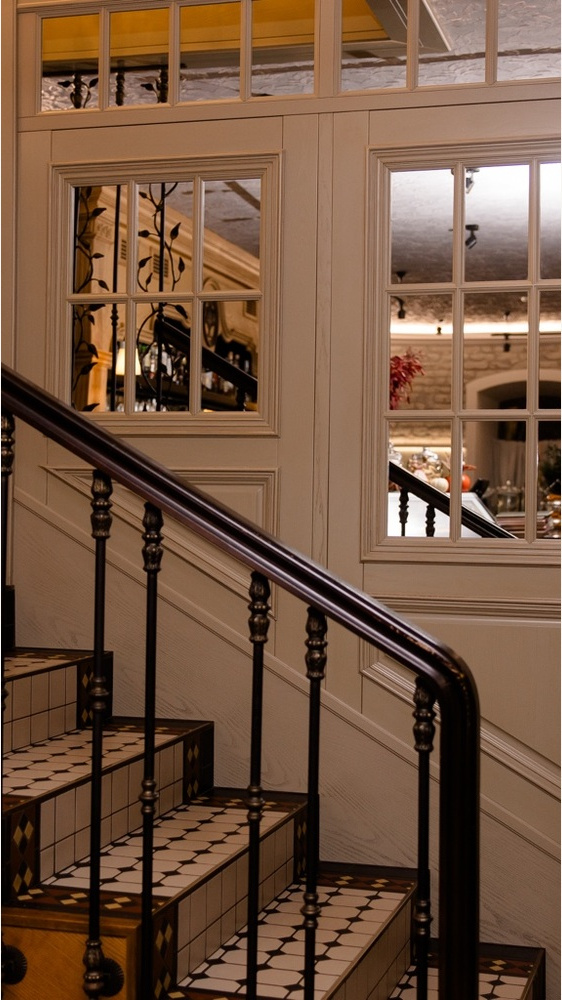
Park, at 31 Lenin Street, is our dinner stop back in the historic centre. Its menu covers Russian cooking and pastries, with breakfast available too if you want to return earlier in the day. The interior is elegant, and a table here makes a welcome finish after travelling between the outer districts.
Check the menu and book directly for the evening. From here, walk back through the centre towards Old Town Hotel.
 Tap to enlarge photographClose photograph ×
Eat & stay / the short list
Old Town Hotel / 2 Myunsterskaya Street. A central base near the first wall.
Gorodok / VDNH, Pavilion 2. Local references, a 1950s-inspired interior and a meal to finish day one.
Park / 31 Lenin Street. Russian cooking, pastries and dinner back in town.
Follow the links for current menus, rooms and reservations.
An evening at the ballet
If the dates line up, leave an evening for the Ryazan Theatre of Ballet, which has presented programmes including Carmen Suite and Chopiniana at the city’s Drama Theatre. After the painted cellist and the airborne figures at the skate park, a live performance offers another way to spend time with movement and the human figure. See what’s on at the theatre before booking dinner.
Before you go
Save the map and addresses before heading out. The walking route has eleven numbered stops after the starting point; day two follows A–G. Gorodok and the Residence of Traditions are both within VDNH. Give each route a flexible day, with time for food, photographs and whatever catches your eye along the way.
Check opening hours and transport locally. International visitors should also consult their government’s current travel advice and entry requirements before booking.
The strongest reason to visit is the work itself. Demkin and Kalugin bring a personal view of Ryazan into public space, drawing on the people, craft and buildings around them. Follow those paintings and the city opens up: a skate park, a residential courtyard, a ceramics display, dinner in the old centre. The walls get you there. There is plenty to keep you looking.