


Edward Hopper made loneliness look beautiful. His gas stations, diners, and sunlit apartment windows monumentalized the in-between moments of American life. Nearly a century later, that visual language still has a pull on artists. Some lean into the mystery. Some strip the figure out entirely. And some flip the mood on its head, trading melancholy for absurdity.
Here are five artists on Saatchi Art who, in their own ways, are in conversation with Hopper.

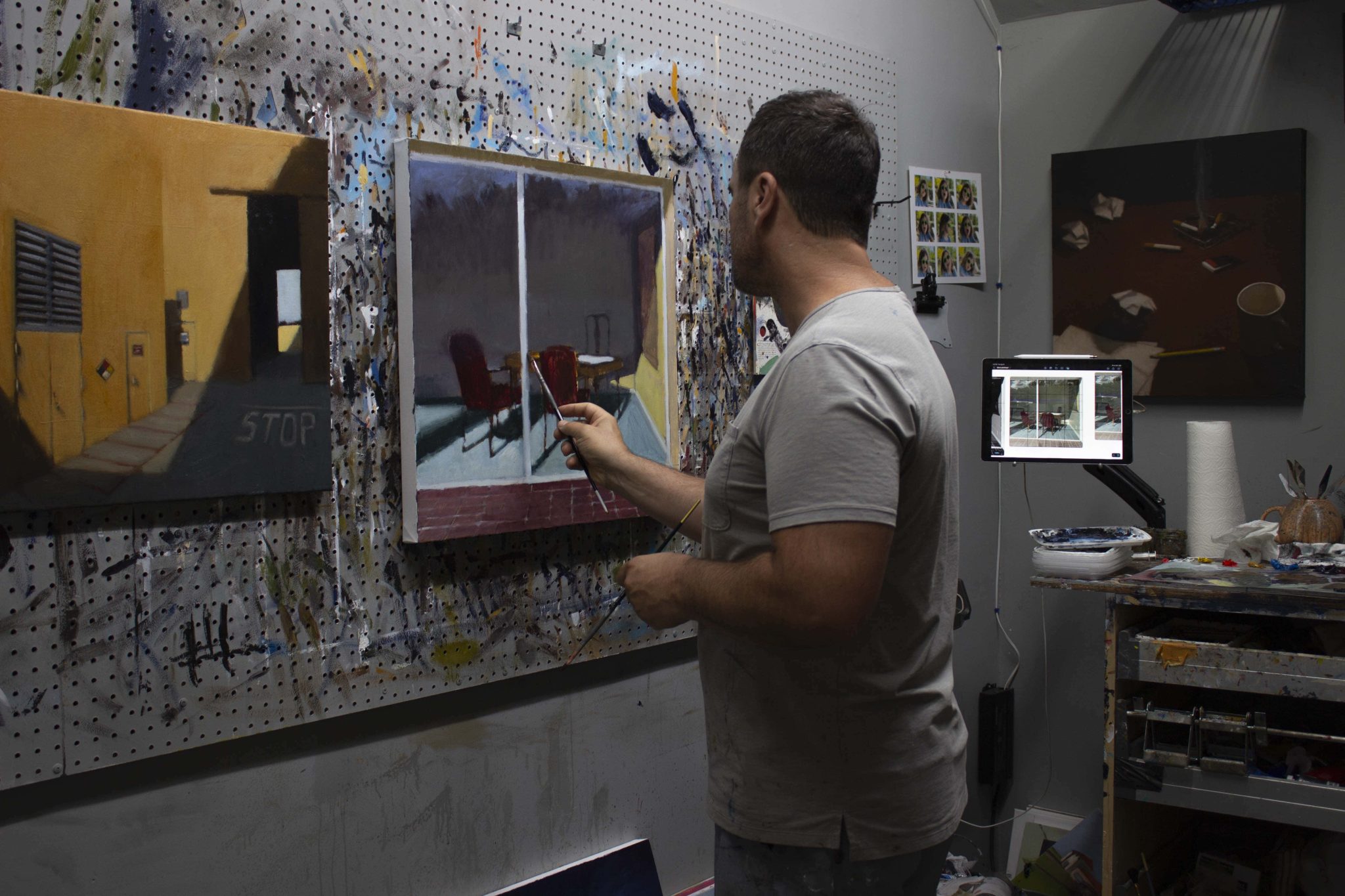
1. Alex Selkowitz | Hopper’s Light, Minus the People
Alex Selkowitz spent decades as a lighting technician in the film industry before turning to painting full-time. His Los Angeles-based practice is built entirely around how light falls: on stucco walls, pool decks, strip malls, and the sprawl of suburban Southern California. The human-made objects are all there, from parked cars to porch chairs, but the human is implied rather than shown.
Where Hopper’s figures were often solitary, Selkowitz removes them altogether. Architecture and shadow carry all the emotional weight. The result is best described as eerily calm, liminal, and dreamlike.
2. Patty Rodgers | A Warmer Descendant
Patty Rodgers, a Texas-based painter trained at RISD and Simmons University, works in the same core vocabulary as Hopper—semi-abstract interiors and landscapes built from geometric shapes of light—but arrives at a completely different emotional destination. Focusing mostly on domestic scenes, her palette is where the real departure happens: bold, saturated color pulls her out of Hopper’s muted realism and into looser, brighter, and more carefree compositions.
Think of it as Hopper’s structure with the volume turned up. The same interest in how light carves a room into shapes, minus the solemnity.
3. Young Park | Figures Suspended in Memory
If Hopper painted the moment right before or after something happens, Young Park paints the moment that’s already dissolving in our minds. The Seoul-based artist creates even less takes Hopper’s nondescriptness to the next level, like half-remembered scenes with lone figures caught within them. Young has described the work as living between memory and oblivion, vaguely expressing the small, entangled emotions of daily life — “as if indifferently” — calm on the surface, unresolved underneath.
The isolated figures in her interiors aren’t from a story you can follow. It’s a feeling you’re meant to sit with, the same way you might stand in front of Automat and never quite know what she’s thinking.
4. Laetitia Molenaar | Rebuilding the Masterworks
Of everyone on this list, Amsterdam-based photographer Laetitia Molenaar has the most literal relationship to Hopper. For her series Here Comes the Sun (it is all right), Molenaar built three-dimensional cardboard scale models of celebrated Hopper paintings. Miniature dioramas stand in for rooms like the diner in Sunlight in a Cafeteria, the train car in Chair Car, and the roadside room in Western Motel. She then lit each tiny set, often with nothing more than a single small lightbulb, and photographed it as though it were a full-scale interior.
The results have a subtly uncanny, waxwork stillness, with figures frozen under artificial light and colors pushed toward overexposure. Critics have noted that it gives her images a theatrical, almost doll’s-house intensity to Hopper’s paintings.
5. Martin Wojnowski | Upending the Formula with a Wink
Martin Wojnowski’s path to this territory is a bit literal: he started out in the early 1990s producing precise watercolor illustrations of interiors for London designers. Somewhere along the way, he started sneaking in “the unexpected,” with figures lurking in a corner or objects slightly out of place. Those disruptions would guide Martin’s artistic practice, which now fits squarely within the realm of Magical Realism.
Where Hopper used the quiet interior to suggest what’s unsaid, Martin uses it to set up a punchline—dryly humorous, a little uncanny, and built to make you look twice.
The post 5 Artists Reimagining Edward Hopper for a New Era appeared first on Canvas: A Blog By Saatchi Art.